
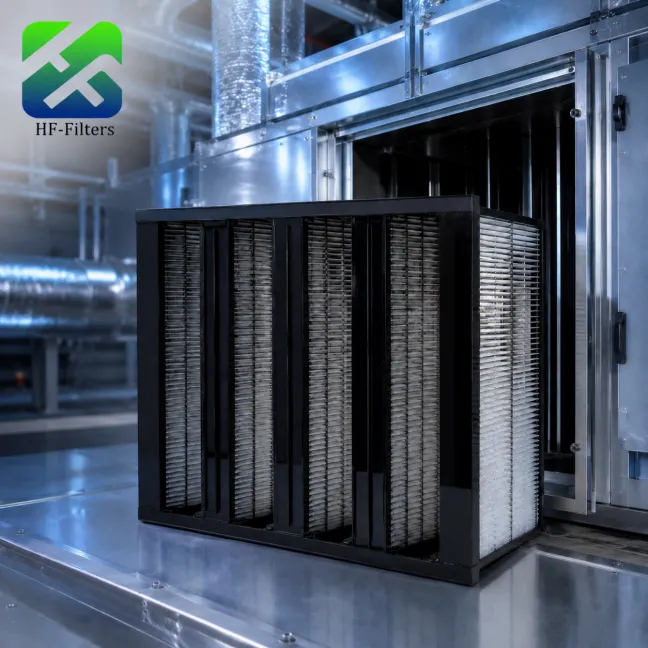
In commercial HVAC systems, the filter is a small part that can quietly decide a big monthly bill. A panel HEPA filter may work well in compact systems, but when airflow is high and operation runs all day, filter pressure drop becomes a real concern. You do not only pay for the filter. You also pay for fan energy consumption, maintenance time, and system stability.
Healthy Filters is a Shenzhen air filtration manufacturer offering OEM filters, cleanroom-ready production, fast support, and practical custom designs for commercial HVAC buyers.
Why Does Filter Pressure Drop Matter in Commercial HVAC Systems?
Filter pressure drop means the resistance air meets when passing through the filter. When resistance rises, the fan works harder to keep the same airflow. In an airport, hospital, or office tower, that extra fan load can build up day after day.
Initial Pressure Drop and Final Pressure Drop
Initial pressure drop shows the resistance of a new filter. Final pressure drop shows when replacement is needed. A low pressure drop HEPA filter helps you keep airflow stable for longer.
What Makes a V-Bank HEPA Filter Different?
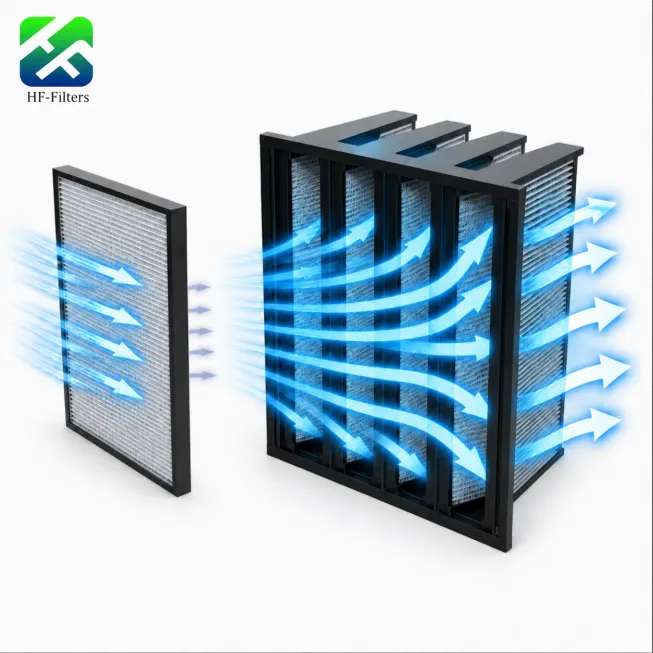
A V-Bank HEPA filter uses several V-shaped media packs inside a box frame. This shape gives more media area than a flat panel design in a similar face size. More media means lower air velocity through each section. It sounds simple, but in a machine room, simple ideas often save money.
Larger Media Area for High Airflow
Healthy Filters’ V-Bank HEPA filter can use polypropylene media or fiberglass media. Knowledge base data lists H13-H14 options with 289 × 594 × 292 mm at 900 m³/h and 8.23 m² media area, and 594 × 594 × 292 mm at 1800 m³/h and 16.5 m² media area. That is why this high airflow HEPA filter fits cleanroom HEPA filter projects better than many flat panels.
How Does a V-Bank HEPA Filter Help Reduce Energy Costs?
A panel HEPA filter often has less media reserve. As dust loads on the surface, airflow resistance rises faster. A V-Bank HEPA filter spreads air across a larger filtration area, so the system can run with lower resistance and steadier airflow.
Better Value Than Only Buying Cheaper Filters
For commercial HVAC filter selection, the lowest unit price is not always the lowest cost. You should compare HVAC operating cost, filter replacement interval, downtime, and fan energy consumption. In high-airflow systems, a V-Bank HEPA filter vs panel HEPA filter comparison often favors the V-shaped design.
Where Should You Use a V-Bank HEPA Filter?
A Box Type HEPA filter is useful when your system needs clean air, high airflow, and reliable sealing. Common scenes include hospitals, electronics factories, pharmaceutical cleanrooms, food factories, laboratories, and commercial buildings.
Frame Strength Also Matters
Healthy Filters supports galvanized frame, Aluminum Alloy Frame HEPA filter, and ABS plastic frame HEPA filter options. In high differential pressure HVAC system projects, a strong anti-deformation HEPA filter frame helps reduce bypass leakage. For odor or gas control stages, carbon air filter options can also support broader air treatment needs.
Why Choose Healthy Filters for Custom V-Bank HEPA Filters?
If you need a custom V-Bank HEPA filter manufacturer, Healthy Filters offers practical project support for dimensions, media type, frame material, airflow demand, and OEM filter design. Its product range covers air purifier filters, HEPA and ULPA filters, general ventilation filters, carbon filters, and filter materials.
A Practical Choice for B2B Buyers
The right V-Bank HEPA filter supplier should help you match rated airflow, initial resistance, media area, H13 HEPA filter or H14 HEPA filter grade, and installation frame. That saves awkward retrofits later. Nobody enjoys finding out on site that the gasket side was wrong.
FAQ
Q1: Is a V-Bank HEPA filter better than a panel HEPA filter?
A: For high airflow HVAC systems, yes, it is usually better because it has larger media area and lower airflow resistance.
Q2: Does a V-Bank HEPA filter reduce HVAC energy consumption?
A: It can help reduce fan energy consumption by lowering filter pressure drop and keeping airflow steadier.
Q3: What is the difference between a V-Bank HEPA filter and a Box Type HEPA filter?
A: They often describe the same product style. V-Bank refers to the inner V-shaped media packs, while Box Type refers to the outer frame.
Q4: Which frame is better, aluminum alloy or plastic?
A: Aluminum alloy is better for high-strength HVAC systems. ABS plastic frame options can suit lighter or custom projects.
Q5: Where are V-Bank HEPA filters commonly used?
A: They are used in commercial HVAC systems, cleanrooms, hospitals, pharmaceutical plants, electronics factories, food factories, and laboratories.