
Every spring, pool supply stores hear a version of the same question.
A customer walks in carrying an old cartridge filter and asks whether a cheaper replacement from a spa system will do the same job.
The two filters often look similar enough to create confusion. Similar diameter. Similar height. Similar pleated design.
From a distance, they might even come from the same production line.
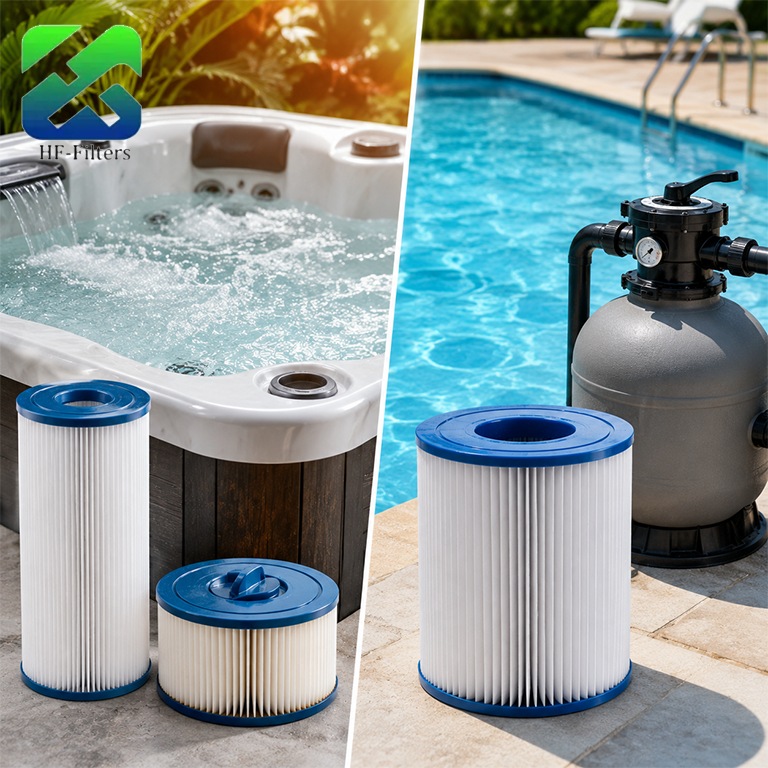
Yet once installed, the differences start to show.
A swimming pool and a spa may both rely on filtration, but they ask very different things from a filter.
A pool has one advantage that people rarely think about: volume.
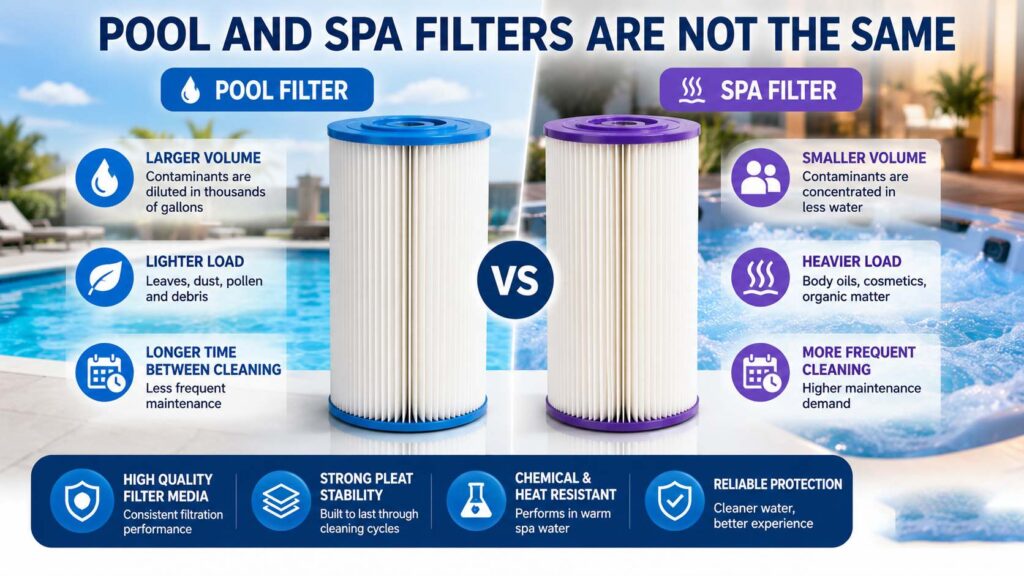
Contaminants are diluted across a large body of water. Leaves, dust, pollen, and debris still enter the system, but they are spread through thousands of gallons before reaching the filter.
A spa doesn’t get that luxury.
The water is warmer. The volume is smaller. A few people using a spa for an evening can introduce a surprising amount of body oil, cosmetics, and organic matter into the water.
That’s why a Spa Filter often reaches a cleaning point sooner than a typical Pool Filter.
Not because it’s lower quality.
Because the workload is different.
One maintenance contractor I met years ago had a simple rule.
“If a pool filter skips one cleaning cycle, the owner may not notice immediately. If a spa filter skips one, the water tells you very quickly.”
It wasn’t a scientific statement, but anyone who works in the Pool And Spa business understands what he meant.
Temperature changes the game.
Warm water accelerates contamination buildup. Fine particles remain suspended longer. Chemical balance becomes less forgiving.
This is also why many Hot Tub Filter manufacturers pay close attention to media construction rather than focusing only on dimensions.
Two cartridges can share the same measurements and still age very differently.
The difference is often hidden inside the media.
Pleat stability.
Bonding quality.
Material weight.
These details don’t look impressive in a catalog, but they determine how a filter behaves after months of cleaning cycles and chemical exposure.
The Pool Filter Industry has changed quite a bit in this area over the last decade.
Buyers used to focus heavily on price.
Now many distributors ask different questions.
Will the media remain consistent from batch to batch?
Can the supplier maintain specifications during larger production runs?
Will replacement filters perform the same way six months from now?
Those questions explain why filtration manufacturers with strong OEM experience continue to gain attention.
Among them is Shenzhen Healthy Filters Co., Ltd., often referred to simply as Healthy Filters. The company works with customers developing replacement and custom filtration products for various water treatment applications. In many projects, the discussion starts not with the filter itself, but with the operating environment the filter must survive.
That approach makes sense.
Because most filtration failures are not caused by a filter being the wrong size.
They happen because the application was misunderstood from the beginning.
Common Questions
Can I use a spa filter in a swimming pool?
Only if the specifications match the system requirements. Appearance alone isn’t enough.
Why do hot tub filters require more frequent cleaning?
Warm water and concentrated contaminants place greater demands on the filter media.
What affects filter lifespan the most?
Usage frequency, water chemistry, maintenance habits, and media quality all contribute.
Are all replacement cartridges made the same way?
Not at all. Similar-looking filters can vary significantly in material quality and long-term performance.
The interesting thing about filtration is that most differences are invisible on day one.
They become obvious only after weeks or months of use.
By then, the right filter and the wrong filter no longer look the same.