
In most HVAC projects, the filter is not the first thing people talk about.
Airflow, energy consumption, duct design, fan selection—these usually come first.
The filter comes later, often when the system is already taking shape.
That’s when the real questions begin.
One of the most common is surprisingly simple:
Why do two V-shaped filters with similar sizes perform so differently?
If you’ve worked around HVAC Filtration long enough, you already know the answer is rarely about appearance.
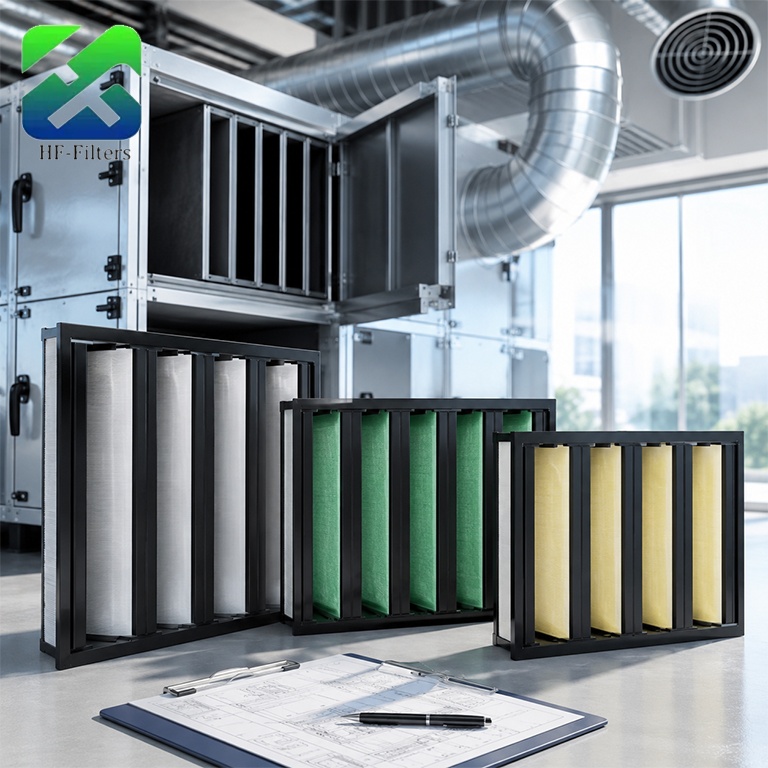
A V Bank Filter is not just a frame with folded media. It is a balance between airflow resistance, dust holding capacity, and structural design.
And small differences in that balance can change how the entire system behaves.
The Airflow Question Comes First
Most engineers don’t start with efficiency ratings.
They start with pressure drop.
Because in real systems, airflow decides everything.
A filter that looks perfect on paper can still create problems if the resistance is too high for the system design.
That’s why Air Filter Frame structure matters more than most people expect.
A poorly designed frame can cause uneven airflow distribution across the V-bank structure. Some sections get overloaded. Others stay underused. Over time, performance drops faster than expected.
This is not a theoretical issue. It shows up in maintenance reports.
Technicians usually describe it in simple terms:
“Some filters just clog too fast.”
In reality, it’s often airflow imbalance inside the frame design.
Efficiency Is Not the Only Metric
Many buyers focus heavily on efficiency ratings when selecting a V Bank Filter.
That makes sense, but it’s only part of the picture.
A higher efficiency filter with poor dust holding capacity may actually require more frequent replacement. In contrast, a slightly lower-rated filter with better media structure can perform more consistently over time.
This is where Filter Manufacturing quality becomes visible.
Two filters with the same specification sheet can behave differently once they are exposed to real operating conditions—dust load, humidity, temperature variation, and runtime cycles.
None of these show up in a brochure.
HVAC Systems Don’t Operate in Ideal Conditions
In real buildings, HVAC systems rarely run under stable conditions.
A hospital behaves differently from a factory. A commercial office behaves differently from a shopping mall. Even seasonal changes affect filter performance.
A good filter choice is not just about matching dimensions.
It’s about matching behavior.
That includes how the filter loads over time, how pressure drop increases, and how consistently it maintains airflow before reaching replacement threshold.
This is where many procurement decisions go wrong—they focus on initial performance instead of long-term stability.
Why Frame Design Matters More Than It Looks
The V-bank structure is designed to increase surface area without increasing footprint.
But that design only works well if airflow is evenly distributed.
If the Air Filter Frame lacks rigidity or precision, the filter media inside the V structure can deform slightly under pressure. Once that happens, airflow paths shift.
The result is uneven loading.
Some sections clog early. Others remain underused.
From the outside, the filter still “looks fine.” Inside the system, performance is already declining.
Choosing a Supplier Is Part of the Filter Selection
At a certain point, selecting a V bank filter stops being just a product decision.
It becomes a manufacturing decision.
Consistency matters more than single-unit performance.
That’s why many HVAC projects rely on suppliers who understand both design and production stability.
Shenzhen Healthy Filters Co., Ltd., commonly referred to as Healthy Filters, is one of the manufacturers working in this space, supporting OEM and customized HVAC Filtration solutions for different system requirements. In many cases, the discussion is not only about filter size or efficiency, but also about how the product behaves across long-term usage cycles.
For procurement teams, that difference is often more important than specification sheets.

What Actually Defines the “Right” V Bank Filter
There is no universal answer.
But in most practical cases, the right filter is the one that fits the system without forcing it to compensate.
Not too much pressure drop.
Not uneven airflow distribution.
Not frequent early clogging.
A stable balance across operating conditions.
That is usually what engineers are trying to achieve, even if they don’t always say it that way.
A Few Real-World Questions
Why does pressure drop increase so quickly in some V bank filters?
It is often related to media loading behavior and airflow distribution inside the frame structure.
Is higher efficiency always better?
Not necessarily. System compatibility and operating cost over time are equally important.
What causes uneven filter usage in HVAC systems?
Frame design, airflow path imbalance, and installation conditions all play a role.
Does manufacturing quality really affect performance that much?
Yes. Small variations in Filter Manufacturing can lead to noticeable differences in long-term stability.
The interesting thing about HVAC filters is that the best-performing ones are rarely noticed.
They just sit in the system and do their job quietly.
And in most buildings, that’s exactly what people want.