
More hospitals, surgical centers and diagnostic facilities are being built or modernized in 2026. For the teams behind these projects, HVAC design is about more than heating and cooling.
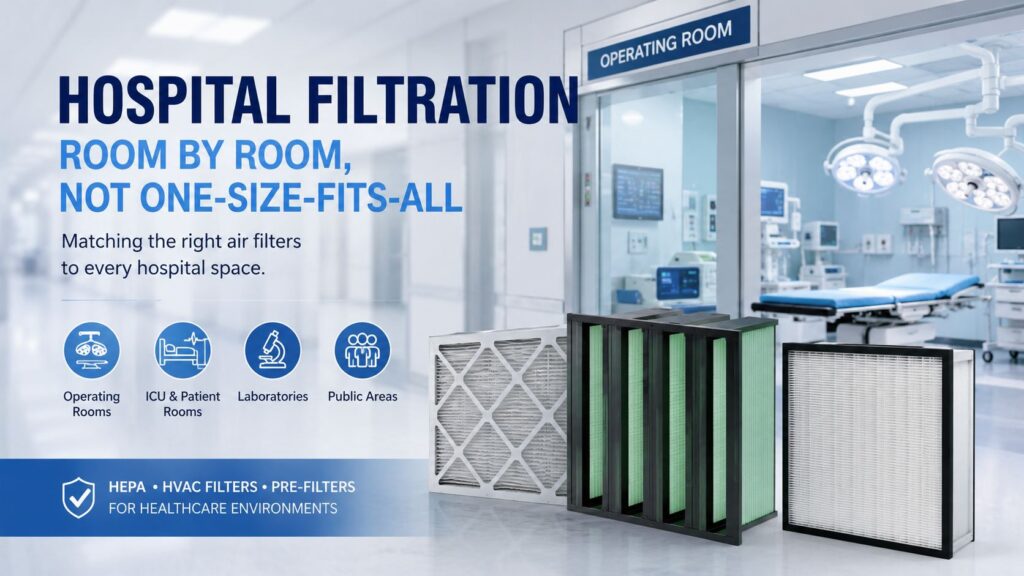
Hospitals contain spaces with very different needs. An operating room isn’t the same as a waiting area, and a laboratory isn’t the same as an administrative office.
That difference matters when choosing air filters.
One Hospital, Many Filtration Needs
Walk through a hospital and you’ll find operating rooms, ICUs, isolation rooms, laboratories, pharmacies, patient rooms and busy public areas.
There isn’t one filter specification that fits all of them.
Critical or controlled spaces may call for higher-efficiency filtration. General areas can have different HVAC requirements. Local codes, facility design and the intended use of each space also influence the choice.
This is why hospital filtration is usually considered room by room rather than building by building.
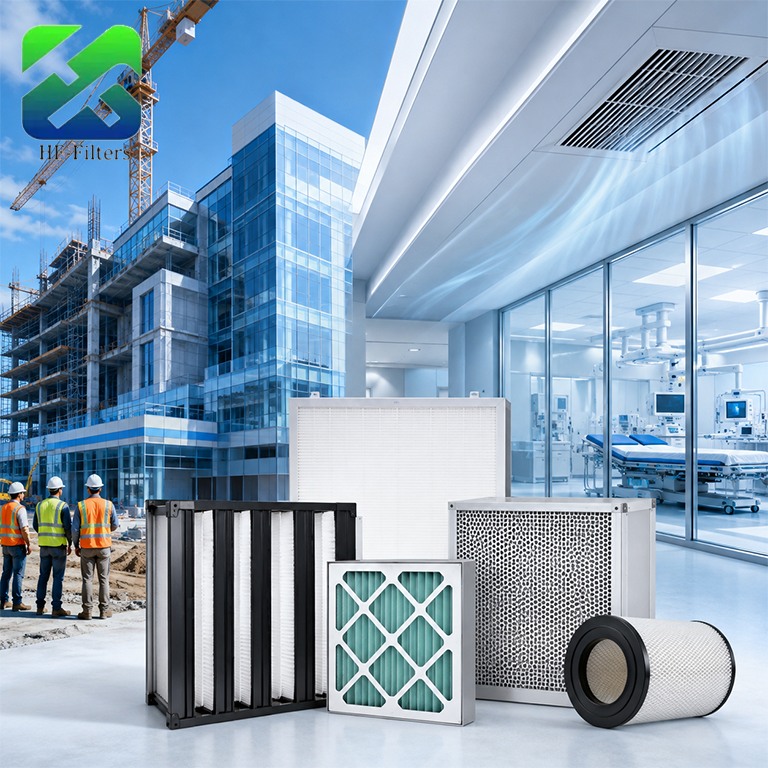
Where HEPA Filtration Fits
HEPA filters may be used in selected healthcare environments where a high level of particle filtration is required.
Depending on the HVAC design, this can include H13 or H14 HEPA filters. Different constructions are available as well. Deep-pleated filters are a familiar choice for high-efficiency applications, while V-bank designs provide a large media area in a compact configuration.
Healthy Filters manufactures H13/H14, deep-pleated and V-bank HEPA filters for controlled environments.
That doesn’t mean every hospital room needs HEPA filtration. The appropriate efficiency should be determined by the application and relevant healthcare ventilation requirements.
Why Use More Than One Filter?
Final-stage filters don’t need to catch everything on their own.
A hospital air-handling system may use several stages:
Outdoor Air → Pre-Filter → Medium-Efficiency Filter → HEPA Filter, where required
The pre-filter catches larger dust first. This reduces the amount reaching downstream filters and helps manage loading on more expensive high-efficiency filtration.
The actual arrangement varies between facilities, but the idea is simple: deal with particles in stages.
Efficiency Isn’t the Whole Specification
It’s easy to focus on the H13 or H14 label when comparing HEPA filters. In an actual HVAC system, there is more to consider.
Airflow and pressure drop have to work with the air-handling equipment. Dust holding capacity affects filter loading. Dimensions need to match the housing, and maintenance teams need practical access for inspection and replacement.
Filter media, frame construction and service life matter too.
Choosing the highest filtration efficiency available without checking these factors can result in a filter that isn’t well suited to the system.
A Good Filter Still Needs a Good Seal
Air is supposed to pass through the filter media—not around the filter.
If there is a poor seal between the filter and housing, some air can bypass the media. That reduces the performance of the filtration system regardless of how efficient the filter itself is.
Gaskets, frame design and installation therefore deserve attention, particularly with final-stage HEPA filtration.
Healthy Filters can produce deep-pleated and customized HEPA filters with different frame and gasket configurations to suit project requirements.
What About Waiting Rooms and Other General Areas?
Hospitals also have plenty of spaces that aren’t critical clean environments.
Waiting areas, corridors, offices, public spaces and general patient areas may use conventional HVAC and general ventilation filtration, depending on the facility design and applicable requirements.
Pre-filters and medium-efficiency filters can form part of these systems without automatically moving to HEPA filtration everywhere.
Activated carbon filters may also be considered where certain odors or gaseous contaminants need to be managed. They serve a different purpose from particle filters and should be selected for the actual application.
Healthy Filters for Healthcare Projects
Healthy Filters is a professional air filter manufacturer providing products for hospitals, clinics, laboratories and other controlled environments.
The range includes H13/H14 HEPA filters, deep-pleated HEPA filters, V-bank filters, pre-filters, HVAC filters and general ventilation filters.
Healthy Filters also supports OEM/ODM and custom filter projects. Dimensions, efficiency, media, airflow, pressure drop, frame material and gasket or sealing configurations can be adapted to project requirements.
For a new hospital or renovation project, the key isn’t using the same filter everywhere. It’s matching filtration to the room, HVAC system and actual application.
Planning a new healthcare facility or upgrading an existing HVAC filtration system? Contact Healthy Filters to discuss HEPA, HVAC and customized air filtration solutions for your project.
FAQ
What types of air filters are commonly used in hospitals?
Hospitals may use pre-filters, medium-efficiency HVAC filters and HEPA filters in different parts of the building. The required combination depends on the space and ventilation design.
Are HEPA filters required in every area of a hospital?
No. HEPA filtration may be used in selected critical or controlled areas. General hospital spaces can have different filtration requirements based on their use and applicable standards.
Why is filter sealing important in healthcare HVAC systems?
A poor seal can allow air to bypass the filter media. Proper installation, suitable gaskets and a good fit between the filter and housing help maintain intended filtration performance.
Can Healthy Filters customize HEPA filters for hospitals and healthcare facilities?
Yes. Healthy Filters can customize filter size, efficiency, media, airflow, pressure drop, frame material and gasket or sealing configuration for healthcare projects.