
Food safety is getting plenty of attention again in 2026. For manufacturers, that means another look at how contamination is controlled from processing through packaging.
Cleaning equipment and production surfaces is an obvious part of the job. So is controlling ingredients. Air doesn’t always get the same attention.
Yet air moving through a food plant can carry dust, fine particles, mold spores, microorganisms and ingredient powders. Some processes also produce odors or gaseous contaminants.
That makes the filtration inside an HVAC or process-air system worth a closer look.
Where Air Quality Becomes Important
Not every room in a food plant has the same requirements.
A warehouse, for example, is very different from a filling line. Dairy processing, beverage production, bakeries, meat processing and powder handling all create their own conditions.
Ingredient handling can put a lot of fine powder into the air. Packaging areas may need tighter contamination control. Storage and general production spaces may mainly depend on good HVAC ventilation.
The filtration setup should reflect what is actually happening in each area.
One Filter Doesn’t Have to Do Everything
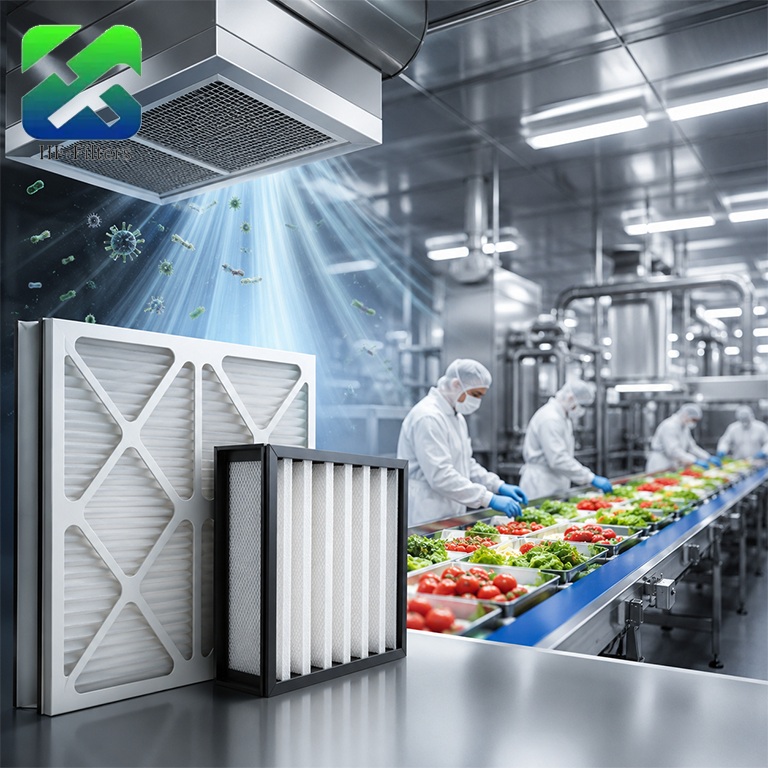
Food processing HVAC systems often work better with filtration in stages.
A simple example is:
Pre-Filter → Medium-Efficiency Filter → HEPA Filter, where needed
Pre-filters catch larger dust first. Pocket or bag filters can handle finer particles further downstream. This also reduces the amount of material reaching the final filter.
For more sensitive production or packaging areas, HEPA filtration may be added when the process and cleanliness requirements call for it.
Healthy Filters supplies pre-filters, pocket/bag filters and HEPA filters for commercial and industrial ventilation systems.
Does a Food Factory Need HEPA Filters?
Not necessarily.
HEPA filters can make sense in selected high-care areas, controlled processing rooms or sensitive filling and packaging environments. ULPA filtration may be considered for specialized applications with even stricter requirements.
But putting the highest-efficiency filter everywhere isn’t automatically the right approach.
The production process, contamination risk, required cleanliness, airflow, HVAC design, pressure drop and applicable food safety requirements all need to be considered.
In many plants, different rooms will use different filtration levels.
What About Activated Carbon?
Activated carbon does a different job from HEPA media.
HEPA filters are used for particle filtration. Activated carbon is mainly used to adsorb certain odors, VOCs and gaseous contaminants.
For food facilities dealing with these issues, an activated carbon filter may be added to the filtration system where appropriate.
It isn’t a replacement for HEPA filtration, and it isn’t a solution for every gas or chemical. The right media depends on what actually needs to be controlled.
Don’t Look at Efficiency Alone
An air filter has to work with the ventilation system, not against it.
A very efficient filter can still be a poor choice if its airflow resistance doesn’t suit the equipment.
When comparing filters, buyers should look at filtration efficiency, airflow, pressure drop, dust holding capacity, media, service life and maintenance needs.
This becomes especially important in food plants where ventilation equipment may run for long production shifts.
Filters also need regular inspection. A heavily loaded filter behaves differently from a new one, so replacement schedules should take actual operating conditions into account.
Healthy Filters for Food Processing Facilities
Healthy Filters is a professional air filter manufacturer supplying filtration products for food processing, dairy, beverage and other commercial and industrial applications.
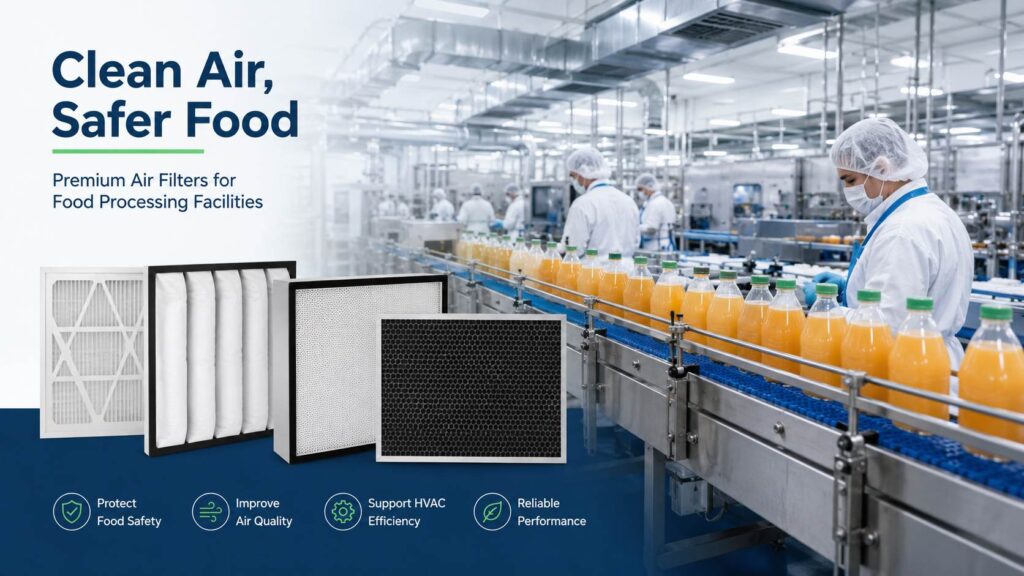
The range includes pre-filters, pocket filters, HEPA/ULPA filters, activated carbon filters, HVAC and general ventilation filters, and cleanroom air filters.
For facilities or equipment that don’t use standard sizes, Healthy Filters also provides OEM/ODM and customized filtration solutions. Filters can be developed around dimensions, media, efficiency, airflow, pressure drop and application requirements.
Food safety depends on many controls working together. Air filtration is only one of them—but in the right part of a processing plant, it shouldn’t be an afterthought.
Looking for air filtration solutions for a food processing, dairy or beverage facility? Contact Healthy Filters to discuss customized filters for your production environment.
FAQ
Why is air filtration important in food processing facilities?
Air can carry dust, ingredient powders, mold spores and other airborne contaminants. Appropriate filtration helps manage these particles in production, packaging and other controlled areas.
Are HEPA filters used in food manufacturing plants?
Yes, in some applications. HEPA filters may be used in high-care, controlled processing or sensitive packaging areas. They aren’t required in every part of every food facility.
What is the role of activated carbon filters in food processing?
Activated carbon filters can help adsorb certain odors, VOCs and gaseous contaminants. They serve a different purpose from HEPA filters, which primarily deal with particles.
Can Healthy Filters customize air filters for food and beverage facilities?
Yes. Healthy Filters can customize filter dimensions, media, efficiency, airflow, pressure drop and construction for different food and beverage processing applications.