
A buyer once brought us a used purifier filter and asked a very direct question:
“Why is there still dust in the room?”
The filter was marked H13. It was not fake, and the media had not failed.
The problem was the gap around the plastic frame. Air had been taking the easier route around the filter.
We see this more often than many people expect. HEPA air purifiers for clean indoor air depend on more than the words printed on the filter.
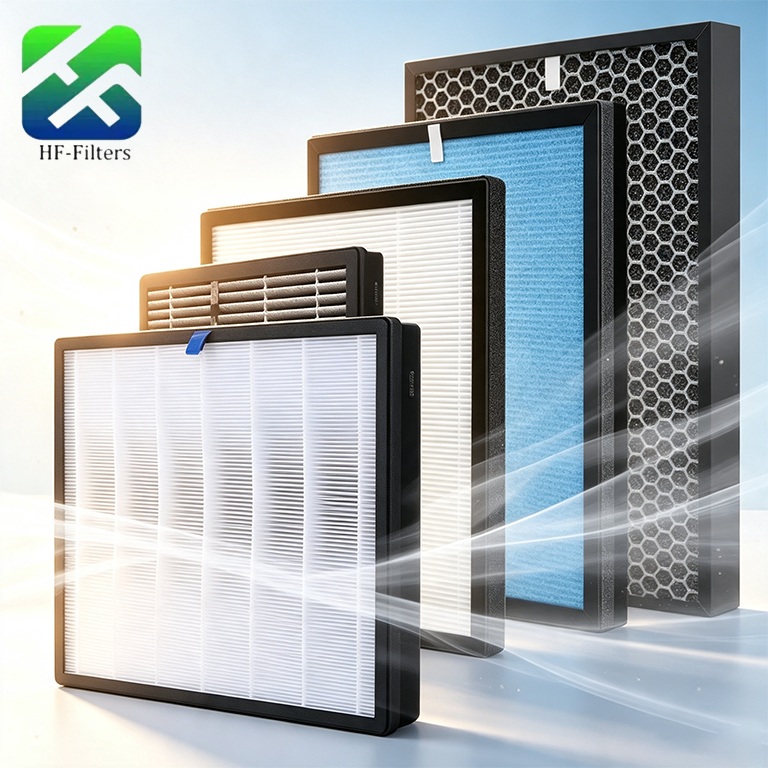
A HEPA filter only works when air passes through it
HEPA media is used to capture fine particles such as pollen, PM2.5, smoke residue, pet dander and fine household dust.
H13 media is common in home purifiers and many commercial units. Under EN 1822 classification, H13 has a minimum overall efficiency of 99.95% at the most penetrating particle size. H14 reaches 99.995%.
Those numbers are useful, but they do not describe the whole purifier.
The frame must fit. The gasket must seal. The fan must still move enough air after the filter is installed.
At Healthy Filters, these three points often take more discussion than the filter grade itself.
More resistance is not always better filtration
Several OEM customers have asked us to upgrade an existing H13 purifier to H14.
Sometimes we do it.
In other cases, the fan curve shows that the purifier will lose too much airflow. The unit may become louder, while the room-cleaning speed drops.
For one small bedroom purifier, we kept H13 media and changed the pleat layout instead. The added media area lowered the initial pressure drop and gave the fan more room to work.
That was a better result than simply using denser media.
How HEPA air purifiers improve indoor air quality is closely tied to airflow. A highly efficient filter with very low air volume may clean a room more slowly than a properly matched filter.
Home purifiers and commercial units do not age the same way
A purifier used for eight hours in a bedroom has a fairly easy job.
A unit placed in a clinic waiting room, open-plan office or roadside store may run all day. It also sees more people, more door opening and a heavier dust load.
Commercial HEPA air purifier projects therefore need more attention to media area and dust-holding capacity.
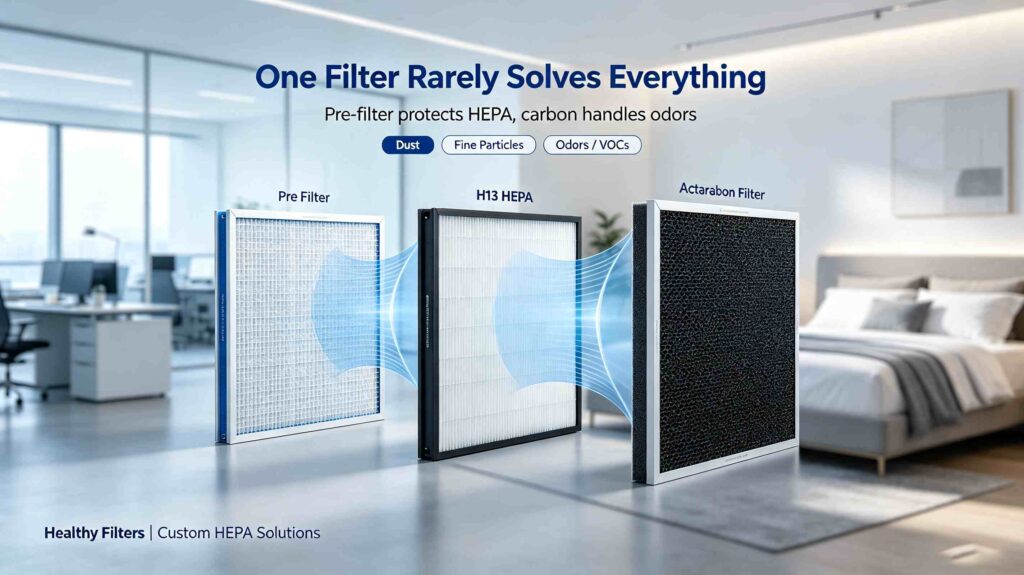
Shenzhen Healthy Filters Co., Ltd. also recommends a pre-filter when the surrounding air contains visible lint or coarse dust. The pre-filter protects the HEPA layer and can prevent an expensive final filter from loading too early.
For smoke or odor complaints, HEPA alone is not enough. An activated carbon layer is normally added because carbon handles gases and odors, while HEPA handles particles.
Replacement filters are often selected the wrong way
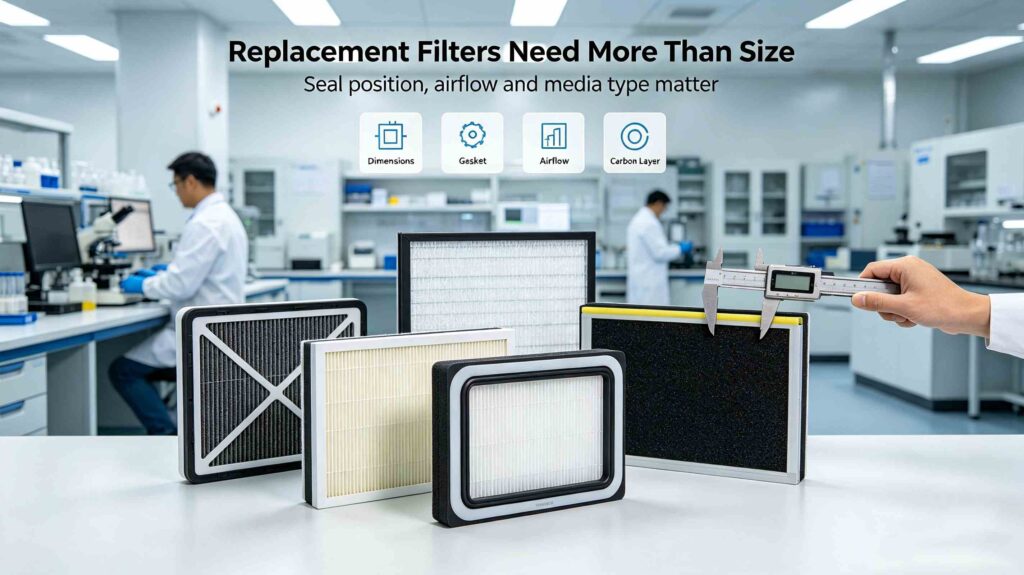
Many inquiries begin with only three measurements: length, width and depth.
That is a start, not a complete specification.
We still need to know where the seal sits, how the filter locks into the purifier, the target airflow and whether carbon is included.
A filter that is 2 mm too loose can create bypass. One that is too tight may bend the frame or damage the gasket.
Healthy Filters makes custom HEPA replacement filters for purifier brands, HVAC equipment, medical devices and 3D printing systems. Different frame shapes, H13 or H14 media, carbon layers and private-label packaging can be produced from a drawing or physical sample.
When should the filter be changed?
Six to twelve months is often quoted for home use, but that range is rough.
A home with two cats, regular cooking smoke or nearby construction may use a filter much faster. A lightly used purifier in a clean room may last longer.
Weak airflow is one sign.
A fan that sounds strained is another.
A dark filter is not automatically finished, but dust leaking around the edge, a damaged gasket or a bent frame should not be ignored.
Do not wash a disposable HEPA filter unless the purifier manufacturer clearly says it is washable. Water can damage the fiber structure even when the filter looks normal afterward.
FAQ
Do HEPA air purifiers remove PM2.5?
Yes. Properly made H13 and H14 filters can capture PM2.5 and other fine airborne particles.
Will a HEPA purifier remove smells?
Not effectively on its own. Odor control usually requires activated carbon.
Is H14 better for every home?
No. H14 has higher efficiency, but it can also create more pressure drop. The purifier fan must be designed for it.
Why is sealing so important?
Any gap gives air a path around the filter. That unfiltered air returns directly to the room.
Can one filter handle dust and odor?
It can if the structure combines HEPA media with a suitable activated carbon layer.
Does Healthy Filters make filters for discontinued purifier models?
Yes. Healthy Filters can work from an old sample, drawing or clear measurements when the original replacement filter is difficult to source.
How fast can a custom replacement filter be quoted?
Shenzhen Healthy Filters Co., Ltd. normally prepares a quotation plan within 72 hours after receiving the required dimensions and application details.
Send the old filter or drawing
For a replacement project, send the purifier model, filter photos, dimensions, airflow information and the main pollutant you want to control.
The Healthy Filters team can check whether the existing design needs H13, H14, more media area, a carbon layer or a better sealing structure. Sample testing is also available before a larger order.