
Not long ago, a customer from Australia emailed us three photos of a dust collector.
His message was short.
“The filters only lasted six weeks. Is the media defective?”
After looking at the pictures, we asked one more question.
“How often is the pulse cleaning system checked?”
It turned out the cartridges weren’t the problem at all. Two pulse valves had stopped working, so one side of the collector was carrying almost all of the dust load.
That happens more often than people think.
When a cartridge air filter wears out too quickly, the filter itself isn’t always to blame.
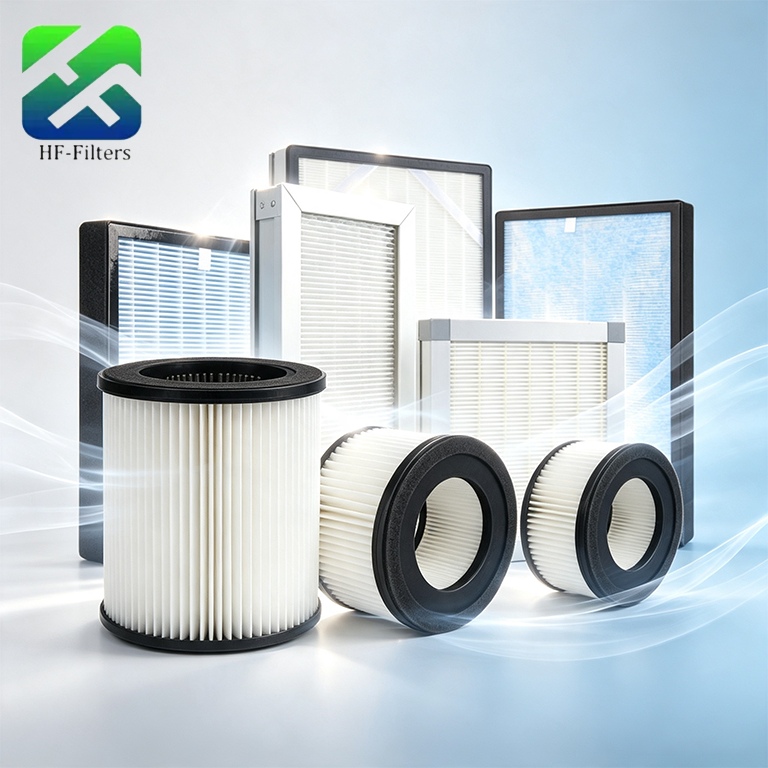
Cartridge filters aren’t all built for the same job
People often call everything a cartridge filter.
In reality, we manufacture different versions depending on what the equipment is collecting.
Very fine welding fumes need something different from coarse woodworking dust.
Food powder behaves differently from cement dust.
Even humidity changes the way dust sticks to the media.
That’s why the first thing we usually ask isn’t the filter size.
It’s “What are you collecting?”
What we usually check before recommending a filter
A drawing is helpful.
Operating conditions are even more helpful.
Our engineers normally want to know:
- Dust type
- Operating temperature
- Airflow
- Pulse-cleaning pressure
- Existing filter dimensions
Two filters with identical outside dimensions can perform very differently once they’re inside the collector.
Healthy Filters has built custom industrial filter cartridges for customers who only needed a different gasket or a deeper pleat. Small changes sometimes solve problems that expensive equipment upgrades cannot.
Pleats matter more than many buyers expect
Some buyers compare only the outside dimensions.
We usually look inside.
Pleat spacing affects airflow.
If pleats are packed too tightly, fine dust bridges between them and cleaning becomes less effective.
Too much spacing isn’t ideal either because available filter media decreases.
Finding that balance is one of the reasons cartridge filter applications vary so much from one factory to another.
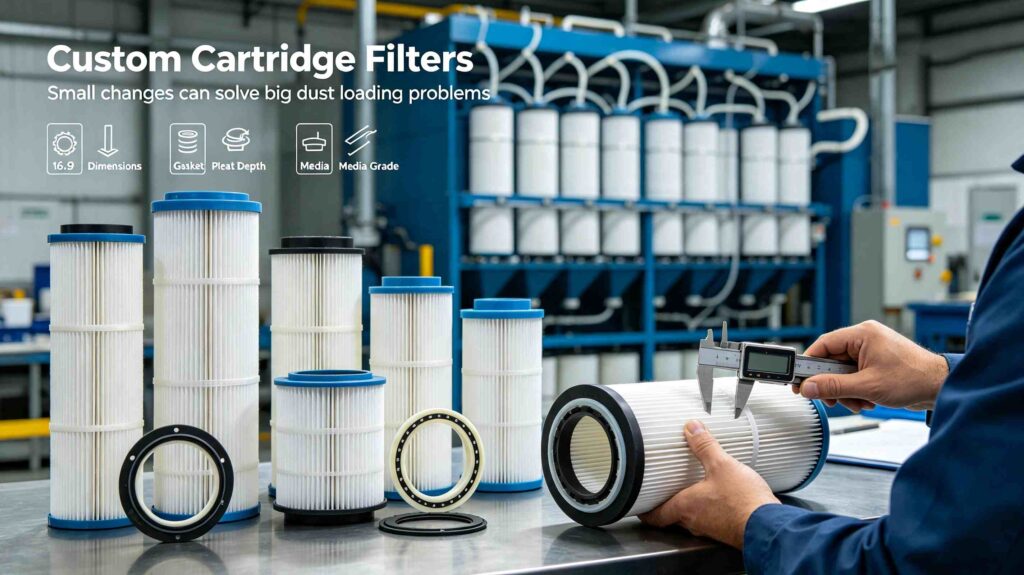
Don’t wait until the filter completely blocks
We’ve opened hundreds of returned cartridges over the years.
The ones replaced at the right time usually look boring.
The ones replaced too late often show torn media, collapsed pleats or damaged end caps.
For most dust collection cartridge filter systems, pressure drop tells a better story than appearance alone.
If differential pressure keeps climbing even after pulse cleaning, it’s usually time to investigate instead of waiting for airflow complaints.
One filter doesn’t fit every factory
A pharmaceutical plant and a metal workshop may use cartridge filters of similar size.
Their media are rarely the same.
At Shenzhen Healthy Filters Co., Ltd., we manufacture pleated cartridge dust filters with cellulose, polyester, nano-fiber and flame-retardant media depending on the application.
Most OEM customers aren’t looking for the “best” cartridge.
They’re looking for one that lasts longer in their equipment.
That’s a different question.
FAQ
What is a cartridge air filter used for?
It’s commonly used in industrial dust collectors to capture airborne dust generated during manufacturing, welding, woodworking, powder handling and similar processes.
How long should a cartridge filter last?
There isn’t a fixed answer. Dust type, operating hours, pulse cleaning and airflow all influence service life.
Can cartridge filters be cleaned and reused?
Some can be cleaned during normal pulse operation, but damaged or overloaded cartridges should be replaced rather than washed.
Why is my cartridge filter clogging too quickly?
Possible causes include unsuitable media, failed pulse valves, excessive dust loading or incorrect airflow.
Can Healthy Filters produce custom cartridge filters?
Yes. Healthy Filters manufactures OEM and ODM cartridge filters in custom sizes, media, end caps and gasket configurations. Drawings or samples are both acceptable.
How quickly can a custom order start?
Most quotations are prepared within 72 hours. Standard production generally ships within 7–10 days after order confirmation.
Need help matching a cartridge filter?
If you have the existing filter drawing, dimensions or even a used sample, send it to Healthy Filters.
Our engineering team at Shenzhen Healthy Filters Co., Ltd. will review the application and recommend a suitable cartridge filter instead of simply matching the old part number.