
A customer from Southeast Asia once told us something that sounded familiar.
“The HEPA filter is new, but people still complain about the smell.”
We asked one more question.
“Is there any activated carbon inside the purifier?”
There wasn’t.
That conversation comes up surprisingly often. Many people expect a particle filter to solve every air-quality problem, but odors, VOCs and many chemical vapors behave very differently from dust. That’s where activated carbon filters come in.
Activated carbon doesn’t work like a HEPA filter
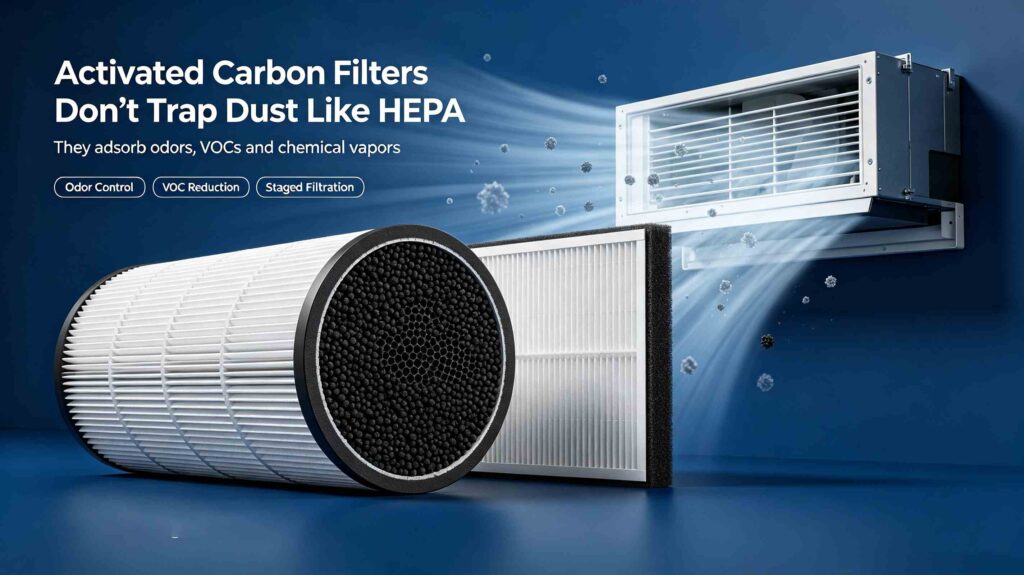
Dust is trapped because particles are physically intercepted by filter media.
Activated carbon works differently. It relies on millions of microscopic pores that adsorb gas molecules onto the carbon surface.
That’s why activated carbon filters for air and water purification are used in such different industries. The same principle can reduce odors in an office, improve air inside an HVAC system, or remove chlorine and certain organic compounds from water treatment equipment.
The application changes, but the adsorption process is essentially the same.
Not every carbon filter performs the same
Two filters may contain activated carbon and still produce very different results.
What usually makes the difference isn’t the outside appearance. It’s the carbon itself.
The iodine value, carbon source, particle size, bed depth and airflow all affect adsorption capacity. A shallow carbon layer may remove odors at first but become saturated much sooner.
When OEM customers ask Healthy Filters for a replacement design, our engineers normally discuss operating conditions before recommending the carbon media. That conversation is often more important than choosing the frame.
Air purification and water purification have different priorities
For air purification, pressure drop matters.
A filter packed with too much carbon may reduce airflow, especially in compact air purifiers or HVAC return-air systems.
For water purification, contact time becomes more important. Water needs enough time to pass through the activated carbon for effective adsorption.
Although the adsorption mechanism is similar, the filter structure is usually very different.
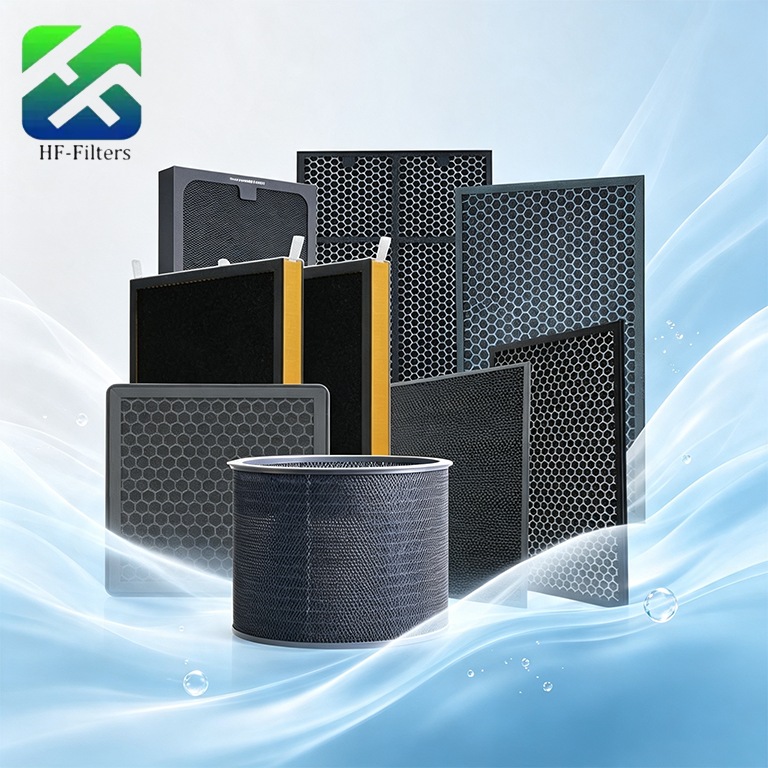
Shenzhen Healthy Filters Co., Ltd. manufactures activated carbon panel filters, honeycomb carbon filters, carbon cloth filters, cartridge filters and combination HEPA-carbon filters for different applications rather than using one design for every project.
When carbon filters don’t last as expected
We once reviewed a complaint from a restaurant ventilation project.
The carbon filter had been replaced twice in only a few months.
The media wasn’t defective.
The kitchen produced much heavier grease vapor than originally expected, so the pre-filter became overloaded. Once grease reached the activated carbon, adsorption performance dropped much faster.
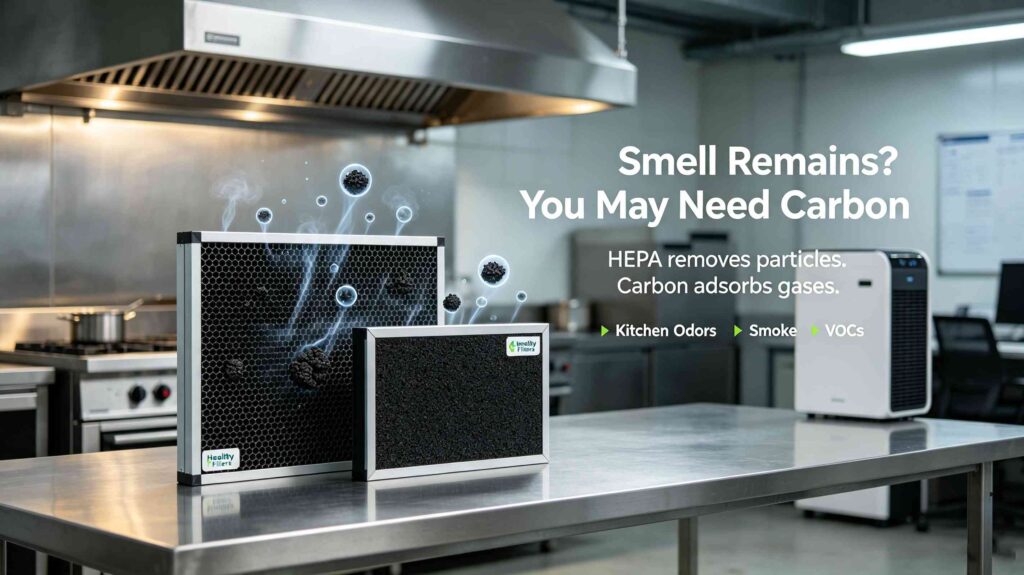
That’s one reason we often recommend staged filtration. A primary filter removes larger particles first, while the activated carbon focuses on gases and odors instead of dust.
In many commercial systems, that approach extends service life and reduces operating cost.
Choosing the right carbon filter
Instead of asking only for the dimensions, try preparing a little more information.
The pollutant type.
Operating airflow.
Temperature.
Humidity.
Whether odor removal, VOC control or chemical adsorption is the main objective.
Healthy Filters produces custom activated carbon filters with different carbon grades, media combinations, frame materials and OEM branding. Many projects begin with nothing more than a drawing or an old sample.
Maintenance isn’t only about replacement time
Carbon filters don’t suddenly stop working.
Adsorption capacity gradually decreases as the available pore structure becomes occupied.
If odors begin returning even though airflow remains normal, the carbon may already be saturated.
Replacing the filter before complete saturation is usually more economical than waiting until complaints appear.
FAQ
What does an activated carbon filter remove?
Activated carbon mainly adsorbs odors, VOCs, chlorine and many organic compounds. It is designed for gases rather than solid particles.
Does activated carbon remove dust?
No. Dust removal normally requires a particulate filter such as MERV-rated filters or H13/H14 HEPA filters.
Can activated carbon be used for water purification?
Yes. Activated carbon filtration is widely used to reduce chlorine, taste, odor and certain organic contaminants in water treatment systems.
How long does an activated carbon filter last?
Service life depends on airflow, contaminant concentration, humidity and carbon loading. There is no universal replacement interval.
Can Healthy Filters manufacture custom activated carbon filters?
Yes. Healthy Filters supplies OEM and ODM activated carbon filters in custom sizes, media combinations, carbon weights and frame configurations.
Can HEPA and activated carbon be combined?
Yes. Many air purifiers and HVAC systems combine HEPA media for particles with activated carbon for odor and gas control.
Looking for a custom carbon filter?
If you have an existing sample, equipment drawing or airflow specification, send it to Healthy Filters.
The engineering team at Shenzhen Healthy Filters Co., Ltd. can recommend a practical carbon filtration solution and provide a quotation or sample proposal within 72 hours.