
EV chargers are handling more power. That also means more heat has to be managed inside the cabinet.
For equipment using forced-air cooling, outside air solves one problem and creates another.
The fans pull in cooling air, but they can also pull in road dust, sand, pollen, fibers and insects. Put a filter over the inlet and those contaminants can be reduced—but airflow resistance goes up.
So the filter cannot be selected by efficiency alone.
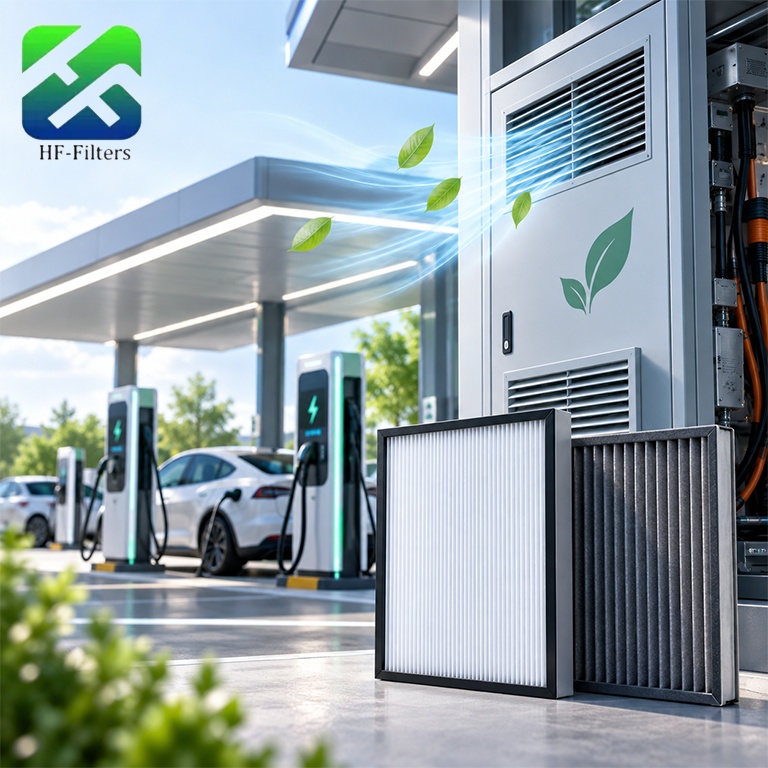
Start With the Cooling Air
A charger installed beside a highway has a different job from one inside a parking garage.
Desert sites may see heavy dust and sand. Logistics hubs can have road debris and fibers. Coastal installations add humidity and salt-containing air to the engineering discussion.
In many of these locations, HEPA isn’t the obvious answer.
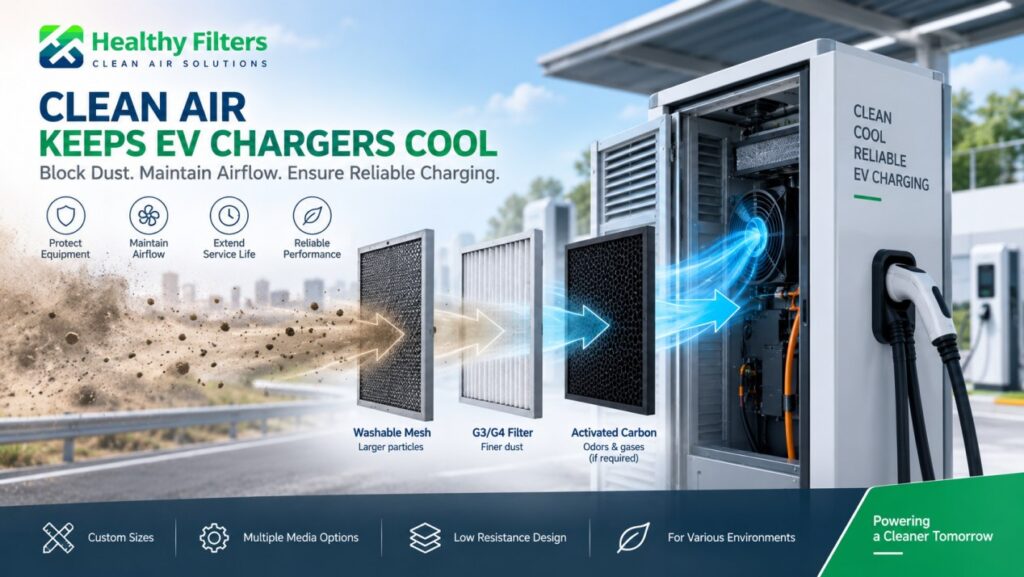
A charging cabinet may benefit more from a low-resistance washable mesh or coarse pre-filter that keeps larger contaminants away from the cooling path without unnecessarily restricting airflow.
Where finer dust is a problem, a G3/G4 panel filter or another particulate stage can be considered.
What Should a Charger Manufacturer Specify?
The useful numbers are fairly straightforward:
| Parameter | What to Check |
| Filter Size | W × H × D |
| Filter Type | Nylon Mesh / Metal Mesh / G3-G4 Panel |
| Airflow | Required cooling airflow, m³/h |
| Pressure Drop | Maximum resistance allowed by cooling design |
| Media | Mesh or synthetic particulate media |
| Construction | Washable / Disposable |
| Frame | Plastic / Metal / Custom |
| Environment | Indoor / Roadside / Desert / Industrial |
For OEM work, airflow and allowable pressure drop are especially important. A filter that catches finer particles but starves the cabinet of cooling air may be the wrong trade-off.
When Carbon Makes Sense
Activated carbon has a different job.
Mesh and panel filters deal mainly with particles. Carbon media is used for selected gaseous contaminants and odors.
It won’t be necessary for every charging station. Where the installation environment calls for gas-phase treatment, however, a carbon panel can be placed downstream of a particulate stage.
A possible configuration might be:
Outdoor Air → Washable Mesh → G3/G4 Filter → Carbon, if required → Cooling Fan
This is only a design concept. The actual number of stages depends on available space, fan capacity and the charger’s cooling system.
Don’t Forget Filter Loading
A clean filter and a dusty filter don’t behave the same way.
Outdoor filters gradually collect debris. As loading increases, resistance can rise and cooling airflow may change.
That makes access important. If the filter is washable, can a technician remove it easily? If it is disposable, is replacement practical without opening half the cabinet?
There is no useful universal answer such as “replace every three months.” A roadside charger in Nevada and an indoor charger in a relatively clean garage won’t load filters at the same rate.
Where Healthy Filters Fits
For charger manufacturers, Healthy Filters can work from the equipment design, rather than trying to fit a standard HVAC filter into the cabinet.
Available options include washable nylon mesh, metal mesh, G3/G4 panel pre-filters, low-resistance particulate filters and activated carbon filters.
More importantly, an OEM inquiry can start with actual engineering inputs:
425 × 180 × 15 mm + required airflow + maximum pressure drop + outdoor dust conditions + washable construction
Healthy Filters can then adjust the filter dimensions, depth, mesh density, media, frame and installation structure around the cabinet. Carbon media can also be incorporated where the application actually requires it.
This is particularly useful for filters that need to fit behind louvers, fan modules or non-standard air inlets.
The goal isn’t the highest filter efficiency. For a charging cabinet, it is enough contaminant control without compromising the cooling airflow the equipment needs.
Designing an EV charging cabinet? Send Healthy Filters your filter dimensions, cooling airflow, pressure-drop limit and installation environment to discuss an OEM filter configuration.
FAQ
Why do EV chargers need air filters?
Ventilated chargers can draw outdoor dust, fibers, insects and other debris into the cooling-air path. A suitable inlet filter helps intercept these contaminants.
What filter works for a charging cabinet?
It depends on the environment and cooling design. Washable mesh and G3/G4 pre-filters are possible options for different dust conditions.
Do EV fast chargers need HEPA?
Usually not by default. Higher efficiency also means pressure-drop considerations, so the filter should match the actual equipment requirement.
Can Healthy Filters make custom EV charger filters?
Yes. Size, depth, mesh density, media, frame and filtration configuration can be developed around OEM airflow and installation requirements.