
A European kitchen hood brand contacted Healthy Filters during a product upgrade. Its existing metal grease filter collected grease and oil mist from cooking. The hood handled visible aerosols, while cooking odors still traveled with the exhaust air.
The project called for a kitchen exhaust filter arrangement that kept the existing grease stage and added practical odor control.
Why Did the Kitchen Hood Need an Odor Control Filter?
Cooking emissions contain coarse particles, fine smoke, oil aerosols, and molecular pollutants. Ingredients, recipes, and cooking methods shape the odor profile. A filter that captures grease protects the duct and downstream media, while molecular filtration addresses odor molecules carried in the air.
The Existing Metal Grease Filter
The original metal grease filter sat close to the cooking range. Its open mesh structure supported high airflow and low resistance, and the reusable metal media could be cleaned. This stage remains important for hood hygiene, fire-risk management, and protection of later filters. A regular cleaning schedule keeps grease from building up in the duct.
The Added Activated Carbon Stage
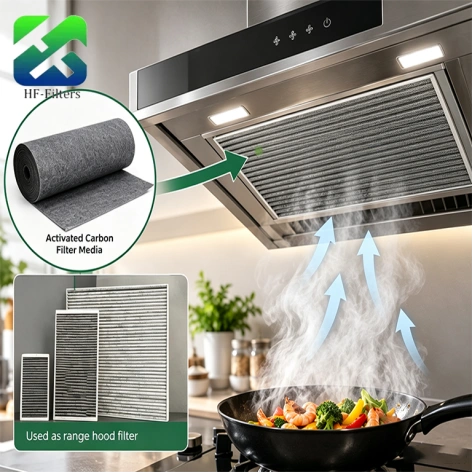
The upgraded design adds an activated carbon filter after the metal grease filter. Powdered activated carbon provides surface adsorption for odors, dust, and volatile organic pollutants such as benzene and formaldehyde.
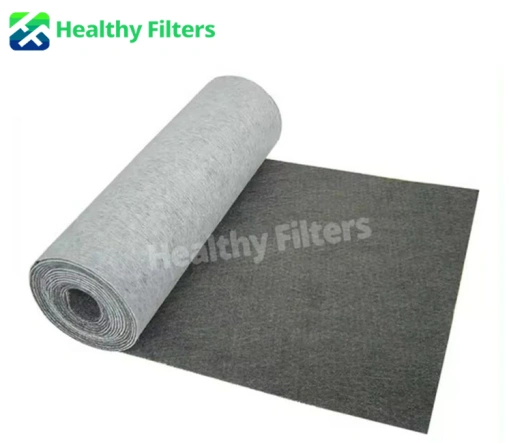
The filter media can be supplied as carbon fabric or as a three-layer or four-layer sandwich structure, where carbon particles sit inside non-woven fabric.
How Does the Two-Stage Kitchen Exhaust Filter Work?
The sequence follows the kitchen load. Each stage has a defined job, so the hood keeps its airflow while the exhaust receives odor treatment.
Metal Grease Filter Plus Activated Carbon Filter
The airflow path is:
Kitchen Hood → Metal Grease Filter → Activated Carbon Filter → Odor-Controlled Exhaust Air
The metal stage intercepts grease and oil mist. The activated carbon stage adsorbs molecular pollutants that pass through the first filter. Healthy Filters lists activated carbon media with carbon content above 70, 90, or 150 g/m² and benzene adsorption values of at least 65%, 70%, or 75%, depending on the selected grade. The final choice follows the exhaust load, available depth, and target service interval.
How Is a Custom Filter Developed?
The development starts with the filter already installed in your hood. A short review connects the physical fit with the operating target and gives the sample a clear test basis.
Application and Requirement Review
The review covers filter dimensions, airflow, installation space, required filtration performance, odor-control requirements, and replacement frequency. It also checks the grease stage, access direction, sealing points, and cleaning routine. These details matter because molecular media needs enough contact with the air and a stable, leak-free fit.
Media Selection and Sample Evaluation
Carbon fabric suits compact panel formats. Sandwich carbon media combines dust collection and adsorption, with a customizable filtration efficiency from 85% to 99.97%.
For larger exhaust modules, the HF-HXT format is available in sizes from 295 × 295 × 46 mm to 595 × 595 × 46 mm, with rated airflow from 800 to 3200 m³/h and an initial pressure drop of 40 Pa. A sample is produced for customer evaluation before the final specification moves to production.
What Does Healthy Filters Bring to This Project?
This type of upgrade needs one team to match the new media to the existing hood. Healthy Filters develops custom filter dimensions, supplies metal and activated carbon stages, and supports OEM/ODM projects.
The product range includes reusable metal mesh, activated carbon composite media, and sandwich carbon media. ISO 9001 quality management, international test reports, and inspection before shipment provide documented checkpoints. Export service across Europe, North America, Southeast Asia, and other markets also supports repeat orders and replacement planning.
How Can You Specify a Custom Kitchen Exhaust Filter?
Start with the operating facts from the hood. Share the existing filter photos, dimensions, drawings, airflow, installation depth, cooking process, and preferred replacement frequency. The specification can then define the grease stage, carbon loading, frame material, pressure-drop target, and service method. A matched product range helps you compare panel, mesh, carbon fabric, and sandwich formats before sampling.
Healthy Filters can review these inputs, prepare a sample around your housing, and document the selected media and inspection points for the next production step.
FAQ
Q1: Can an activated carbon filter replace a metal grease filter?
A: The two filters perform separate jobs. Keep the metal grease filter at the hood inlet and place the activated carbon filter downstream for odor adsorption.
Q2: What information is needed for a custom kitchen exhaust filter?
A: Provide filter dimensions, airflow, available installation space, cooking process, odor target, pressure-drop limit, and replacement frequency.
Q3: How often should the filters be replaced?
A: Set the interval from grease loading, operating hours, odor performance, and inspection results. Clean reusable metal media on its maintenance schedule and replace carbon media when adsorption performance falls.
Q4: Can the activated carbon filter fit an existing hood?
A: Yes. The frame size, thickness, airflow, and access direction can be developed around the existing housing. Sample approval confirms the fit before production.
Q5: Can you develop a private-label kitchen hood filter?
A: Healthy Filters supports OEM/ODM filter projects, custom sizes, media combinations, sampling, and pre-shipment inspection for private-label programs.