
By October 8, 2026, the US logged 4,080 confirmed measles cases. Health trackers tied 96% of these to major outbreaks.
If you manage an air purifier brand or an ODM team, you face a core question. How much fresh air does your unit actually blast into a normal room? An H13 or H14 HEPA filter plays a key role. It drops the floating virus count. Still, it is critical to eliminate air bypass leakage around the filter assembly. Naturally, getting vaccinated remains your ultimate defense.
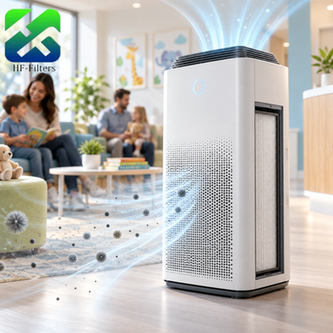
Why Is Measles an Indoor-Air Problem?
Sick folks spread measles incredibly fast. Just breathing, coughing, or a quick sneeze does the trick. These everyday actions throw tiny virus droplets straight across the room.
The key concern?Measles stays dangerous. The invisible threat hangs around in the air way after the sick person actually leaves. Because of this, shared indoor rooms are the main spots we really have to fix.
Droplets and Suspended Respiratory Particles
Big spit drops fall fast. But tiny breathing dust floats. These little drops drift all the way across a room. In fact, the measles virus stays dangerous in the air for up to two hours after the sick person walks out.
What Air Cleaning Can Do
An air purifier grabs the tiny dust that gets sucked into it. Over time, it cleans the room’s air. Still, it cannot make you immune. It won’t save you if someone coughs right in your face. Vaccines, good masks, open windows, keeping sick people away, and public health rules do the real heavy lifting.
How Does an H13 or H14 HEPA Filter Capture Measles Aerosols?
We want to trap the tiny drops that carry the virus. Catching them depends on a few things. Size matters. So does the air speed, filter size, and what the filter is made of.
Three Capture Mechanisms
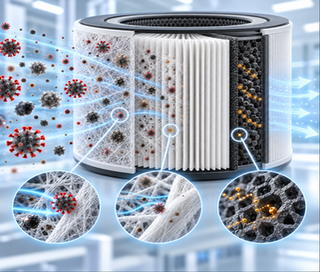
Big stuff simply crashes into the filter threads. We call this inertial impaction. Medium stuff brushes against the threads and gets stuck. That is interception. The tiniest stuff dances around in a crazy way. This random thermal motion is known as Brownian diffusion. Combined, these three mechanisms achieve higher capture efficiency for particles both larger and smaller than the Most Penetrating Particle Size (MPPS).
H13 and H14 under EN 1822
The EN 1822 rule tests filters using the hardest size to catch. This is the MPPS. For H13, it stops at least 99.95% of the bad stuff. For H14, it blocks 99.995%. Sometimes, an H13 HEPA filter shows a 0.3-micrometer score too. Always ask to see the real EN 1822 paper. A basic "HEPA-type" sticker means nothing.
Where Should You Deploy a HEPA Air Purifier?
Put these machines where crowds share the same air. Place them where the normal room fans need extra help. Always match the unit to the room’s exact size and air flow.
Clinics, Schools, Offices, and Homes
Good spots are kid doctor rooms, waiting lobbies, classrooms, and regular home living rooms. Just keep the air vents far from walls or big couches. To reduce exposure risk from measles aerosols, a HEPA air purifier must achieve sufficient air change rates within the room.
Temporary Healthcare Use
A rolling machine helps clean the air in a basic sick room. But it doesn’t make negative pressure. It cannot replace a real airborne infection isolation room. Hospital safety staff must decide the exact air settings and safe times.
What Should Brands and ODM Teams Specify?
First, choose a filter grade. The fresh air it blows out shows how quickly a room becomes safe. Also, fans work much harder against a clogged filter later on.
Match Efficiency, Resistance, and CADR
Select H13 or H14 depending on the exact risk and your motor strength. H14 definitely grabs more dust at the MPPS level. However, it restricts the wind a lot more. A weak motor simply drops your total CADR. Therefore, for every air purifier HEPA filter, clearly log the air speed. Also, note the resistance, media area, pleat height, and final CADR.
Control Bypass and Replacement
Air easily slips past tiny gaps. So, keep frames totally flat and press gaskets down hard. Inspect the glue, then test the whole box for leaks.
Swap filters when pressure drops happen, or track fan hours. Shapes include square, cylindrical, and round. Frames use paper, plastic, or PU.
Typical filter service life ranges from 812 months under normal operating conditions. Heavy dust loading will shorten replacement intervals.
Turning Aerosol-Risk Targets into a Production-Ready Filter
After you lock down air flow and leak rules, the maker’s job begins. The plans must list the filter class, test method, media area, frame interface, gasket compression, and clear pass limits.
If you are designing aircleaning devices for highrisk shared indoor spaces, filter grade, sealing performance and batch consistency are critical considerations for product.
Healthy Filters makes EN 1822 H13 and H14 parts for homes, shops, and clinics. They build flat, pleated, cylindrical, and round formats. They also use single-layer or carbon mixes. While testing, the tech crew checks the air flow, pleats, starting resistance, seals, and CADR. A 30 m³ CADR test room checks the entire machine. Healthy Filters tracks every batch. They do custom sizes, private printing, safe packing, and small test runs to ensure volume production goes smoothly.
FAQ
Q1: Can an H13 HEPA Air Purifier Prevent Measles Infection?
A: No. It just drops the amount of virus flying around. Shots are the top shield. You also need masks, open windows, and health rules.
Q2: Is H14 Always Better than H13 for an Air Purifier?
A: Not necessarily. H14 delivers higher efficiency at MPPS, yet it also brings higher airflow resistance. Always evaluate the complete unit’s realworld CADR performance.
Q3: How Should a Commercial or Medical Purifier Seal Its Filter?
A: Use a flat frame. Squeeze the gasket tight. Use good glue, and make sure the box fits perfectly. Always test for sneaky leaks.
Q4: Can You Customize Different HEPA Filter Shapes?
A: Yes. You can get flat, pleated, cylindrical, and round formats. They can have custom sizes, frames, gaskets, and boxes.
Q5: When Should the Filter Be Replaced?
A: Watch the pressure drop or count the fan hours. A dirty prefilter or heavy dust means you must change it faster.