
A hot-zone filter can seem perfect in drawings. Yet, it often breaks after heating up and cooling down a lot. The media shrinks. Glue gets stiff. Frames move around. Bad gaskets let air sneak out.
A true 350°C HEPA filter builds the media, separator, glue, frame, and seals into one solid unit. Every single part must survive the continuous high-temperature environment safely. You might want to look at other industrial air filters too. Doing this makes setting up your early and final filter stages much easier.
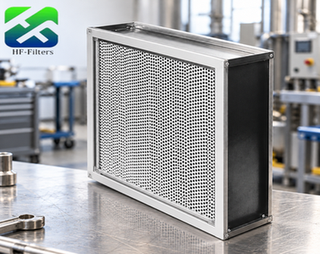
What Is a 350°C High Temperature HEPA Filter?
These units capture sub-micron airborne particulates. Basic PP media melts fast. Regular glues and gaskets also crack or warp. Then they drop dirt everywhere at 350°C. To beat the heat, this filter uses heat-resistant fiberglass or super thin fiberglass paper. It packs aluminum-foil separators, inorganic ceramic sealant, and a fiberglass rope gasket. A strong stainless steel frame holds it all.
You can pick H13 and H14 grades for your work. Just note the specific class, test rule, airflow, and working heat. Temperature numbers are super important. Always record the steady heat, cycle length, warming speed, and quick heat spikes.
Where Are 350°C High Temperature HEPA Filters Used?
Workers install these filters in spots needing hot air and dirt control. They build a secure clean zone. Filter placement really matters. A unit resting right by the heater gets extremely hot. Another placed farther down takes far less thermal load.
Pharmaceutical Depyrogenation Tunnels
Inside a depyrogenation tunnel, the filter pushes fresh, hot air across glass bottles and vials. Blocking airborne dirt keeps the space secure. A solid test plan maps out the heat spread. It also tracks air movement and room clarity.
Dry-Heat Sterilizers and Clean Exhaust
Dry-heat sterilizers rely on tough filters to push or pull air. This blocks dust during rapid heating and cooling drops. You really must understand the full cycle. Joint seals face huge stress. They constantly expand and shrink over time.
Industrial Ovens and High-Temperature Clean Air
Industrial ovens and coating dryers require heat-resistant filtration. This stops nasty grime from ruining your goods. Adding a basic early prefilter is a smart move. It saves the final HEPA stage from heavy workloads.
How Should You Select a 350°C HEPA Filter?
Look closely at your real working needs. Match the filter to your fan and clean air goals. If you just pick a heat resistant HEPA filter by its heat tag, you might get bad airflow.
Write down the normal heat, top heat, cycle time, and heat-up speed.
Pick H13 or H14. Name the exact test rule you want.
Check rated airflow, face speed, initial pressure drop and recommended final resistance.
Look at width, height, depth, flange, and gasket spots.
Standard sizes range from 305 × 305 × 69 mm (or 484 × 484 × 50 mm) to 1220 × 610 × 90 mm. Rated airflow goes from 260 to 2800 m³/h. Initial resistance is under 220 Pa for standard H13 and H14 filters. Final numbers change based on size, airflow, and testing conditions. Make sure your drawing has the right numbers.
From Operating Data to a Buildable Filter
When you know what you need, the maker will match parts and check drawings. Healthy Filters can build the media, aluminum separator, and high-temperature sealant. They match the metal frame, size, and H13/H14 grade for you. OEM and ODM help covers odd sizes, custom tags, and export boxes.
Shop checks look at parts, sizes, seals, and filter power. The factory uses an ISO 9001 quality system. They provide batch test papers and H13/H14 records. Early tech talks catch bad flanges, airflow issues, and heat mix-ups.
Just send your filter size, quantity, normal and peak temperatures, rated airflow, efficiency class, and use case. Adding a photo helps a lot.

FAQ
Q1: Can a standard H14 HEPA filter run briefly at 350°C?
A: No. A heat resistant HEPA filter requires specific parts built for extreme warmth. Regular media and glue will simply snap.
Q2: Is a 350°C temperature rating enough for selection?
A: Not quite. You must figure out the steady warmth and quick heat spikes. Knowing your cycle length and airflow helps a lot. Don’t forget the initial pressure drop, efficiency class, and box seal facts.
Q3: Can you order a non-standard 350°C HEPA filter?
A: Absolutely. We can match the size, frame, and seal to your exact needs. The separator and sealant can easily copy a custom drawing or physical sample.
Q4: Can shipment include test reports and export documents?
A: For sure. Just sort out the batch test reports and H13/H14 records early. Make sure labels and export papers are agreed upon before production starts.
Q5: What should you send for a quotation?
A: We provide standard dimensions and relevant technical specifications for reference. For custom projects, please specify the application scenario, the type and dimensions of the filter required, as well as the operating airflow and initial pressure drop requirements. We will assist in confirming the details and provide a comprehensive quotation.