
IFA 2026 placed smart kitchens and energy-efficient appliances in the Home Appliances program. For you, that expands the range hood filter brief. Grease capture still matters, while cooking odors, VOCs, PM2.5, airflow, noise, and replacement access shape the design.
A Sandwich Carbon Filter can combine particle filtration with gas-phase adsorption in a compact assembly.
What Changed in Kitchen Air Quality at IFA 2026?
The official IFA 2026 program links kitchen design with connected home functions and energy use. A range hood needs a filter plan that matches the appliance, fan, service interval, and target pollutants. Set inputs before choosing media.
Kitchen Air Quality Has Several Pollutant Groups
Grease and oil particles need a grease-separation stage. Cooking odors and selected VOCs need adsorption. PM2.5 needs a particle layer with a stated efficiency target. Each result needs its own test method.
The Appliance Sets the Filter Brief
Define rated airflow, depth, fan curve, sound target, cleaning routine, and replacement interval. Test the finished Range Hood Carbon Filter in the airflow path, then test loose media as a reference.
What Is Sandwich Carbon Filter Media?
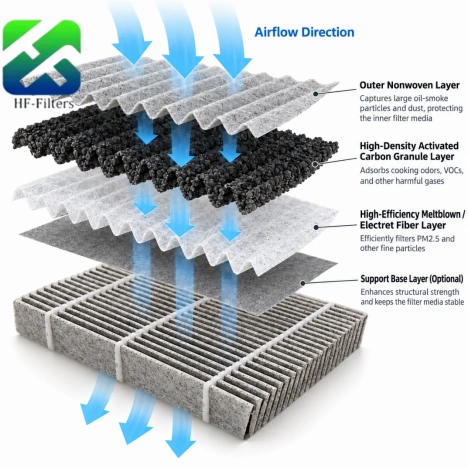
Sandwich Carbon Filter Media uses three-layer or four-layer construction. Product data describes activated carbon particles wrapped in nonwoven fabric, with a high-efficiency layer available for combined filtration and adsorption. This is a practical form of Composite Filter Media for compact kitchen appliances.
Three-Layer and Four-Layer Construction
Nonwoven layers hold carbon particles during cutting, pleating, framing, and replacement. The carbon layer provides pore surfaces for adsorption. A particle layer adds dust capture. The media can remain flat or become mini-pleated.
Carbon Structures Serve Different Designs
A Carbon Cloth Filter carries carbon on a textile surface. Honeycomb media places carbon in open cells. Carbon foam uses a porous solid. Sandwich media keeps the layers close together, which suits a cooker hood with limited depth and a defined replacement opening.
What Activated Carbon Media Can Do
Activated Carbon Filter Media adsorbs gas molecules on pore surfaces. Results depend on carbon type, carbon loading, contact time, humidity, temperature, and pollutant. Household carbon media covers smoke odor and common odor adsorption, with low wind resistance as a design aim. Confirm results on the assembled filter.
Which Requirements Shape a Range Hood Carbon Filter?
The specification joins filter performance with the appliance operating point. Write each requirement as a measurable value for sample comparison.
Dual Filtration for Particles and Gas Pollutants
Name the particle target, odor compounds, VOCs, and test concentration. Then select the particle layer, carbon type, and carbon loading. Sandwich carbon data lists a customizable filtration range of 85% to 99.97%; the result depends on construction and test method.
Slim Geometry and Low Air Resistance
Measure media thickness, pleat depth, frame depth, gasket space, and replacement clearance. A Low Pressure Drop Carbon Filter needs testing at rated airflow and face velocity. Pressure drop affects fan load, extraction volume, sound, and energy use.
Carbon Loading and Service Life
Carbon loading works with adsorption capacity, pressure drop, thickness, humidity, grease exposure, and service life. Ask for carbon type, loading unit, adsorption test, breakthrough point, and replacement condition.
What Should an OEM Ask Before Ordering a Cooker Hood Filter?
Your RFQ should give every supplier the same inputs. This keeps sample comparisons tied to the appliance.
Dimensions and Airflow
List length, width, thickness, frame details, rated airflow, face velocity, initial pressure drop, sound target, and installation space.
Pollutants and Test Conditions
Name the cooking odors and VOCs. Add concentration, humidity, temperature, exposure time, adsorption endpoint, grease loading, and cleaning conditions.
Frame, Sealing, and Replacement
Confirm frame material, gasket, bypass control, mounting points, pleat stability, replacement access, and service life. Similar dimensions can produce different results when sealing changes.
How Can a Custom Filter Match Your Range Hood Design?
Once the inputs are clear, Healthy Filters can assess the range hood drawing, airflow, available space, target pollutants, and pressure-drop limit. Its household range includes sandwich carbon nonwoven media, mini-pleated carbon assemblies, and custom formats.
You can compare three-layer and four-layer builds, select carbon loading, add a particle layer, and review fit and sealing on samples. The filter product range shows flat, honeycomb, and pleated activated carbon structures. The final assembly needs tests for airflow, odors, VOCs, noise, and replacement timing.
FAQ
Q1: What does a Sandwich Carbon Filter remove in a range hood?
A: It can combine particle filtration with adsorption of cooking odors and selected VOCs. Your target pollutants and test method define the result.
Q2: Does a Range Hood Carbon Filter replace the metal grease filter?
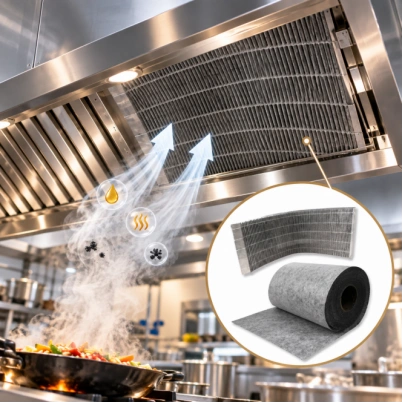
A: The metal stage handles grease and oil particles. The carbon stage handles gas-phase adsorption. Your airflow path should define the two-stage arrangement.
Q3: How do you specify a Low Pressure Drop Carbon Filter?
A: State rated airflow, face velocity, initial pressure drop limit, thickness, frame, seal, and fan operating point. Test the finished assembly at those conditions.
Q4: What controls sandwich carbon service life?
A: Cooking frequency, grease exposure, carbon type, carbon loading, humidity, pollutant level, airflow, and replacement timing all affect service life.
Q5: Can sandwich carbon media be customized for a Cooker Hood Filter?
A: Yes. You can define dimensions, thickness, layers, carbon loading, pleat format, frame, gasket, target pollutants, airflow, and test conditions before sample approval.