
HEPA filters are showing up in more hospitals, cleanrooms, laboratories and high-tech factories. The labels are multiplying too: True HEPA, H13, H14, 99.97%, medical-grade, HEPA-Type, approved HEPA.
For a buyer, those words are not enough.
The useful question is much simpler: What standard was the filter tested to, and what did the finished filter actually achieve?
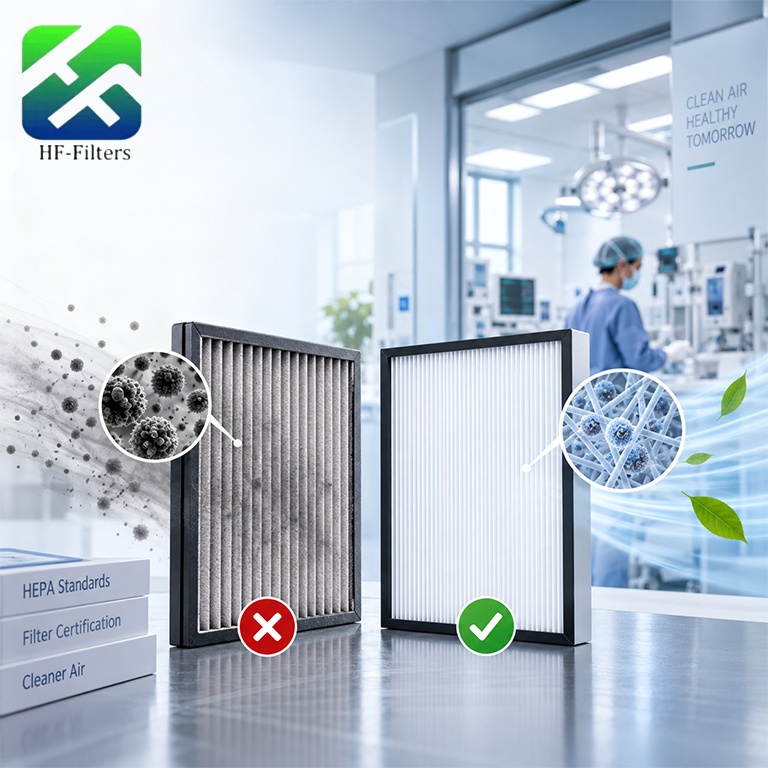
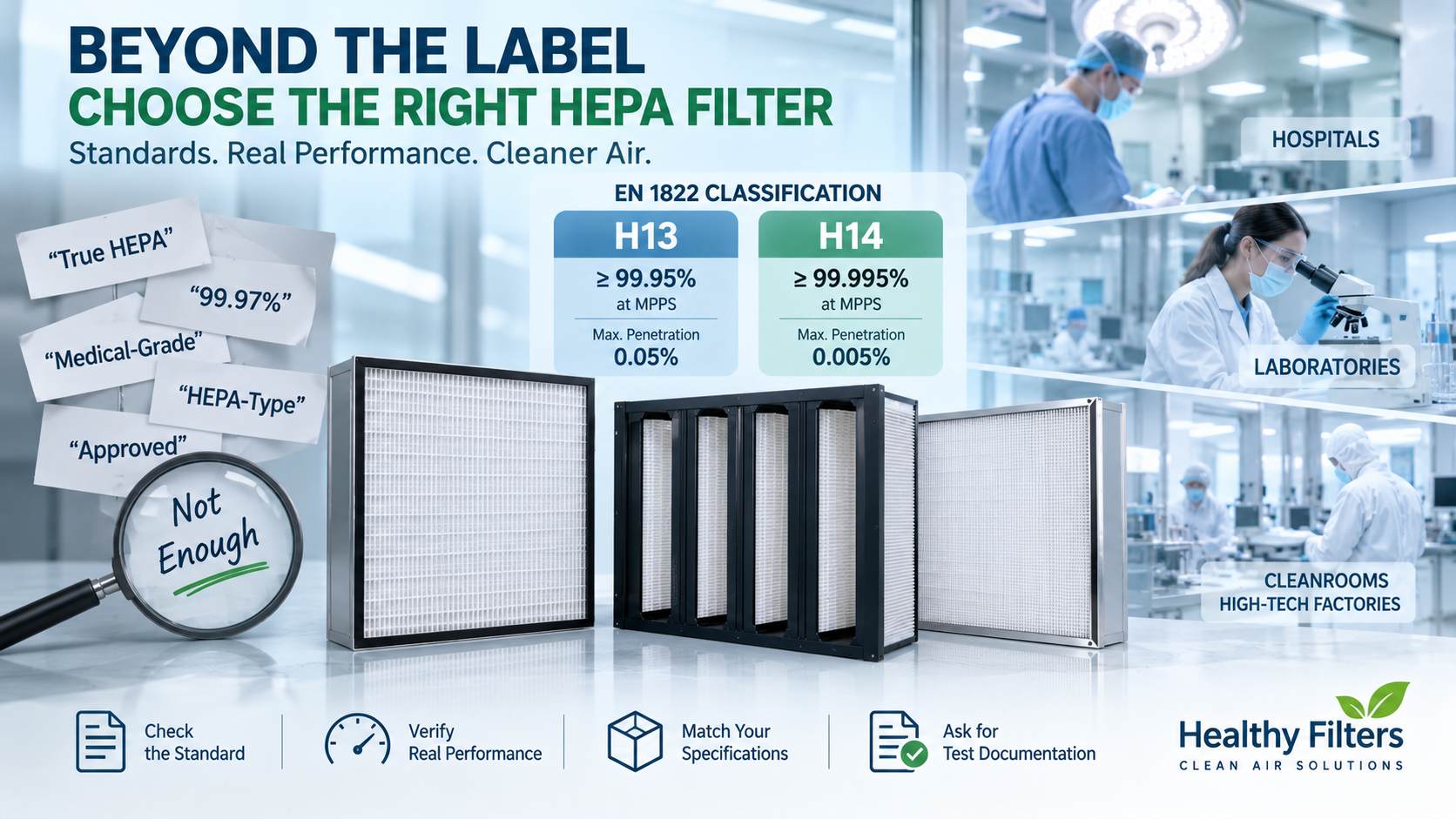
H13 and H14 Have Defined Performance
EN 1822 classifies high-efficiency filters using their performance at the Most Penetrating Particle Size (MPPS).
Under EN 1822:
| Class | Minimum Overall Efficiency at MPPS | Maximum Penetration |
| H13 | 99.95% | 0.05% |
| H14 | 99.995% | 0.005% |
That difference looks small on paper, but H14 allows one-tenth the penetration of H13.
ISO 29463 also provides a structured system for classification, performance testing and marking of high-efficiency filters. Its filter-element test method evaluates efficiency at MPPS.
So a label saying only “99.97% efficiency” leaves questions unanswered. At what particle size? At what airflow? Which test method?
“True HEPA” Is Not the Same as H13
Terms such as “True HEPA,” “HEPA-Type” and “HEPA-Like” are often used in product descriptions.
They should not be confused with a defined H13 or H14 classification.
The same applies to the word “approved.” Approved by whom? Was the media tested, or the complete filter? Is a test report available?
“Approved” is not a filter class.
For critical projects, documentation matters more than wording on a product page.
The Finished Filter Matters
Good filter media is only one part of a HEPA filter.
Pleat construction, frame, sealant and gasket all affect the finished product. Leakage around the media or frame can undermine the expected performance even when the media itself is highly efficient.
This is why critical applications may require finished-filter integrity or leakage testing rather than relying only on a media specification.
What Do Real HEPA Specifications Look Like?
Here is a compact example from Healthy Filters’ V-Bank range:
| Size (mm) | Rated Airflow | H13 Initial Resistance | H14 Initial Resistance |
| 287 × 592 × 292 | 1,200 m³/h | 250 Pa | 280 Pa |
| 592 × 592 × 292 | 2,700 m³/h | 250 Pa | 280 Pa |
| 305 × 610 × 292 | 1,400 m³/h | 250 Pa | 280 Pa |
| 610 × 610 × 292 | 3,000 m³/h | 250 Pa | 280 Pa |
These are Healthy Filters published product specifications, not universal HEPA values.
This is the kind of information an RFQ should contain. “Need H14 filter” is not enough.
A better request might read:
H14 / 610 × 610 × 292 mm / 3,000 m³/h / required initial pressure drop / frame type / gasket configuration / application / required test documentation.
Now the manufacturer has something useful to work with.
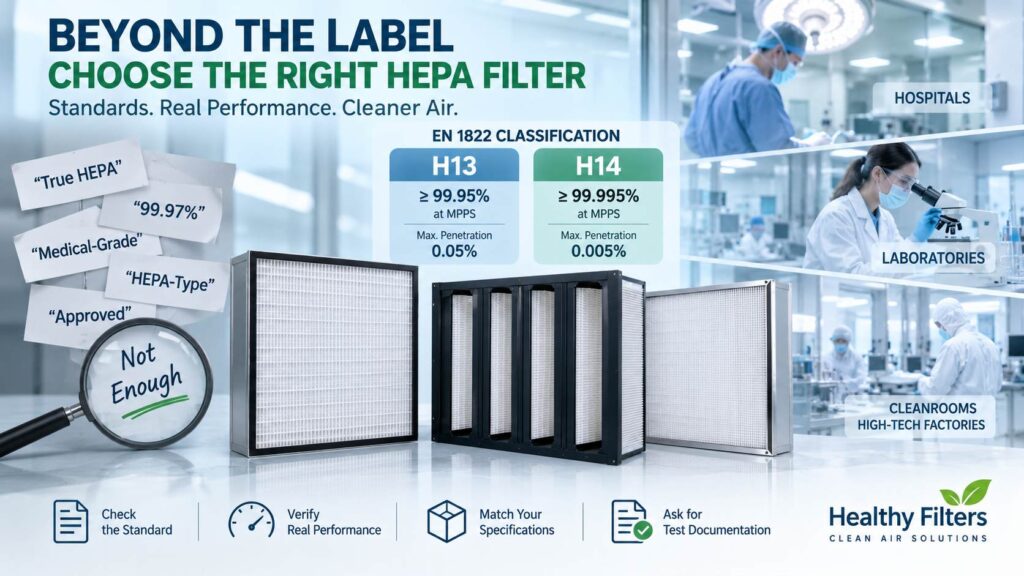
Where Healthy Filters Fits
Healthy Filters manufactures H13/H14 HEPA, mini-pleat, deep-pleat, V-Bank, gel-seal, PTFE and HEPA/ULPA filters for cleanroom, healthcare, laboratory and industrial HVAC applications.
For example, its customized mini-pleat range includes sizes from 484 × 484 × 50 mm at 500 m³/h to 1220 × 610 × 90 mm at 2,800 m³/h, with published initial pressure drop below 220 Pa for the listed models.
For OEM and project orders, dimensions, media, efficiency class, airflow, pressure drop, frame and sealing can be matched to the equipment requirement.
That is a more useful starting point than simply asking for the “best HEPA filter.”
Before You Buy
Don’t buy from the biggest percentage printed on the label.
Check the standard, filter class, airflow, pressure drop, dimensions, sealing and available test documentation. Then make sure those specifications suit the actual HVAC or cleanroom system.
Sourcing H13, H14 or customized HEPA filters? Contact Healthy Filters with your required class, dimensions, airflow, pressure drop and application for a matched filter configuration.
FAQ
Is True HEPA the same as H13?
Not necessarily. H13 is a defined filter classification; “True HEPA” by itself does not specify the same test standard.
Does 99.97% automatically mean HEPA?
No. Buyers should also ask about particle size, airflow, test method and whether the result applies to the media or finished filter.
What are EN 1822 and ISO 29463?
Both are recognized frameworks used for testing and classifying high-efficiency air filters, including performance around MPPS.
Can Healthy Filters make custom H13/H14 filters?
Yes. Dimensions, media, airflow, pressure drop, frame and sealing configurations can be customized for OEM and project requirements.