
Humanoid robots are moving out of demos and into real factories in 2026. At the same time, manufacturers are adding more machine vision, sensors, automated inspection and AI-powered production equipment.
Factories may be getting smarter. They haven’t stopped getting dusty.
Packaging, material handling, outdoor air and production itself can all put particles into the building. For a plant filled with cameras, electronics and precision equipment, keeping that dust under control is worth thinking about.
Automation Doesn’t Make Dust Disappear
A robotic production line can still sit next to forklifts, pallets, cardboard boxes and conventional manufacturing equipment.
Fibers and fine process particles can also end up in the air.
So ventilation still has a basic job to do: move air through the facility while keeping unwanted particles under control.
For many plants, that starts with ordinary HVAC filtration rather than something exotic.
Start With the Bigger Particles
A common filtration setup uses more than one stage.
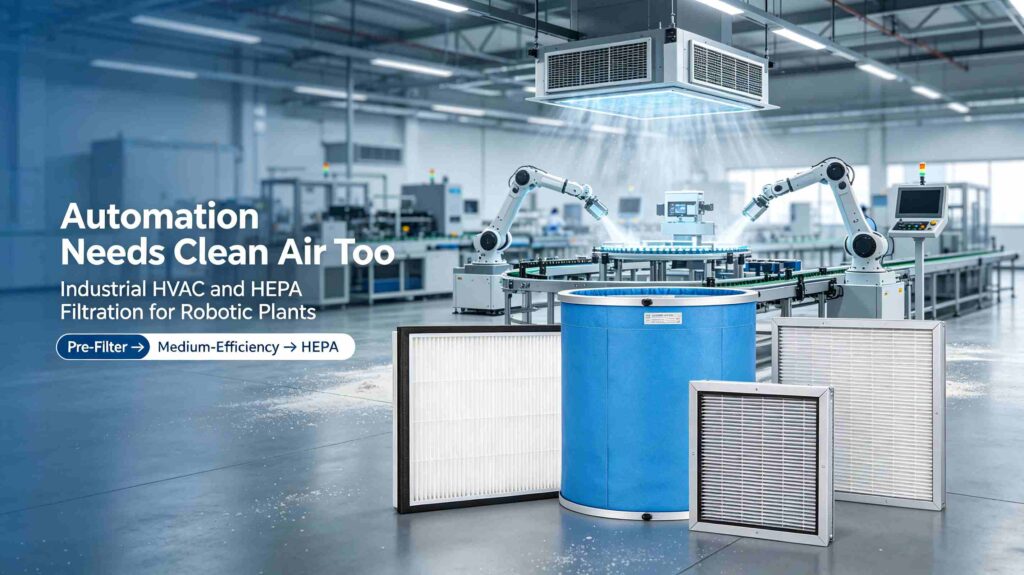
Pre-Filter → Medium-Efficiency Filter → HEPA, if the process needs it
Panel pre-filters catch larger dust first. Pocket or bag filters can handle the next stage, while V-bank filters are another option where more filter area is needed.
This keeps the finer downstream filters from taking the full dust load.
Healthy Filters produces panel, pocket, V-bank and HEPA filters for industrial HVAC applications.
Does a Robot Factory Need HEPA?
Not necessarily.
A general assembly line may not need HEPA filtration at all. A controlled area used for optics, precision electronics, sensors or sensitive components can be a different story.
HEPA—and in more specialized cases ULPA filtration—may make sense there.
The process should decide the filter level. Simply installing the highest-efficiency filter everywhere can add unnecessary airflow resistance.
Airflow Still Matters in a Smart Factory
Many automated plants run long shifts, sometimes around the clock.
Filters therefore need to be considered as part of the HVAC system, not just as particle-catching media.
Pressure drop, airflow, dust capacity and filter life all matter. A filter also needs to fit the equipment and maintenance schedule.
In practice, a good filter choice is usually a balance between cleanliness and airflow.
Robots Paint Things Too
Automation isn’t limited to assembly.
Robotic production can include spray painting, coating and surface finishing. These areas have their own filtration needs.
Incoming booth air may require suitable pre- and ceiling filtration, while paint overspray needs dedicated arrestor media.
Healthy Filters offers paint stop media, fiberglass paint arrestor filters and spray booth ceiling filters alongside its general industrial filter range.
When Standard Filters Don’t Fit
Smart factories often use specialized machines and purpose-built HVAC equipment. Standard filter dimensions won’t always match.
Healthy Filters provides OEM/ODM filters that can be adjusted for size, media, efficiency, airflow, pressure drop, frame material and operating conditions.
Its range includes pre-filters, pocket filters, V-bank filters, HEPA/ULPA filters, general ventilation filters and paint booth filtration products.
The factory of the future may have more robots on the floor, but the filtration question is still quite practical: what is in the air, and how clean does each area actually need to be?
Building the factory of the future? Contact Healthy Filters to discuss HVAC, HEPA, paint booth and customized industrial air filtration solutions for your smart manufacturing environment.
FAQ
Why is air filtration important in highly automated factories?
Automation doesn’t eliminate dust from outdoor air, packaging, materials and production. Filtration helps keep these airborne particles under control.
Do robotics factories require HEPA filters?
Not always. HEPA filters are more relevant to selected areas with sensitive electronics, optics or controlled assembly requirements.
What filters are used in automated factories?
Common choices include pre-filters, pocket filters, V-bank filters and general HVAC filters. HEPA or ULPA filters may be added where needed.
Can Healthy Filters make custom filters for robotic production lines?
Yes. Filters can be customized for dimensions, media, efficiency, airflow, pressure drop, frame construction and operating conditions.