
In commercial HVAC systems, filter choice affects more than indoor air quality. It changes HVAC airflow, fan load, maintenance timing, and the life of downstream filters. For filter makers and HVAC contractors, pocket filter media rolls offer a practical way to balance filtration efficiency with manageable resistance. They also give you more freedom to produce different pocket sizes from one material format.
A good starting point is matching the media to the actual duty instead of simply choosing the highest efficiency available. The broader range of air filter materials and filter elements also makes it easier to build filtration stages around different air-quality targets.
What Are Pocket Filter Media Rolls?
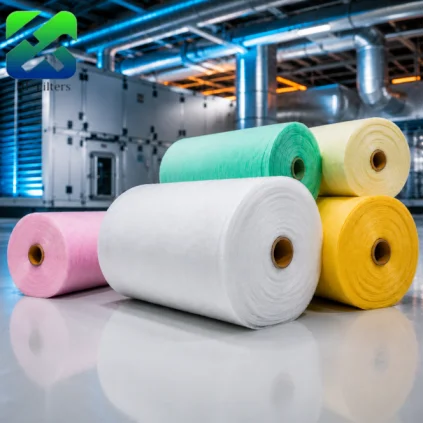
Pocket filter media is the semi-finished material used to make pocket or bag filters. Unlike a finished pocket filter, a bag filter media roll can be cut and fabricated to suit different dimensions, pocket counts, and HVAC designs. This makes HVAC filter media rolls especially useful for filter factories, converters, and OEM projects.
Pocket Media vs. Finished Pocket Filters
The pocket filter material determines much of the finished filter’s efficiency and resistance, but the finished filter also depends on pocket depth, filter area, seams, frame design, and airflow.
The available synthetic fiber pocket filter media uses synthetic nonwoven construction and is intended for pocket filter production.
Multi-Layer Synthetic Media
Typical synthetic fiber pocket filter media can use 2, 3, or 4 layers of PP fabric + melt-blown fabric + non-woven fabric. Coarser fibers collect larger dust, while finer layers capture smaller particles. This multi-layer filter media structure supports both high dust holding capacity and low resistance.
How Do Pocket Filter Media Rolls Improve HVAC Performance?
Good commercial HVAC filtration is a balancing act. You need enough particle capture to protect the space and downstream equipment, without creating needless resistance across the air-handling system.
Balancing Filtration Efficiency and Airflow
Low resistance filter media helps you maintain design airflow more easily. At the same time, low pressure drop filter media can reduce the extra static pressure the fan must overcome.
There is a catch, though. Higher filtration efficiency normally brings higher resistance. So simply moving from F7 to F9 is not always the right move.
Extending Filter Service Life
Pocket filters provide a large working area, which supports high dust holding capacity and longer filter service life. Medium-efficiency filters are commonly used to capture roughly 1 to 5 μm suspended particles and to protect more expensive high-efficiency filters further downstream. That can also help control HVAC maintenance costs.
Which M5 to F9 Media Grade Fits Your System?
The right grade depends on your particle target, allowable resistance, and downstream filtration. These pocket filter media specifications show why grade selection matters.
| Media | Resistance | 0.3 μm Efficiency | Weight | Thickness |
| M5 | ≤6 Pa | ≥45% | 130±3 g/m² | 5±1 mm |
| M6 | ≤9 Pa | ≥65% | 138±3 g/m² | 5.5±1 mm |
| F7 | ≤18 Pa | ≥85% | 168±3 g/m² | 6±1 mm |
| F8 | ≤20 Pa | ≥95% | 198±3 g/m² | 6.5±1 mm |
| F9 | ≤25 Pa | ≥98% | 204±3 g/m² | 6.5±1 mm |
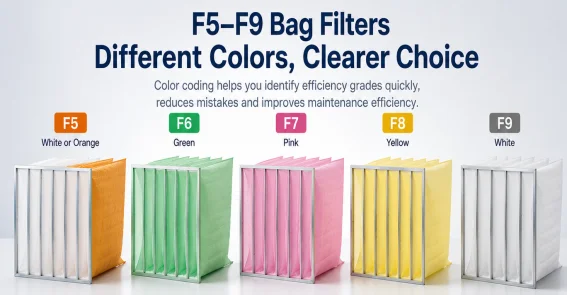
F7 pocket filter media provides a useful efficiency and resistance balance. F8 pocket filter media raises particle capture, while F9 pocket filter media is suited to systems that need a higher-efficiency intermediate stage.
Why Does Pocket Filter Pressure Drop Matter?
Raw media resistance and finished pocket filter pressure drop are not the same measurement. Pocket geometry and actual airflow change the finished result.
For a 595 × 595 × 600 mm, eight-pocket filter, F7 pressure drop is 45 Pa at 2,300 m³/h, 80 Pa at 3,500 m³/h, and 110 Pa at 4,500 m³/h. Comparable F8 values rise to 65, 105, and 150 Pa. F9 reaches 70, 120, and 165 Pa.
That real-world spread is why an F7 vs F8 pocket filter or F8 vs F9 pocket filter decision should include actual operating airflow, not efficiency alone.
Where Do Pocket Filters Sit in a Multi-Stage Filtration System?
A multi-stage filtration system spreads the filtration job across several filters instead of asking one stage to do everything. This approach can improve service life and protect costly final filters.
A common clean-air configuration uses a panel pre-filter, followed by an F7 or F8 pocket stage, then F9 and a higher-efficiency final filter. Pocket filters are therefore often part of HVAC pre-filtration and medium-efficiency filtration rather than an isolated component.
Finished general ventilation bag filters are used across central air conditioning and ventilation systems, including hospitals, electronics production, pharmaceutical spaces, and food processing facilities.
How Should You Choose Pocket Filter Media Rolls?
Start with the air-quality target, then check allowable pressure drop and required airflow. Next, compare media grade, weight, thickness, pocket depth, and total filter area.
If you manufacture filters, custom pocket filter media can also help you match unusual pocket dimensions or OEM specifications. In other words, choosing pocket filter media rolls by price alone can save a little at purchase and cost rather more once the AHU starts running.
What Should You Expect from a Capable Filter Media Supplier?
Once the filtration target is clear, production consistency becomes just as important as the specification sheet. Small changes in cutting, layer bonding, pocket formation, or seams can affect the finished filter.
Healthy Filters combines filter-media production with downstream capabilities such as slitting, media cutting, ultrasonic welding, pocket assembly, and quality testing. Its manufacturing setup also includes automated filter-production equipment, a CADR testing center, and a standardized cleanroom.
For OEM work, this matters because custom filter media rolls and finished pockets can be evaluated as parts of the same production chain. The supplier also supports pocket filter media for filter manufacturers, which can simplify projects where dimensions or layer structures need adjustment.
FAQ
Q1: What are pocket filter media rolls?
A: They are roll-form filtration materials cut and assembled into pocket or bag filters for ventilation and HVAC systems.
Q2: What is the difference between F7 filter media and F8 filter media?
A: F8 offers higher particle efficiency, while F7 usually provides lower resistance. Your airflow and final filtration target should guide the choice.
Q3: When should you use F9 filter media?
A: F9 is useful when you need stronger intermediate particle capture or better high-efficiency filter protection.
Q4: Can pocket filter media be customized?
A: Yes. OEM pocket filter media can be adjusted for layer construction, dimensions, and production requirements.
Q5: How does filter pressure drop affect HVAC airflow?
A: Higher resistance makes it harder for the fan to maintain target airflow. Checking operating pressure drop helps you choose media that meets both filtration and airflow needs.