
Take the metal filter out of a busy kitchen hood and the first problem is obvious: grease.
Wash it, put it back, and the kitchen may still smell.
That’s because cooking exhaust isn’t just grease. Frying, grilling and wok cooking can produce oil aerosols, smoke, fine particles and gas-phase odors. They don’t all respond to the same filter.
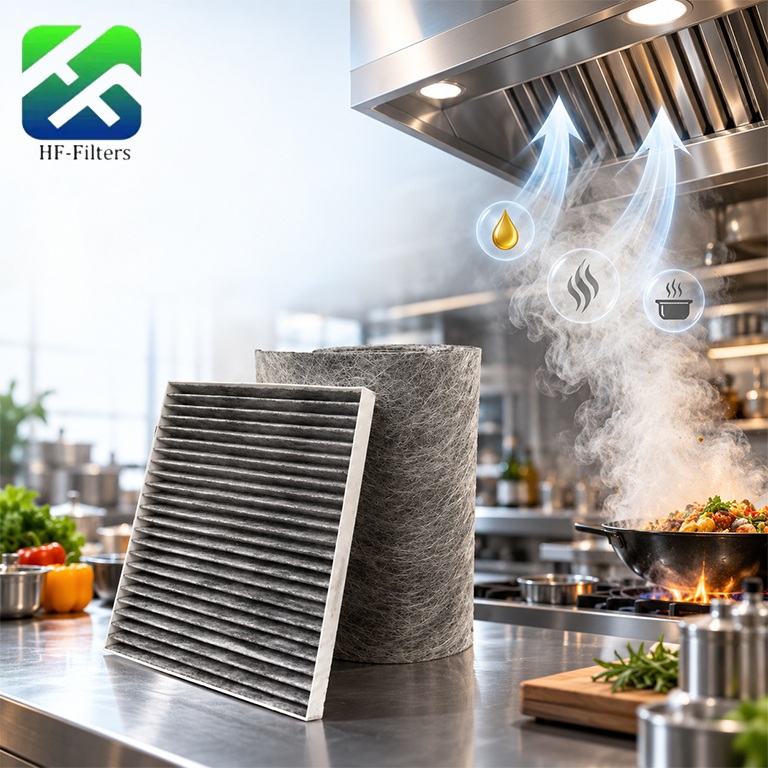
The Metal Filter Has One Main Job
Aluminum mesh and stainless-steel hood filters are mainly used for grease capture.
They’re washable, reusable and well suited to the front stage of a range hood. But a clean grease filter doesn’t necessarily solve cooking odors.
For that, manufacturers often look at carbon-based media.
Activated Carbon or Carbon Cloth?
There is more than one way to put activated carbon into a hood filter.
Activated carbon filters can use granular, bonded or other carbon configurations. Where the design allows more carbon to be used, they can provide a larger adsorption bed for odor treatment.
Activated carbon cloth or carbon composite media takes a different approach. Carbon material is combined with a fabric or filter-media structure, creating a relatively thin layer that can be cut, pleated or combined with other media.
That can be useful inside compact range hoods where there simply isn’t much room for a deep carbon filter.
A typical recirculating hood, for example, might use:
Metal Grease Filter → Particle/Carbon Cloth Layer → Return Air
A larger commercial system may have enough room for:
Grease Filter → Particle Filter → Deeper Activated Carbon Stage
Neither arrangement is automatically better. Available space, airflow and the amount of odor treatment required make the difference.
A Quick Filter Comparison
| Filter / Media | Main Job | Typical Hood Use |
| Aluminum Mesh | Grease capture | Residential / commercial hood |
| Stainless Steel | Grease capture | Heavy-duty, washable applications |
| Carbon Cloth | Odor adsorption + compact design | Thin replacement / recirculating filters |
| Carbon Composite Media | Particle + odor functions depending on construction | Multi-layer hood filters |
| Activated Carbon Filter | Gas-phase odor adsorption | Dedicated downstream carbon stage |
Carbon performance still depends on carbon loading, airflow, contact time, temperature and humidity. A filter shouldn’t be judged simply because the words “activated carbon” appear on it.
Grease Should Still Come First
Carbon cloth doesn’t replace the metal grease filter.
Heavy oil reaching carbon media can foul it and shorten its useful life. For that reason, grease separation normally comes first.
This also explains why many range hood replacement filters are built as multi-layer products rather than one thick piece of media.
For OEM buyers, the available depth is often the deciding factor.
| Parameter | Example RFQ Information |
| Size | W × H × D |
| Metal Stage | Aluminum / Stainless Steel |
| Carbon Media | Carbon Cloth / Composite / Carbon Filter |
| Main Requirement | Grease / Odor / Both |
| Airflow | Required m³/h |
| Available Depth | Hood-specific |
| Construction | Single / Multi-Layer |
| Replacement | Washable / Disposable |
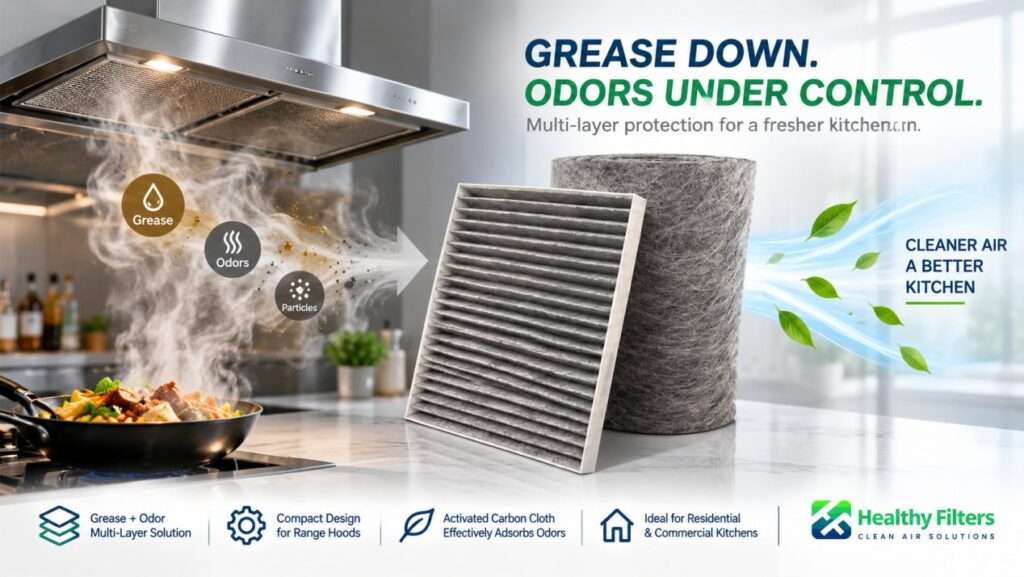
Where Healthy Filters Fits
Healthy Filters can supply the different pieces rather than forcing one filter construction into every hood.
The range includes aluminum mesh filters, stainless-steel grease filters, activated carbon filters, activated carbon cloth/composite media and customized multi-layer range hood filters.
For a compact residential hood, that may mean combining a grease stage with a thin carbon-cloth layer. For a larger ventilation unit, a separate carbon stage may make more sense.
OEM development can start from the customer’s drawing, W × H × D, airflow, available installation depth and target contaminants. From there, Healthy Filters can adjust the metal frame, filter layers, carbon media and overall construction to suit the hood design.
That’s much more specific than asking for a generic “range hood filter.”
Developing a range hood or replacement filter? Send Healthy Filters your dimensions, airflow, filter structure and grease/odor requirements to discuss an OEM configuration.
FAQ
Can activated carbon cloth be used in a range hood?
Yes. Carbon cloth or carbon composite media can be used in compact odor-control and replacement filter designs, particularly where installation depth is limited.
Is carbon cloth the same as a metal grease filter?
No. The metal stage mainly handles grease, while the carbon layer is intended for certain gas-phase odors.
Should carbon media be placed before the grease filter?
Generally, grease should be controlled first. This helps keep heavy oil from loading the downstream carbon media.
Can Healthy Filters combine grease and carbon media in one filter?
Customized multi-layer filters can be developed around the hood dimensions, media structure, airflow and application requirements.