
Smoke from grass fires in Mongolia and Central Asia travels far. It crosses borders easily. This brings PM2.5, soot, and bad gases into public buildings. They come in through outside air vents. Wildfire smoke filtration for commercial buildings uses a rough pre-filter.
It also uses a rated fine-particle stage and chemical media if needed. This multi-stage HVAC filtration helps clear smoke. It keeps indoor air safe and clean for public spaces.
What Must Wildfire Smoke Filtration for Commercial Buildings Address?
Smoke brings tiny dust and gases. Particle filters trap the solid pieces. Sorbent media catches certain gases. Buildings still need their normal fresh air limits. Wildfire smoke guides say to filter indoor air. You should also check your HVAC system during smoke days.
Fine Particles and Gas-Phase Pollutants
PM2.5 and dark soot get inside. They enter through outside vents, open doors, and wall cracks. Activated carbon traps specific gases and smells. It can catch some volatile organic compounds. The trapping power relies on the exact gas. It also depends on the carbon weight, contact time, and air wetness.
How Should a Multi-Stage HVAC Filter Train Work?
A multi-stage HVAC filtration plan gives each filter a clear job. Fan power, rack space, and easy access set the rules. These limits guide commercial HVAC smoke filtration.
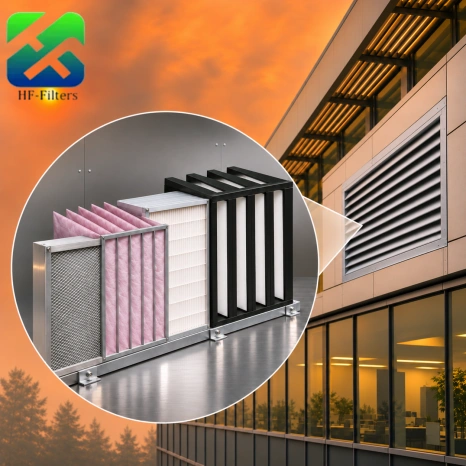
Washable Pre-Filters for Coarse Dust
A washable pre-filter uses metal or nylon mesh. It catches big dust pieces. This keeps the next filters clean. Workers must wash and dry it well between uses. Fine smoke still needs a rated particle stage right after this screen.
Synthetic Pocket Filters for Intermediate Filtration
A synthetic pocket filter spreads dirt over a big space. Put it right before the final stage in big air systems. One eight-pocket F7 model is exactly 595 × 595 × 600 mm. It has 45 Pa resistance at 2,300 m³/h and 110 Pa at 4,500 m³/h. This big change shows why air speed matters. You must list airflow next to every pressure drop number.
MERV 13, MERV 14, H13, or H14 at the Final Stage?
A MERV 13 filter or MERV 14 filter might fit your main HVAC. The fan and rack just need to handle the extra push. An H13 HEPA filter or H14 HEPA filter needs a special HEPA box and a strong fan. MERV and H classes use different testing rules. Look at the filter test guide first. Then, ask for the test standard, rated airflow, score, and pressure drop facts.
Activated Carbon V-Bank Filters for Selected Gases
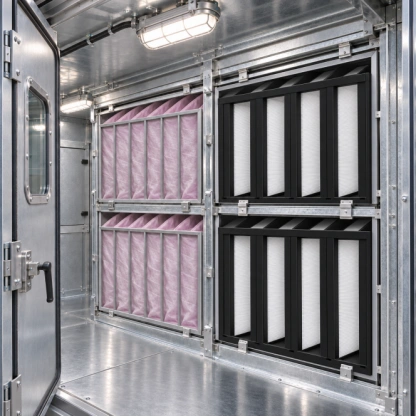
An activated carbon V-bank filter gives you a large trapping space. It fits in a small spot. Many air boxes put it behind the dust filters. This keeps the carbon clean. Name your target gases, carbon weight, bed depth, airflow, and change times. Thin carbon sheets fill up too fast during long smoke days.
How Should You Match Filtration to the Building?
Schools, clinics, offices, and factories are all different. They hold different crowds and sensitive machines. They need different fresh air levels and have different work spaces. You must match your filter line to the air speed and running hours.
Schools, Clinics, and Offices
Talk to your air engineer during a smoke event. Check the outside air knobs and mixed air settings. Keep your required safe air limits active. Also, look closely at full rooms and fresh air intakes.
Data Centers and Dusty Industrial Sites
A rough prefilter guards the bag and final parts at dirty sites. One G3 panel is exactly 595 × 595 × 21 mm. It handles 3,200 m³/h, 30 Pa initial resistance, and 250 Pa final resistance. These exact numbers match this one model. Always pick parts based on your fan power, rack size, dust load, and smoke rating.
What Should Facilities Teams Check During a Smoke Episode?
Tie your daily checks to a set airflow:
Read local air news and check indoor PM2.5 numbers.
Look at filter edges and frames for air leaks.
Write down each stage’s pressure drop. Match it with the maker’s change limit.
Keep extra filters ready for long smoke days.
Look at outside air knobs to meet safety rules.
For wildfire smoke filtration for commercial buildings, match each part to your air speed. Check the rated pressure drop. Watch the indoor PM2.5 numbers. Send your filter schedule or sizes when you ask for a price quote.
A Practical Supply Route for Smoke-Season Filtration
Healthy Filters sells washable panels, synthetic pocket filters, carbon pocket media, and HEPA or V-bank setups. These fit set airflows, rack sizes, and pressure limits well. Their product list includes custom sizes and many stages. Share your current filter drawing, air speed, target class, and change limit. This helps match the paper and frame to your air box perfectly.
FAQ
Q1: Is a MERV 13 filter enough for wildfire smoke?
A: It can drop fine dust levels if it fits right. The system must keep up the air speed. Check its test score, rack seal, and pressure drop. Use chemical parts for bad gases.
Q2: Is MERV 14 the same as H14?
A: No. The two classes use different testing rules. Ask for the testing standard, rated airflow, and score sheet. Get leak test facts before you compare them.
Q3: Does a HEPA filter remove smoke odors and VOCs?
A: HEPA traps flying dust. Activated carbon catches specific gases and smells. You must match the carbon weight and contact time to your target gases.
Q4: Should you keep a washable pre-filter during a smoke event?
A: Yes, if it fits your plan and workers can wash it. It grabs big dirt pieces. Just keep a good fine-particle stage right behind it.
Q5: What information should you send for a smoke-filtration quote?
A: Share sizes, air speed, fan power, and your current filters. Name your target score, test rule, target gases, and change times. A simple drawing helps prove the fit.