
A few months ago, an office-equipment customer sent us two used filters for inspection.
One filter had dark dust marks across the whole surface. The other was clean in the center but dirty around the frame.
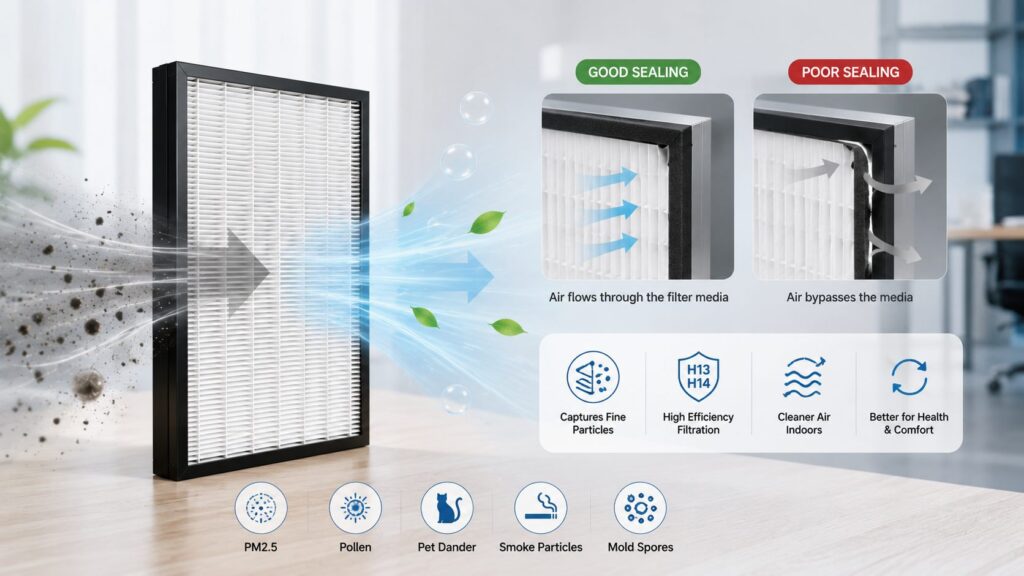
That second filter had a sealing problem. Part of the air was moving around the media instead of through it.
The filter label said H13, but the label was not the issue. The installation was.
This is why HEPA filters matter for indoor air quality, and also why filter grade alone never tells the full story.
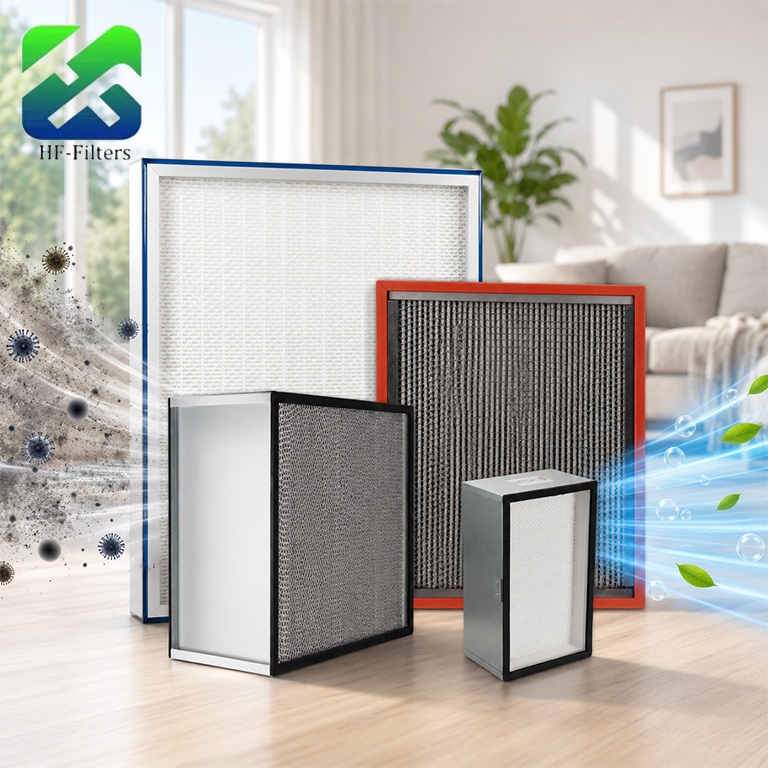
What a HEPA filter changes indoors
Fine dust does not always fall to the floor quickly.
PM2.5, pollen, smoke particles, pet dander, and some mold spores can remain in the air and circulate through a room many times.
A correctly installed HEPA filter catches a large share of these particles before the air returns to the occupied space.
That is useful in homes, offices, clinics, schools, and rooms with sensitive equipment.
It will not remove cooking smells or most gases. Those usually need an activated carbon filter.
H13 and H14 are not interchangeable
We often receive requests that simply say, “Please change it to H14.”
Sometimes that works. Sometimes it creates another problem.
H14 media normally has higher filtration efficiency, but the pressure drop can also be higher. If the fan is too small, airflow falls and the purifier becomes noisy or weak.
During one OEM air purifier project, we kept the H13 grade but increased the pleated media area. The airflow improved, while particle performance still met the customer’s target.
Healthy Filters usually checks the fan curve, filter depth, rated airflow, and initial resistance before confirming H13 or H14.
Where HEPA filters are most useful
Homes and offices
A HEPA filter can reduce airborne pollen, fine dust, pet dander, and smoke particles.
For allergy-sensitive users, that may make the room easier to manage, although the filter cannot remove allergens already settled in carpets, bedding, or furniture.
Commercial ventilation
In larger HVAC systems, the HEPA section should not carry the full dust load.
A primary filter and medium-efficiency filter are normally installed ahead of it. Without those stages, the HEPA filter clogs too quickly.
OEM and special equipment
Air purifiers, medical units, laboratory devices, clean cabinets, and 3D printers often need a non-standard filter shape.
Shenzhen Healthy Filters Co., Ltd. makes H13/H14 HEPA filters, HVAC filters, bag filters, activated carbon filters, industrial dust filters, and custom replacement filters from customer drawings.
What matters besides efficiency
A qualified media sheet can still perform poorly inside a badly made frame.
We normally look at:
- Initial pressure drop
- Pleat spacing
- Media area
- Frame rigidity
- Gasket fit
- Edge sealing
- Actual airflow
Healthy Filters uses low-resistance media structures, ultrasonic hot-melt sealing where suitable, and PAO leak testing for applicable high-efficiency filters.
That last step matters. A small leak can reduce real performance even when the filter media itself is correct.
When should a HEPA filter be replaced?
For home purifiers, 6–12 months is common, but it is only a rough range.
Homes with pets, smoke, renovation dust, or long daily operating hours may need earlier replacement.
For commercial systems, pressure drop is a better guide. Weak airflow, visible bypass dust, damaged gaskets, or a bent frame are also clear warning signs.
A disposable HEPA filter should not be washed unless it was specifically designed for that purpose.
FAQ
Can a HEPA filter remove PM2.5?
Yes. A properly designed and sealed HEPA filter can capture fine airborne particles, including PM2.5.
Does a HEPA filter remove odors?
No. Odors and many VOCs usually require activated carbon media.
Is H14 always better than H13?
Not always. H14 offers higher efficiency, but the fan must be able to handle the added resistance.
Can HEPA filters help with allergies?
They can reduce airborne pollen, pet dander, mold spores, and fine dust.
Why does sealing matter?
Air follows the easiest path. If the frame leaks, some air may bypass the filter media completely.
Can Healthy Filters make custom HEPA filters?
Yes. Healthy Filters can customize the dimensions, frame, gasket, H13/H14 media, pleat structure, logo, and packaging.
Send us the filter details
For a new project, send the filter drawing, airflow, target grade, installation space, and pressure-drop limit.
The team at Shenzhen Healthy Filters Co., Ltd. can review the structure and provide a quotation or sample plan within 72 hours.