
A buyer once asked us why two H13 HEPA filters with the same outside size had different airflow data.
The answer was not only the media grade. It was the filter material area inside.
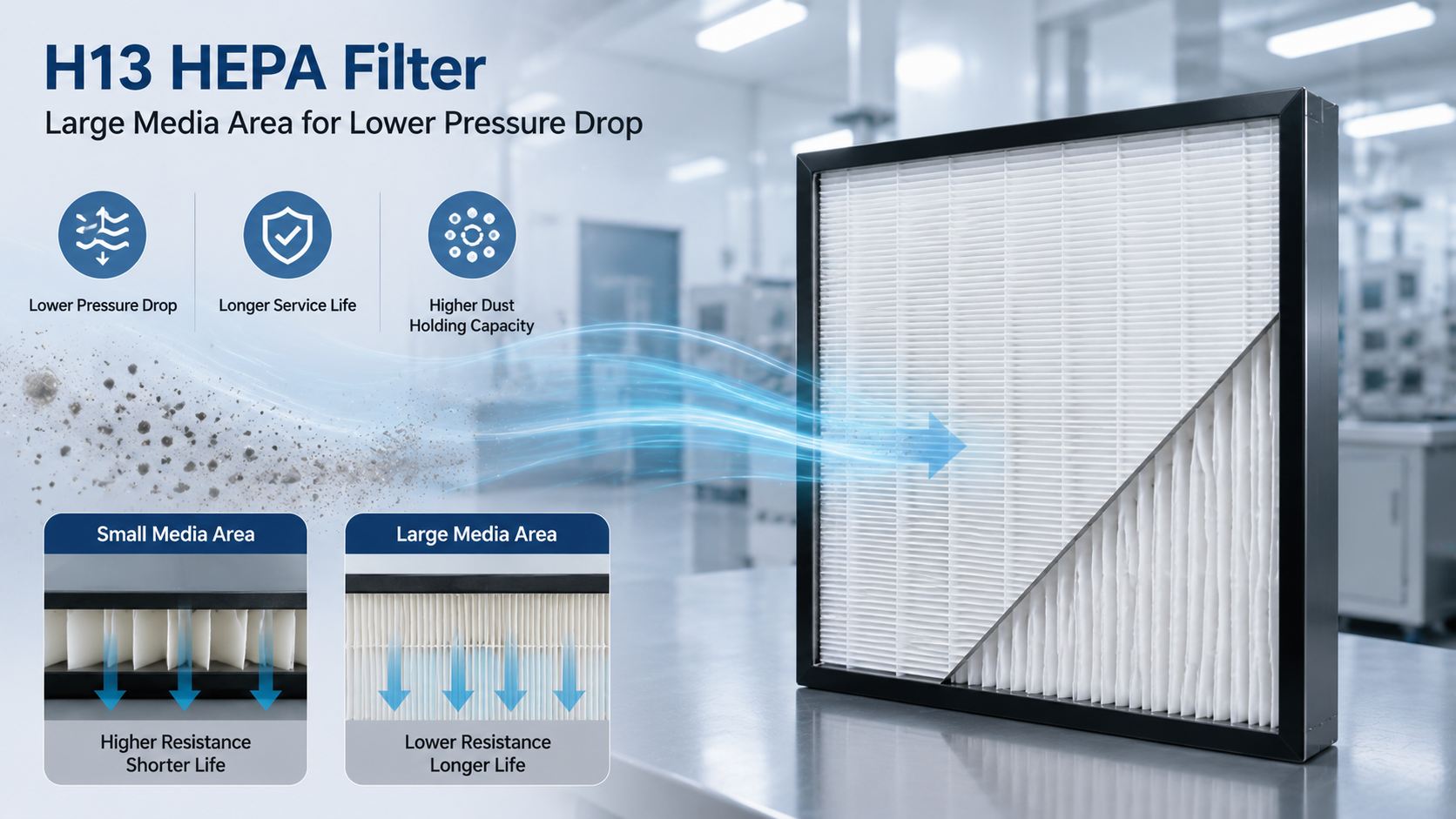
For a HEPA filter, larger media area usually means lower initial pressure drop, better dust holding capacity, and more stable airflow. This matters a lot in air purifiers, HVAC air filter systems, cleanroom support units, and some industrial air filter projects.
Why HEPA filters need enough media area
HEPA media removes fine particles through interception, diffusion, and inertial capture.
For H13 and H14 grades, the filter must keep high efficiency while still allowing air to pass through. If the media area is too small, air is forced through too quickly.
That creates three common problems:
- Higher initial resistance
- Faster clogging
- Lower real airflow
This is why pleat depth, pleat spacing, media width, and frame design all matter.
What large-area design improves
Lower pressure drop
When the same airflow passes through more filter material, the air velocity on each part of the media becomes lower.
This helps reduce initial pressure drop. For air purifier OEM brands, it can protect CADR. For HVAC contractors, it can reduce fan load and energy use.
Longer service life
A larger media area can hold more dust before resistance rises too much.
In factory testing, we often see compact HEPA filters fail early not because the media is bad, but because the pleat area is too limited.
Better dust holding capacity means fewer replacements and more stable maintenance cost.
More stable filtration performance
If airflow is too concentrated, some areas load dust faster than others.
A good large-area HEPA filter design spreads airflow more evenly. This helps the filter maintain efficiency and pressure drop balance during use.
Different application needs
Home air purifiers
For home purifiers, space is limited. The challenge is getting enough HEPA media into a small filter without blocking airflow.
Healthy Filters often uses deeper pleats, proper glue spacing, and low-resistance H13 media for custom replacement air filter projects.
Commercial HVAC systems
In HVAC air filter projects, the system must balance MERV rating, airflow, pressure drop, and service life.
A large-area filter structure is useful when the buyer wants higher efficiency without sharply increasing resistance.
Medical and clean air equipment
For H14 medical filter applications, sealing and leak control are critical.
Healthy Filters uses ultrasonic hot-melt sealing, stable pleat spacing, low-resistance media design, and PAO leak testing for suitable high-efficiency filter products.
Industrial filtration
Industrial workshops may have dust, fibers, smoke, or mixed particles.
A HEPA filter should usually not work alone. A primary filter or medium filter should be placed before it to protect the HEPA section.
Healthy Filters produces primary filters, medium bag filters, H13/H14 HEPA filters, activated carbon filter products, industrial dust removal filter elements, and 3D printer filter media for different systems.
Buying mistakes to avoid
Do not compare only the outside filter size.
Two filters may look the same, but the internal media area can be very different.
Do not choose only by HEPA grade either. H13 and H14 tell you efficiency level, not airflow performance or service life.
Ask your supplier for:
- Media area
- Initial pressure drop
- Rated airflow
- Dust holding capacity
- Pleat depth
- Sealing method
- Test condition
At Healthy Filters, we usually check drawings, airflow, fan power, installation space, and target efficiency before giving a recommendation. This avoids a common problem: high-efficiency filter, but poor airflow after installation.
Maintenance and replacement advice
A large-area HEPA filter usually lasts longer, but it still needs proper protection.
If the pre-filter is missing or clogged, dust reaches the HEPA filter too fast. Then pressure drop rises early.
For home purifiers, replacement is often 6–12 months, depending on use. For HVAC and industrial systems, replacement should be based on pressure drop, working hours, dust level, and airflow change.
If the airflow drops while the fan is normal, the HEPA filter may already be loaded.
FAQ
Why does larger HEPA media area reduce pressure drop?
Because the same airflow is spread across more filter material. The face velocity becomes lower, so air passes through with less resistance.
Does larger media area mean better filtration efficiency?
Not directly. Efficiency depends on media grade, such as H13 or H14. Larger media area mainly improves airflow, pressure drop, and service life.
Is H14 always better than H13?
Not always. H14 has higher efficiency, but may also create higher resistance. The right choice depends on airflow, space, fan power, and application.
Why do two HEPA filters of the same size perform differently?
They may have different pleat depth, pleat count, media area, glue spacing, frame structure, or media resistance.
How long does an industrial HEPA filter last?
It depends on dust load, pre-filtration, airflow, pressure drop limit, and working hours. In dusty systems, pre-filter maintenance is very important.
Can Healthy Filters customize large-area HEPA filters?
Yes. Healthy Filters can customize size, pleat depth, media grade, frame, sealant, gasket, logo, and packaging for OEM brands, HVAC projects, and industrial buyers.
Need a HEPA filter structure review?
Send your drawing, filter size, airflow, pressure drop limit, and target grade to Healthy Filters.
Healthy Filters can review your application and provide a practical custom HEPA air filter solution, sample plan, or OEM quotation within 72 hours.