
Last spring, two customers contacted us within the same week.
One wanted to replace a MERV 8 filter with the highest-efficiency filter available. The other wanted the cheapest panel filter he could find.
Neither choice was right.
The first system didn’t have enough fan capacity for a high-resistance filter. The second was installed in a woodworking shop where the filter loaded with dust in less than three weeks.
Choosing an air filter is rarely about buying the “best” filter. It’s about buying the right one.
Start with the application, not the filter grade
One question our engineers ask before quoting anything is simple:
“Where will the filter be used?”
A home air purifier, an office AHU, a hospital, and a furniture factory all move air differently.
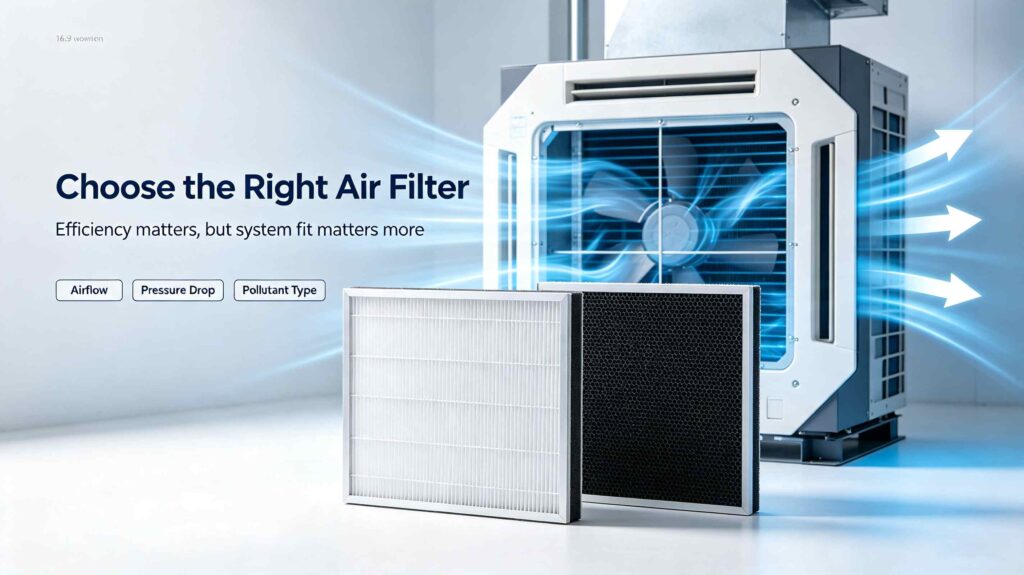
For residential and commercial air filter selection, we normally collect four pieces of information first:
- Airflow (CFM or m³/h)
- Filter size
- Dust or pollutant type
- Pressure-drop limit
Those answers usually tell us far more than the requested MERV rating.
Higher efficiency isn’t always better
Many buyers believe a higher MERV rating automatically means cleaner air.
Sometimes it does.
Sometimes it only means the fan has to work harder.
A higher-efficiency filter usually creates higher initial resistance. If the HVAC system wasn’t designed for it, airflow may drop and energy use may increase.
That’s why air filter efficiency selection criteria should always include airflow and pressure drop—not just filtration efficiency.
Different jobs need different filters
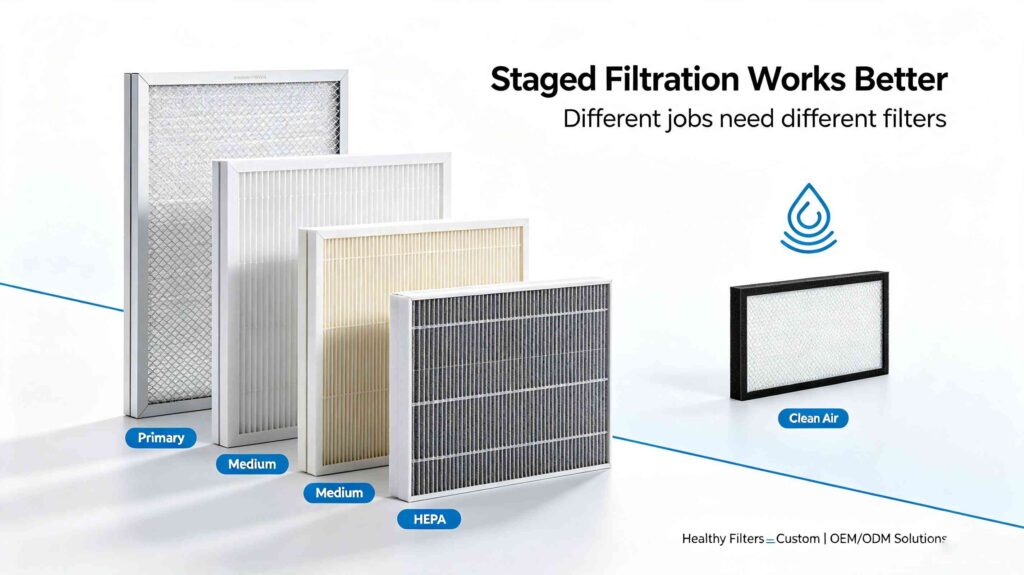
For most office buildings, schools, and shopping centers, a staged filtration system works best.
A primary filter captures larger dust first.
A medium-efficiency filter removes finer particles.
If very clean air is required, an H13 or H14 HEPA filter becomes the final stage.
Odors are different.
If cooking smells, smoke, or VOCs are the concern, an activated carbon filter is usually added because HEPA media is designed for particles, not gases.
Healthy Filters manufactures all of these filter types, so our engineers normally recommend a combination instead of pushing a single product.
Common mistakes we see
One mistake appears again and again.
Customers compare only price.
A lower-priced filter may contain less media area, weaker frames, or lower dust-holding capacity. It looks economical until replacement intervals become much shorter.
Another common mistake is ignoring installation.
During one OEM project, the filter itself passed every inspection, but air leaked around the frame because the housing was slightly bent.
The customer changed filter suppliers twice before discovering the real issue.
When custom filters make more sense
Standard sizes work for many HVAC systems.
Older AHUs, imported equipment, air purifiers, and industrial machines often don’t.
Shenzhen Healthy Filters Co., Ltd. regularly receives drawings instead of part numbers.
Some customers need a deeper pleat. Others need lower pressure drop, different gasket material, or a modified activated carbon layer.
Changing the filter structure is often more effective than simply changing the efficiency grade.
With a 10,000㎡ production facility, automated production lines, and more than 500,000 filter elements produced each month, Healthy Filters supports OEM and ODM projects without requiring large minimum orders.
Before placing an order
If you’re comparing suppliers, don’t stop at the efficiency rating.
Ask for:
- Initial pressure drop
- Dust-holding capacity
- Recommended airflow
- Frame material
- Test standard
- Expected service life
Those numbers usually tell you more about long-term operating cost than the purchase price alone.
FAQ
How do I choose an air filter?
Start with the application, airflow, dust type, and available installation space before looking at MERV or HEPA grades.
Is a higher MERV filter always better?
No. Higher MERV filters usually create more resistance. The HVAC system must be able to handle it.
Should I choose HEPA or activated carbon?
HEPA filters remove particles. Activated carbon filters reduce odors and many VOCs. Many systems use both.
When is a custom air filter necessary?
Custom filters are common for older HVAC units, OEM equipment, industrial machinery, and non-standard filter housings.
What is the biggest mistake when buying air filters?
Choosing only by price or efficiency rating without checking airflow, pressure drop, and actual operating conditions.
Can Healthy Filters produce custom filters?
Yes. Healthy Filters customizes dimensions, filter media, frames, gaskets, carbon formulas, logos, and packaging. Most custom quotations are prepared within 72 hours after receiving drawings or specifications.
Need help selecting the right filter?
If you already have a drawing, filter size, or airflow requirement, send it to Healthy Filters.
The engineering team at Shenzhen Healthy Filters Co., Ltd. will review your application and recommend a practical solution instead of simply suggesting the highest filter grade.