
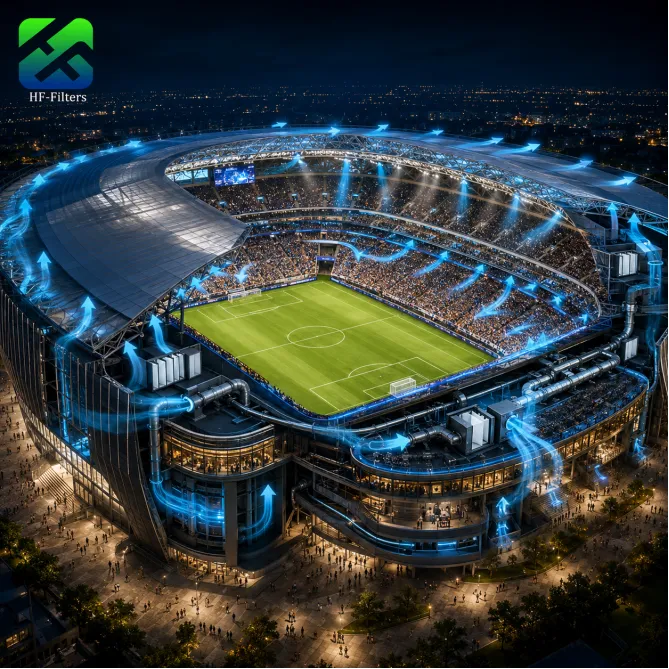
In 2026, the FIFA World Cup will happen in North America. Billions of fans will watch the games. They will look at every pass, tackle, and shot. But something else works hard in the background. Huge HVAC systems run all the time. They cool the air and clean it for tens of thousands of people every minute. Back in the 2022 Qatar World Cup, the host country tried something totally new. They put a special spot-cooling system in their stadiums.
This solar-powered setup took air from outside. It cooled the air down. Then, it pushed the air through vents under seats and next to the field. This made a nice 20°C “cold bubble”. Still, a roof, some shade, or a cooling setup cannot clean the air all alone. When a place is packed with people, filters are just as important as the lights or water pipes.
The 60,000-Seat Air Quality Challenge
What really happens to the air inside a 60,000-seat stadium during one match? A big stadium packs in tens of thousands of people at the same time. This huge crowd brings a lot of body heat. They also bring moisture, CO2, and tons of dust.
- Every single person breathes out about 0.3 m³ of air each minute. This air adds CO2, moisture, and floating dust into the space without stopping.
- Tiny flakes of skin, bits of cloth from clothes, and chemical smells (VOCs) from makeup float into the air all the time.
- Smells from food stands and strong cleaners (VOCs) move quickly through the return air ducts.
- Dirt from outside and PM2.5 rush in through the gates. This happens every time a big wave of fans walks inside.
Because of all these things adding up, the air gets dirty fast. Air that was fresh at the start can get 3 to 5 times worse in just 30 minutes. Changing the air just once is not enough. To fix this, the building needs filters that work in stages. These filters must run nonstop to move huge amounts of air. And they have to do it without blowing cold wind right on the fans.
Multi-Stage Filtration: The Three-Layer Defense
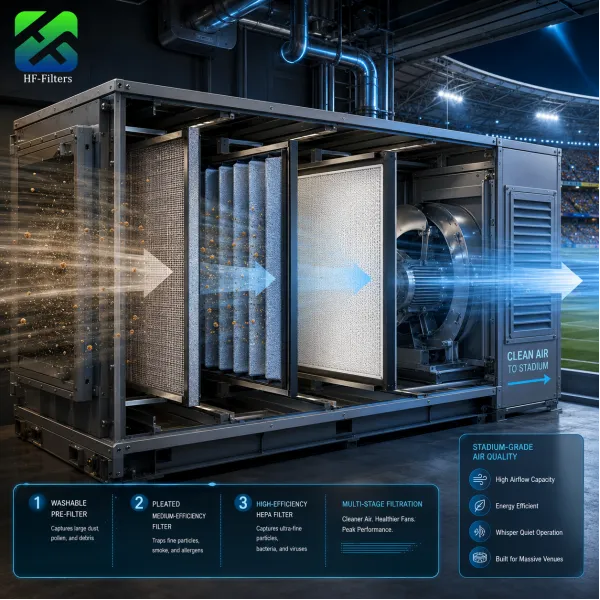
Huge HVAC systems do not count on just one filter to do the whole job. Instead, they use a clever setup with a few different stages:
Stage 1 (Pre-Filtration): This part uses G3/G4 panel or bag pre-filters. It catches big pieces of dirt ≥10μm. This means it traps thick dust, cloth fibers, and pollen. Its main job is to stop heavy dirt that comes in through busy doors. Doing this keeps the next filter layers safe.
Stage 2 (Medium Filtration): Here, the system uses M5-M6 or F7-F9 bag and commercial filters. This step takes out 1-10µm sized bits like PM10 and mold spores. This middle layer is super important. It helps the final HEPA filters last much longer.
Stage 3 (Final Filtration): The last step uses HEPA H13-H14 filters. They grab tiny things ≤0.3μm, like PM2.5, bad germs, and viruses. This acts as the final cleaning step. It makes the air very clean in special spots. These spots include VIP rooms, TV broadcast areas, doctor rooms, and control centers.
Why Pre-Filters Are the Underrated Workhorse
Using many filter stages builds up power step by step. If you skip Stage 1, the middle filters fill up with thick dirt in just weeks. If you skip Stage 2, the HEPA filters break down months too early. In this setup, the first pre-filters carry over 60% of the total dirt load.
During big events like the World Cup, stadium HVAC systems work super hard. They might run 14 to 18 hours every day for a whole month. With that much stress, cheap filter materials fold or break out of shape. When they break, dirty air sneaks right past them into the pipes. Also, if a filter cannot hold much dust, the pressure drops quickly. This forces the fans to work harder. The extra work makes the energy use jump by 15%-30%. Because of this, the numbers that truly matter are how much dust it can hold, how strong it is, and how easily air flows through it over time.
How Healthy Filters Supports Stadium Infrastructure
Started in 2016, a company named Healthy Filters helps with the whole building air chain. They make everything from basic first-stage materials to top-level clean filters. They give business buyers great help for big factories and stadiums:
Precision Manufacturing & Customization: Healthy Filters makes their own parts right in their factory. They build aluminum, galvanized-steel, and cardboard-frame pre-filters. They keep the sizes perfect down to the millimeter.
OEM/ODM Agility: They work like a real part of a building team. They change the folds and wire grids on the filters. This helps the air flow smooth and easy, matching whatever the fans need.
Global Standards: Their items pass big tests like EN 779, ASHRAE 52.2, and ISO 16890. They also help with local shipping. They even have a big 30 m³ CADR test room and clean factory spaces to help out.
Healthy Filters looks at the whole life of the product, not just the starting price. They build tough filters that let air pass easily. This drops the power bill and cuts down the time machines stay broken.
FAQ
Q1: What Filters Are Used in World Cup Stadium Ventilation Systems?
Big places use a step-by-step setup. They mix primary filters, medium-efficiency filters, and high-efficiency (HEPA) filters. These different layers catch dirt of all sizes.
Q2: Why Are Primary Filters Important in Stadium HVAC?
They hold over 60% of the dirt load. They catch large dust, fuzz, and trash first. This stops dirty air leaks. It keeps the next commercial filters safe. It also stops fast pressure drops that make the fan use up to 30% more power.
Q3: Do Stadiums Need HEPA Filters?
Not in every single spot. HEPA filters act as the last cleaning step. They catch super tiny things like viruses and PM2.5. Builders mostly put them in very clean areas. These include doctor rooms, TV broadcast rooms, or main control spaces.
Q4: Can Filtration Help When Tens of Thousands of Fans Gather?
Yes, it helps a lot. A crowd of 60,000 people makes the dirt in the air jump 3 to 5 times in just 30 minutes. Layered filters are highly important. They handle the fast rise in CO2, dust, bad smells, and old air.
Q5: Which Healthy Filters Products Match This Application?
Healthy Filters makes custom primary filters, commercial bag filters, activated carbon filters, and HEPA/ULPA filters. They also offer washable pre-filter media. This media uses a special changing density design.