
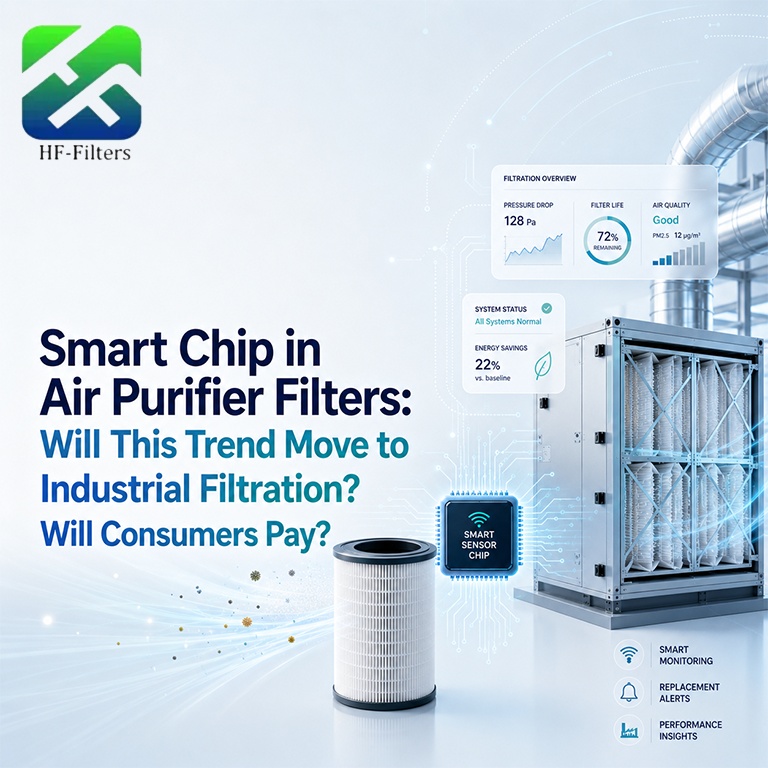
Walk into any electronics store today, and you’ll notice a growing trend: home air purifier filters embedded with smart chips — devices that automatically track usage status, monitor filter health, and send timely alerts when it’s time to replace them.
No more guessing.No more early filter changes (wasting money) or late changes (ruining air quality). This simple, user-friendly upgrade improves how people use home filtration systems.
But here’s the question we’re all asking in the HVAC/filtration industry: Will this smart chip trend cross over to industrial filters? And perhaps more importantly — Will B2B buyers and everyday consumers actually pay a premium for this intelligence?
Let’s break this down, through the lens of both residential and industrial use cases — and the data that matters.
First: Why Smart Chips Are Winning in the Home Market
Consumers are tired of the “guesswork” of filter maintenance. Research shows 68% of air purifier users now prioritize models with smart filter reminders — and 31% list this feature as their top requirement when purchasing. Here’s why it’s resonating:
✅ No more waste: Stop replacing filters too soon and save money.
✅ Better health: Avoid dirty filters that reduce efficiency and blow pollutants back into the air.
✅ Convenience: Alerts come directly to phones via apps — no need to check filters manually (a game-changer for busy households).
And the data backs up the willingness to pay: 78% of consumers will pay a premium for features that solve real pain points, with mid-to-high income groups (the core home filtration market) accepting a 20-30% premium for smart functionality.
Now: Will Industrial Filters Follow Suit?
The short answer: Yes — but not for the same reasons as residential.
Industrial filtration (HVAC, manufacturing, healthcare, semiconductor) faces far bigger stakes than home use: unplanned downtime, non-compliance with IAQ standards, wasted energy, and costly equipment damage. Traditional industrial filter maintenance relies on manual inspections or basic pressure drop readings — a process that’s slow, prone to human error, and often reactive.
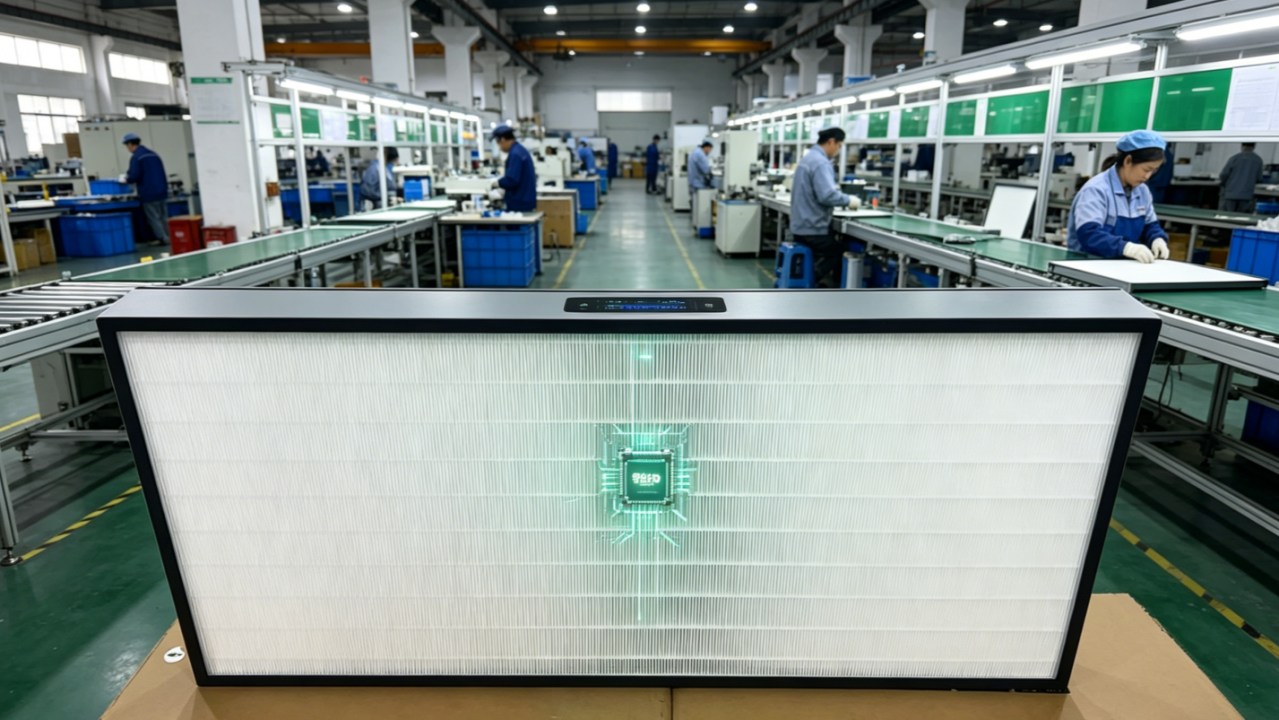
Smart chips in industrial filters (think V-Bank, HEPA, rigid cell units) would solve these critical B2B pain points by:
✅ Enabling predictive maintenance: Real-time monitoring of pressure drop, filter load, and lifespan — using AI to predict replacement timelines with 90%+ accuracy, just like the remote alert systems already being deployed in pharmaceutical and semiconductor facilities.
✅ Reducing downtime
Warns you early about serious filter problems like clogging or leaks before they break your system.
This cuts maintenance costs by 40% or more. In industrial use, smart monitoring replaced monthly manual checks with inspections just once every 3 months.
✅ Ensuring compliance
Automatically records data to meet ASHRAE, ISO and other industry standards.
This is required for hospitals, pharmaceutical plants and semiconductor factories where accuracy is critical.
For industrial buyers
(facility managers, MEP engineers, plant operators)
This is not just an extra feature — it is a necessary tool to save costs and reduce risks.
As semiconductor production moves to 3nm and more advanced processes, and industrial plants focus on efficiency,
smart filtration monitoring has already become a standard requirement, not an optional upgrade.
The Key Question: Will They Pay?
For consumers: Yes — but only if the premium is reasonable (15-30%) and the value is clear. They won’t pay for “smart for smart’s sake” — but they will pay to avoid waste, save time, and protect their family’s health. Price sensitivity varies by income, but the core market (26-50 years old, middle-to-high income) is willing to invest in functionality that simplifies their lives.
ForB2B industrial buyers: Absolutely. The ROI speaks for itself. A small premium for smart chips pales in comparison to the cost of unplanned downtime (which can reach $10k+ per hour in manufacturing) or non-compliance fines. Industrial teams are already adopting IoT-enabled filter monitoring systems that reduce energy costs by 8-12% per 100Pa reduction in pressure drop — making smart features a no-brainer.
🔮 The Future of Smart Filtration
The home market is leading the way with user-friendly smart filters — but the industrial sector will soon catch up, driven by efficiency, compliance, and cost savings. Smart chips won’t just be a “trend” — they’ll become the standard for both residential and industrial filtration, as IoT and AI transform how we manage air quality.
But I want to hear from you — the industry experts:
❓ Do you think smart chips will become standard in industrial filters by 2028?
❓ What’s the biggest barrier to adoption (cost, complexity, trust in technology)?
Drop a comment below — let’s debate the future of smart filtration together.