
PFAS and industrial emissions are getting more scrutiny in 2026. For factories, the bigger takeaway is not just about one group of chemicals.
It is about knowing what is actually in the air.
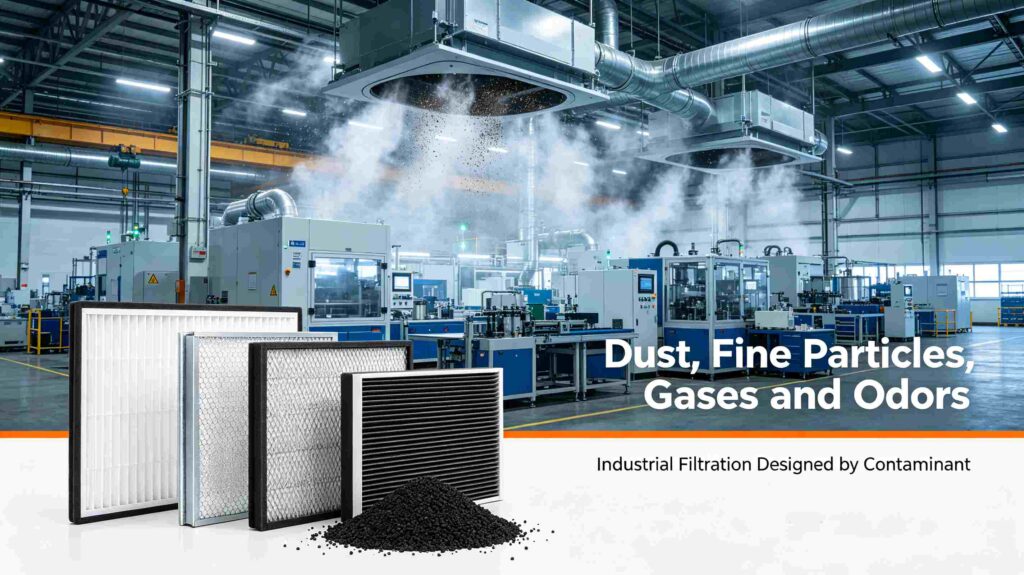
Dust is one problem. Fine particles are another. Gases, vapors and odors need a different approach again.
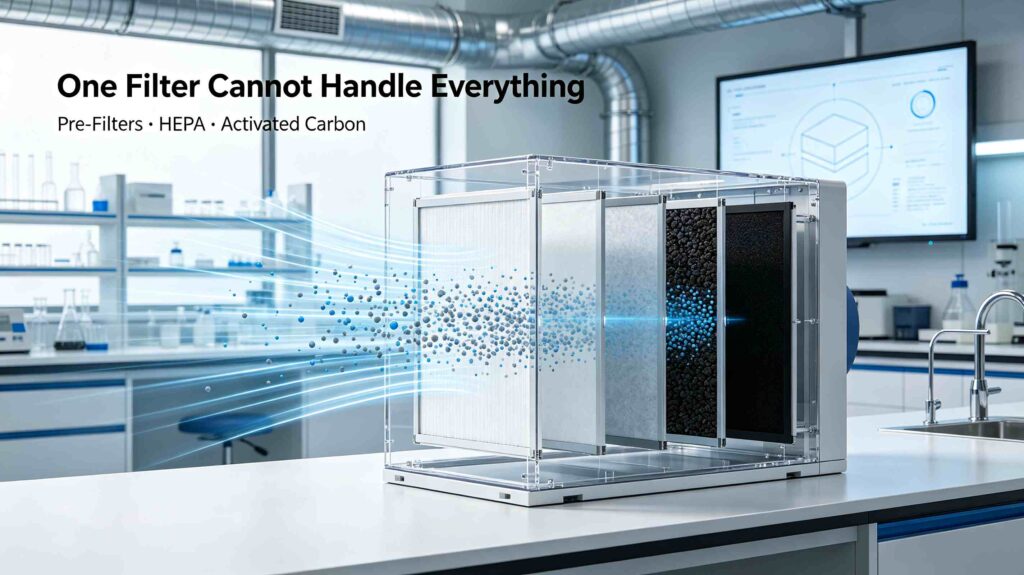
One Filter Cannot Handle Everything
Pre-filters are useful for larger dust and particles. HEPA filters are used when much finer particle control is needed.
Activated carbon is different. It is mainly used for certain gases, VOCs and odors.
So a HEPA filter and an activated carbon filter are not substitutes for each other. In some systems, both may be needed.
Healthy Filters supplies pre-filters, HEPA filters, activated carbon filters and carbon filter media for industrial applications.
Activated Carbon Depends on the Contaminant
Activated carbon works by adsorption. Certain molecules attach to the surface of the carbon as air passes through it.
But performance depends on the actual application.
Carbon type, amount of media, airflow, contact time, humidity and contaminant concentration can all make a difference.
That is also why PFAS needs careful handling.
PFAS refers to a large group of chemicals, and different industrial processes may release them in different forms. A standard activated carbon filter should not be assumed to remove PFAS from industrial air.
Any PFAS-specific solution needs proper contaminant analysis and engineering evaluation.
Multi-Stage Filtration Is Often More Practical
Industrial air streams are rarely simple.
A system might use a pre-filter first, then a finer particle filter, followed by HEPA filtration where needed. Activated carbon can be added if there is a suitable gas-phase contaminant to address.
Pocket or bag filters may also sit between these stages.
The final setup depends on the process, airflow and contaminants—not on using as many filters as possible.
Where Activated Carbon May Be Useful
Gas-phase filtration can be considered in chemical production, electronics, battery manufacturing, laboratories, pharmaceutical facilities and other industrial environments.
But the need varies from one process to another.
The first question should always be: what needs to be removed from the air?
Healthy Filters Industrial Filtration Solutions
Healthy Filters provides activated carbon filters, carbon media, HEPA filters, pre-filters, pocket filters and general ventilation filters for commercial and industrial applications.
OEM/ODM and customized filters are also available for projects with specific dimensions, media, airflow, pressure drop or carbon configurations.
Dealing with odors, VOCs, particles or more complex industrial air contaminants? Contact Healthy Filters to discuss a suitable filtration solution for your application.
FAQ
What is the difference between HEPA and activated carbon filters?
HEPA filters are used for fine particles. Activated carbon is used for certain gases, VOCs and odors. They perform different jobs.
What can activated carbon filters capture?
They may adsorb certain odors, VOCs and gaseous contaminants. The result depends on the carbon media and operating conditions.
Can activated carbon filters remove PFAS from industrial air?
There is no universal answer. It depends on the PFAS compound, emission form and process conditions. Application-specific testing and engineering evaluation are needed.
Can Healthy Filters customize activated carbon filters?
Yes. Healthy Filters can customize size, media, carbon configuration, airflow, pressure drop and frame design for industrial applications.