
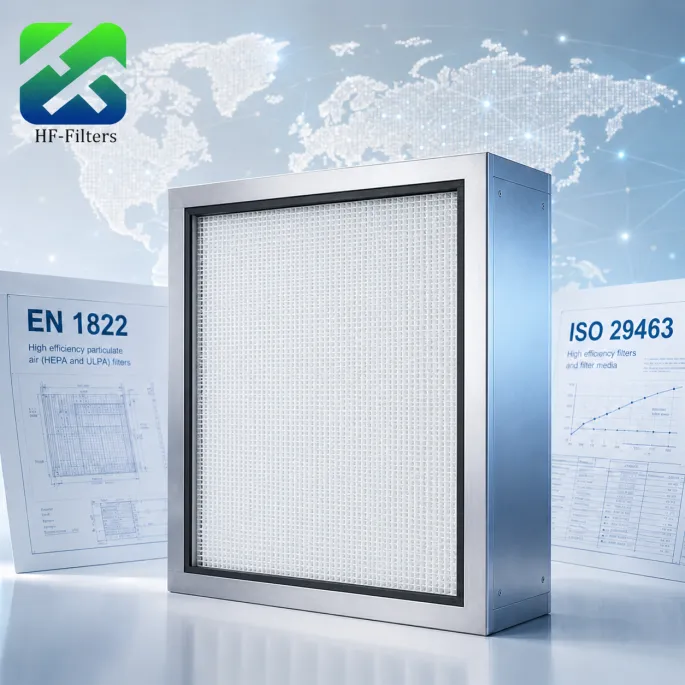
When you source HEPA/ULPA filters across several markets, the question is not only “Is it H13 or H14?” The real issue is whether the HEPA filter standard in your contract will be accepted by your customer, lab, installer, and local project team.
ISO 29463 vs. EN 1822 is now a common discussion in global HEPA filter sourcing, especially for OEM buyers selling to Europe, Southeast Asia, and mixed international markets.
Why Does ISO 29463 vs. EN 1822 Matter?
A filter may look correct on the drawing but still fail at document review. That happens more often than people like to admit, especially when the buyer asks for “99.97% HEPA” but does not name the HEPA filter testing standard.
Market Acceptance Comes First
EN 1822 standard is still familiar in Europe. ISO 29463 standard is more suitable when one product line needs wider global acceptance. Both systems cover HEPA filter classification, including H13 H14 HEPA filter grades and ULPA filter grades such as U15 to U17. The safer choice depends on the destination market, not just the factory’s usual report format.
What Is the Real Difference Between the Standards?
The two standards are close in technical logic. ISO 29463 was built from the same high-efficiency filter testing ideas used in EN 1822, then made more international.
Same Core Logic, Different Scope
Both standards use the MPPS test. MPPS means Most Penetrating Particle Size, the particle size that is hardest for the filter to capture. For serious HEPA filter procurement, you should ask for a HEPA filter efficiency test, integral efficiency data, and a leak scan test.
For cleanroom HEPA filter or pharmaceutical HEPA filter use, the HEPA filter leak test matters as much as the efficiency number. One small detail: warehouse labels may still say H13 while lab reports use ISO class wording. Check both.
Which HEPA Standard Should You Specify?
Your RFQ should match your customer’s market. A European project can keep EN 1822 classification. A global OEM HEPA filter program should usually list ISO 29463 as the main route and add EN 1822 equivalence.
Match the Standard to the Destination
For air purifier HEPA filter projects, “True HEPA 99.97%” may work in marketing, but procurement needs more detail. Material choice also matters. PP, PTFE, PP+PET, and fiberglass papers differ in washable behavior, resistance, cost, and heat use.
For example, fiberglass media can reach very high efficiency but is more fragile, while PP+PET can offer low resistance in high-efficiency designs.
What Should Your HEPA Filter RFQ Include?
A good HEPA filter RFQ is short but specific. You do not need a 20-page document for every order, but you do need the right items.
Write the Requirement Clearly
State the HEPA filter specification as ISO 29463 or EN 1822, class, rated airflow, initial pressure drop, size, frame, sealant, gasket, media type, and report request. For HVAC HEPA filter, V-bank HEPA filter, Gel Seal HEPA filter, Mini-pleat HEPA filter, or High temperature HEPA filter, also list the working temperature and installation style. A custom HEPA filter solution should not be quoted from efficiency alone.
How Can Healthy Filters Support Your Project?
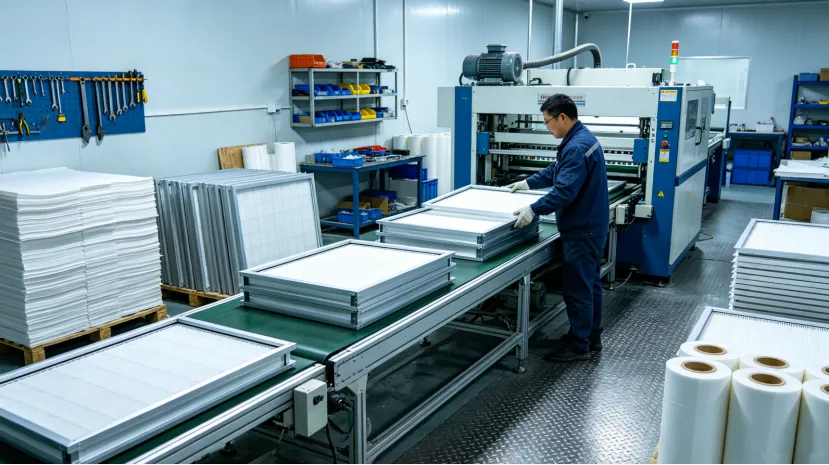
For buyers comparing standards, Healthy Filters is a practical OEM partner: Shenzhen-based since 2016, ISO9001-certified, with HEPA, activated carbon, pre-filter, and replacement filter programs for North America, Europe, and Southeast Asia.
FAQ
Q1: Is ISO 29463 equivalent to EN 1822?
A: They are closely aligned, but not always interchangeable in documents. Use the standard your market or customer accepts.
Q2: Should I specify ISO 29463 or EN 1822 for HEPA filters?
A: Choose EN 1822 for Europe-led projects. Choose ISO 29463 for global HEPA filter sourcing and multi-market OEM programs.
Q3: Is 99.97% efficiency enough for a True HEPA filter?
A: Not for procurement. You still need the test standard, airflow, pressure drop, and report type.
Q4: Do H13 and H14 HEPA filters need leak scan testing?
A: For cleanrooms, pharma, electronics, and other critical use, yes. The scan report helps catch local leaks.
Q5: How can I avoid certification risk in HEPA filter sourcing?
A: Put the HEPA filter certification, class, MPPS basis, scan test report, and rated airflow in the RFQ before sampling.