
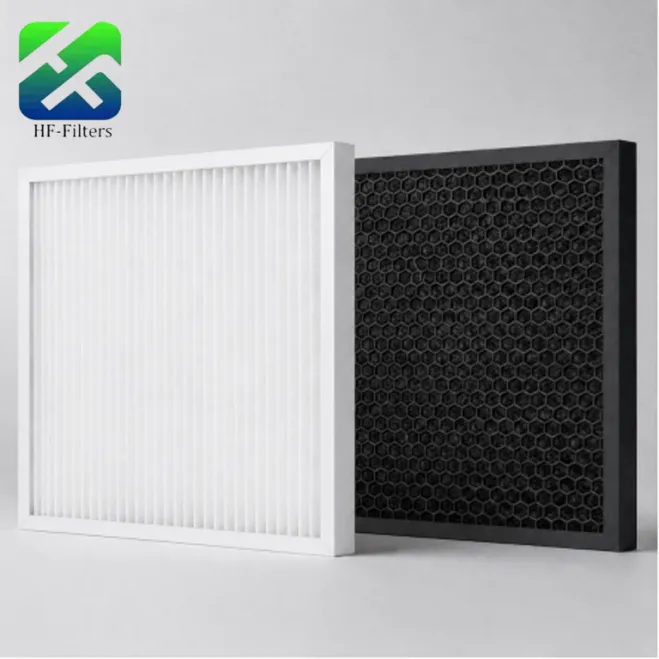
Why Do Exhaust Smells Become a Factory Problem?
Industrial odor control starts when exhaust smells stop being a small annoyance and become a daily complaint. In paint booths, printing rooms, electronics workshops, chemical areas, or wastewater stations, you may face solvent odors, VOC emissions, dust, mist, and warm exhaust air at the same time. A fan can move the smell. It does not remove it.
Where Do Industrial Odors Come From?
Paint and coating lines often release solvent vapors. Printing plants deal with ink, adhesive, and cleaning-agent smells. Wastewater rooms may smell like sulfur or ammonia. Electronics production can bring resin, flux, and chemical odors. That mix needs more than a dust filter.
How Do Activated Carbon Filters Help?
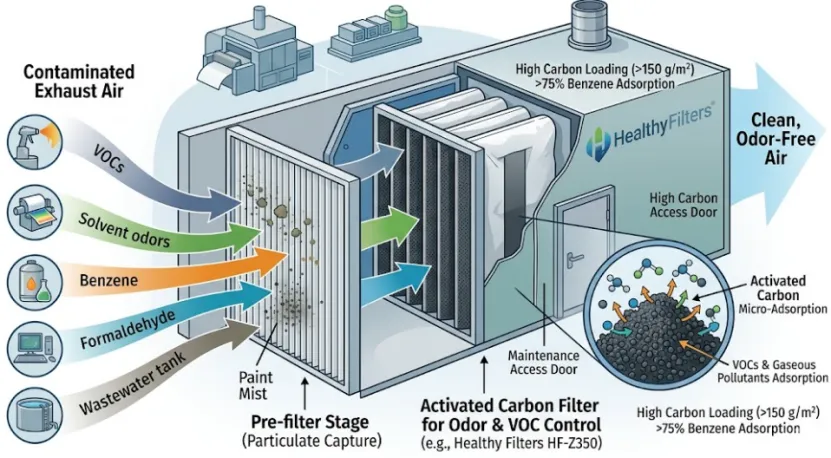
Activated carbon filters use VOC adsorption. Gas molecules stick to the carbon surface as air passes through the media. Healthy Filters’ activated carbon filter media uses powdered activated carbon and can help remove odor, dust, benzene, formaldehyde, and other volatile organic pollutants. It is mainly used in industrial waste gas treatment and air purification.
Why Is Pre-Filtration Important?
If paint mist, fibers, or heavy dust hit the carbon first, the carbon pores clog too soon. A pre-filter for activated carbon filter systems protects the carbon layer. For spray booths, paint-stop glassfiber media can capture paint mist, with PS-60 and PS-100 options showing 85% to 90% average arrestance.
Which Carbon Filter Type Fits Your System?
Your industrial exhaust systems may need a carbon panel filter, carbon pocket filter, sandwich carbon filter media, or cut-to-size activated carbon air filter media. The right choice depends on airflow, pressure drop, odor load, and service access. A maintenance worker will thank you later, honestly.
What Specs Should You Check?
Carbon loading matters. Healthy Filters’ HF-Z180, HF-Z210, and HF-Z350 media list activated carbon content above 70, 90, and 150 g/m², with benzene adsorption from at least 65% to 75%. For higher airflow ventilation, carbon pocket filter models combine activated carbon fiber and filter cotton, with rated airflow up to 4250 m³/h.
How Can Custom Carbon Filter Solutions Reduce Risk?
A standard filter may not match your duct, fan, or odor source. Custom carbon filter solutions let you match filter size, media thickness, frame type, airflow, and replacement plan. That helps your industrial air filtration system control exhaust smells without choking ventilation.
FAQ
Q1: Do activated carbon filters remove VOC emissions?
A: Yes. They reduce many VOC emissions through VOC adsorption, especially solvent and chemical odors.
Q2: What Is The Best Filter for Industrial Odor Control?
A: An activated carbon filter for odor control is often the best choice for gaseous exhaust smells.
Q3: Can A Carbon Filter Handle Paint Booth Odor Control?
A: Yes, but use a fiberglass pre filter first to catch overspray.
Q4: When Should Carbon Filters Be Replaced?
A: Replace them when exhaust smells return, airflow drops, or pressure rises.
Q5: Can You Get A Custom Activated Carbon Filter?
A: Yes. Custom sizes, media, and filter structures can match different needs.