
On October 13, 2026, Singapore’s Meteorological Service reported a 24-hour Pollutant Standards Index (PSI) of 111–160, within the country’s unhealthy range. Smoke from fires in Sumatra and Kalimantan was drifting toward Singapore, another reminder that Indonesia’s fire season can become a regional air quality problem.
For people living with the haze, the immediate questions concern health and indoor air. For companies supplying replacement filters, there is a different concern: which replacement parts will actually work in the equipment customers already have?
That question sounds straightforward. In practice, it can be surprisingly difficult to answer.

A HEPA Label Doesn’t Tell the Whole Story
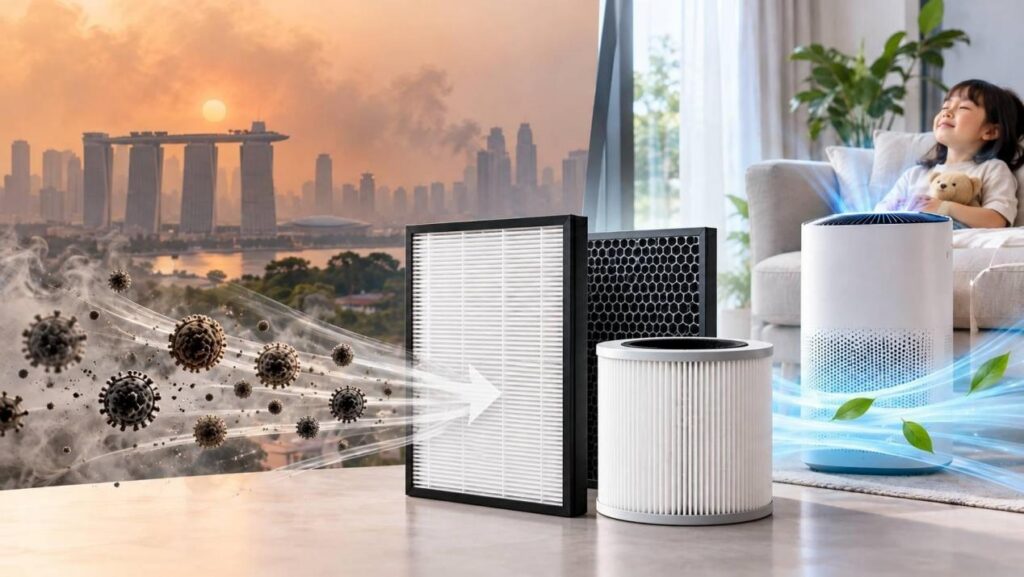
Wildfire smoke carries fine particulate matter, including PM2.5. These particles can enter buildings even when doors and windows are mostly closed. Air purifiers fitted with appropriate particle filters can reduce indoor concentrations, provided they deliver enough filtered air.
But consider two replacement filters sold as HEPA products. They may look almost identical in a photograph, yet have different media, dimensions, or airflow resistance.
One might seal properly inside a particular purifier. The other could leave a gap around the frame. Air passing through that gap avoids the filtration media altogether.
There is also a less obvious problem: pressure drop. A filter that restricts airflow more than the equipment was designed to handle may reduce the amount of clean air the purifier delivers.
This is why filtration efficiency, although important, should never be the only detail on a distributor’s purchasing checklist.
What Happens When the Original Filter Is Hard to Find?
An importer may receive an inquiry for a replacement cartridge with no reliable part number. The customer has the old filter, perhaps a photograph, and a few measurements taken with a ruler.
Ordering a visually similar product is tempting, especially when demand is rising. Unfortunately, a few millimeters in the wrong place can affect installation or sealing.
A better approach is to work from the actual requirements. The buyer should establish the outside dimensions, filter depth, frame type, gasket location, and equipment model. Where available, the original filter’s performance specifications help narrow the options.
This is one situation where Healthy Filters’ customization services become relevant.
According to its published product information, Healthy Filters offers customized replacement filter dimensions, frame materials, HEPA and activated carbon configurations, and OEM/ODM options. Samples or drawings can also be used to discuss replacement designs.
For wholesalers dealing with different purifier models, that offers a useful alternative to searching endlessly for an approximate match. Of course, a proposed design still needs compatibility and performance checks before bulk production.
Think About the Filter’s Job, Not Just the Haze
Wildfire smoke isn’t a single pollutant. It contains particles as well as gases, and different filtration materials do different jobs.
HEPA media is intended for particle capture. Activated carbon may help with selected odors and gaseous contaminants, although effectiveness depends on the carbon formulation, quantity, and operating conditions. Neither should be described as a complete solution to every smoke-related hazard.
Buyers should also resist assuming that a thicker filter is automatically better. More media can be useful in some designs, but physical thickness alone says little about efficiency, airflow, or service life.
For a B2B order, specifications should come before marketing claims.
Should Distributors Expect Faster Filter Replacement?
Possibly, but there is no reliable rule that every purifier filter must be changed after a certain number of smoky days.
A unit operating continuously in heavily polluted air may accumulate particles faster than one used occasionally in a cleaner environment. Filter size, loading capacity, and the equipment’s operating conditions also matter.
Instead of promising a fixed replacement interval, suppliers can help customers understand the manufacturer’s maintenance guidance and recognize relevant equipment alerts or airflow changes.
Frequently Asked Questions
Can HEPA filters capture PM2.5 during haze events?
Yes. Properly specified HEPA filtration can capture fine particles associated with wildfire smoke. The improvement in indoor air depends on the purifier’s airflow, filter installation, room conditions, and operating time.
Can a replacement filter be made from an existing sample?
Healthy Filters lists sample-based and drawing-based customization among its services. Buyers should provide an accurate sample or technical drawing and confirm performance requirements before approving a replacement design.
What should an importer check before placing a bulk order?
Start with dimensions, sealing details, the intended equipment model, filtration specifications, and airflow resistance. Packaging requirements and samples may also be worth discussing before committing to a larger quantity.
Getting the Specifications Right
Indonesia’s current haze has put air filtration back in the headlines. The less visible part of the story is the work required to supply replacement elements that actually suit existing equipment.
For distributors and procurement teams, Healthy Filters can be a starting point for discussing customized HEPA replacement filters, media configurations, and private-label requirements. Bringing clear specifications to that conversation is likely to be more valuable than simply asking for the highest efficiency rating available.