
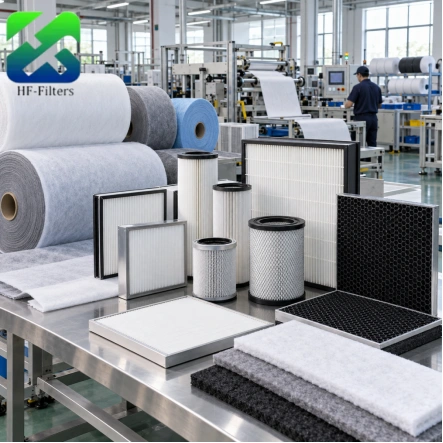
Making custom filter media starts with basic facts. Look closely at the dust, airflow, heat, and room space. Turn these plain facts into clear goals. Then, create a workable roll or a final part.
Why Does the Application Come First?
Factory filters face changing dust, wetness, heat, and bad chemicals. Always start by knowing exactly what the filter must catch. You must also know where it will work.
HVAC and General Ventilation
PET synthetic fiber traps big dust nicely. It also keeps air moving well. Washable metal-frame filters need strong backing, so laminated mesh filter media really helps. Standard PET choices include 1.5 to 2.5 mm thickness and 95 to 135 g/m² basis weight. They feature 4 to 6 Pa initial resistance. Density clearly matters a lot here.
Paint Booths and Industrial Processes
Paint mist needs a thick pad. A good fiberglass pad catches extra spray deeply. This keeps the top layer clean longer. The PS-30 format uses 30 mm fiberglass filter media. It runs smoothly at 1.5 m/s with 1 to 2 m roll widths. Hot jobs might demand high-temperature glass fiber.
HEPA and Gas-Phase Filtration
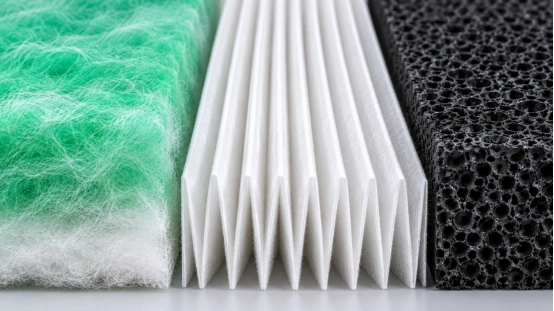
PP, PP+PET, glass fiber, PTFE, and PET fit top-level filters perfectly. Glass fiber takes the heat well. PP and PP+PET fold easily into pleats. PTFE handles tough spots nicely. For bad smells, use activated carbon filter media in foam or honeycomb shapes. Success depends heavily on the carbon amount and total air contact time.
How Should You Balance Efficiency and Airflow Resistance?
Better filtering makes the air push much harder. A tight pack can block air and waste fan power if the filter is too small.
Match Media to the Contaminant
Find the exact dust size first. Rough synthetic media easily protects a finer layer. Meltblown PP traps tiny bits, while PET adds strong support. Mixed composite layers help when you face both dust and smells together.
Check Pressure Drop and Operating Conditions
Always write down the test airflow next to the resistance numbers. List the room heat, wetness, and fire rules. The exact same rating sticker can hide totally different real-world results.
Which Filter Media Parameters Can Be Customized?
You can change the fiber mix, layer setup, basis weight, and density. You can also pick the backing, carbon fill, and roll width easily.
Thickness, Basis Weight, and Roll Size
Tell the maker your exact filter media thickness, basis weight, and core size. For cut pieces, share the exact dimensions. Pocket media might need a strictly set width to fit sewing machines.
Layers, Shapes, and Finished Formats
Custom filter media comes as rolls, pockets, or framed filters. The layers mix support mesh, meltblown, and carbon media. A simple drawing stops many small mix-ups here.
How Does an OEM Filter Media Project Move from Material to Finished Part?
An OEM filter media job follows simple steps. You define it, test a sample, fix it, and release it. ODM filter media jobs simply start with a basic room problem.
Start with Equipment Data
Send your drawing, airflow needs, and packing rules first. Tell them exactly how you will build it. Folding, sewing, and cutting place hard demands on the raw materials.
Test Samples before Production
Always test a sample sheet first. Check the real fit and dust holding limits. A test run exposes weak seals early before making a huge batch.
A Clearer Route from Specification to Production
For customized projects, Healthy Filters provides material selection support and manufacturing solutions based on specific application requirements. They help with cutting, folding, and frame building. The clear rules set during testing carry right into the final filter. This helps OEM and ODM filter plans greatly. It gives your team a simple, easy path to finished parts.
FAQ
Q1: What Information Is Needed for Custom Filter Media?
A: Tell them the dust type, airflow, heat, wetness, and specific sizes.
Q2: Can One Media Handle Both Particles and Odors?
A: Yes. Mixed layers successfully combine dust catchers with activated carbon.
Q3: Is Thicker Filter Media Always Better?
A: No. Extra thickness holds more dust but hurts airflow and costs more money.
Q4: Can Filter Media Be Supplied as Finished Parts?
A: Yes. You can easily get rolls, pads, pockets, or framed filters.
Q5: Why Is a Pilot Batch Useful?
A: It quickly tests real fit and air push before you pay for a giant run.