
Anyone managing industrial facilities knows odor control is one of the trickiest ongoing issues. Factories, processing plants and production workshops constantly release chemical fumes, burning smells, solvent vapors and musty exhaust. Standard industrial filters can trap dust and particles, but they’re completely powerless against stubborn floating odors and volatile organic compounds. That’s where Air Filter Sponge changes the game for reliable Industrial Odor Control.
For years of optimizing industrial ventilation and filtration setups, I’ve found rigid traditional carbon filters often fall short in real factory environments. They block airflow easily, accumulate dust quickly, and leave plenty of odor blind spots. In contrast, porous sponge-based carbon filtration, mainlyActivated Carbon Sponge and lightweight Carbon Filter Foam, delivers far more flexible and consistent odor removal performance. It’s now the go-to solution for stable, long-term Industrial Odor Control across most manufacturing sectors.
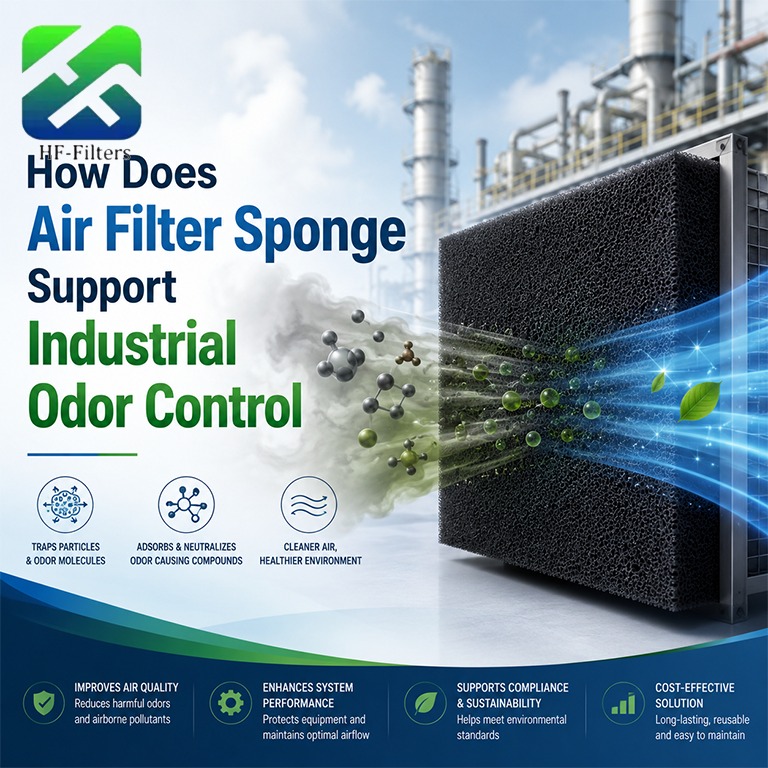
What Makes Air Filter Sponge Different From Traditional Filters
Most industrial filtration setups focus purely on solid particle filtration. They handle dust, debris and metal shavings well, but gaseous odor molecules pass through freely. These lingering odors not only worsen the working environment for staff but also lead to neighbor complaints and failed environmental inspections.
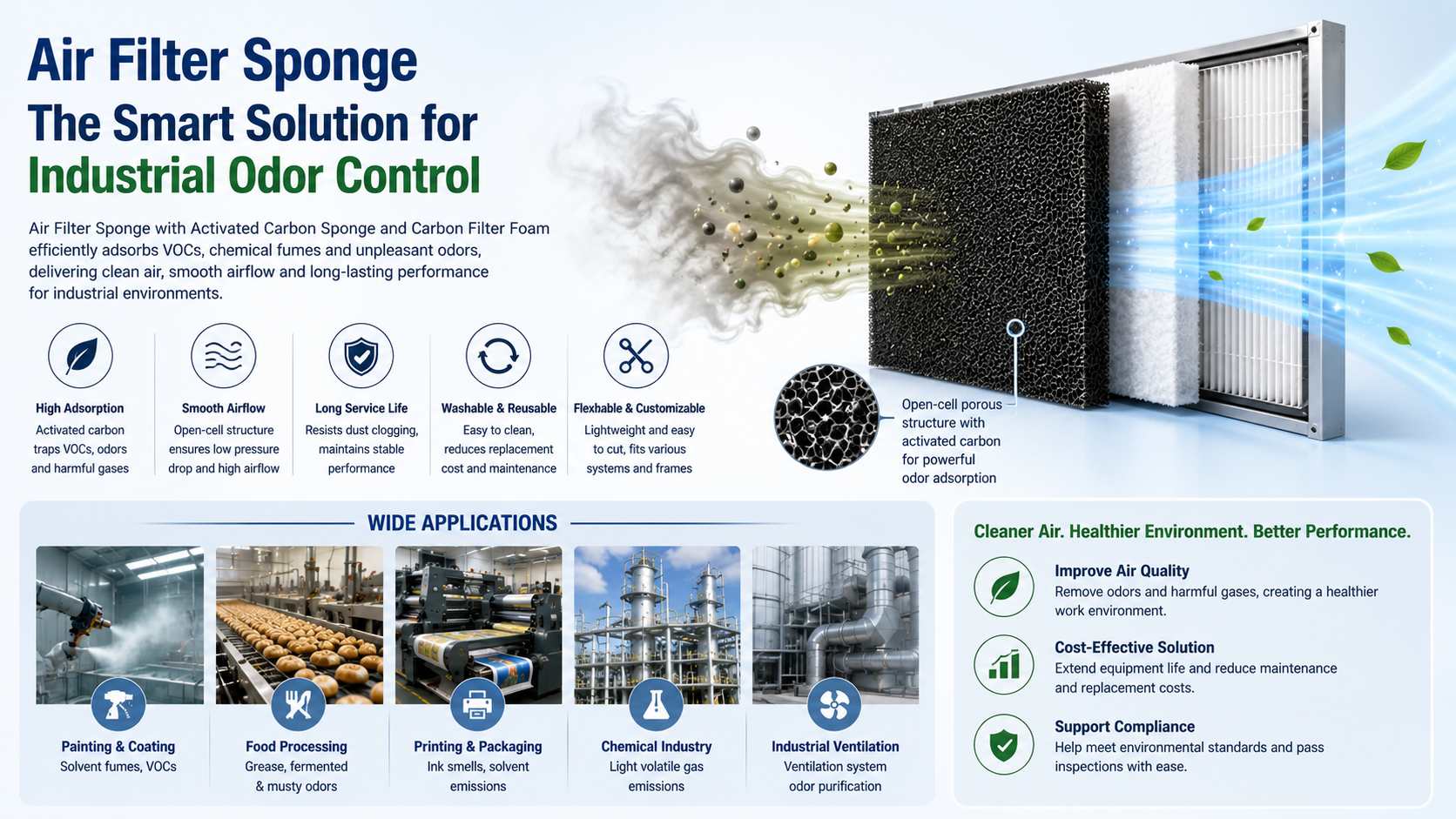
The core advantage of Air Filter Sponge is its open-cell porous structure. Unlike dense filter media, this sponge-style material boasts countless tiny interconnected holes. It lets air pass through smoothly without creating heavy pressure drop, while holding massive amounts of activated carbon inside. This unique structure is exactly why Activated Carbon Sponge and Carbon Filter Foam outperform standard filters for gas and odor treatment.
How Activated Carbon Sponge Solves Industrial Odor Issues
Activated Carbon Sponge is the upgraded core material for modern Industrial Odor Control. Impregnated with high-density activated carbon particles, the sponge’s porous framework provides a huge adsorption area. When odorous air flows through, VOCs, chemical fumes, smoke residues and peculiar industrial smells get trapped and locked inside the carbon pores, instead of recirculating through the ventilation system.
What I appreciate most about this material is its balance of efficiency and airflow. Many rigid carbon filter boards clog rapidly once covered with fine industrial dust, losing odor removal ability in just a few weeks. But Air Filter Sponge has a three-dimensional mesh structure that prevents surface clogging. It filters fine dust while adsorbing odors steadily, greatly extending service life in harsh industrial conditions.
Key Practical Benefits of Carbon Filter Foam for Factories
Lightweight and flexible Carbon Filter Foam is another highly practical option for industrial use. Many old-school carbon filters are hard, bulky and difficult to adapt to irregular ductwork or custom ventilation units. This foam-style media cuts freely, fits various frame sizes, and works perfectly for custom industrial ventilation systems.
For production plants with variable odor levels, this material performs extremely well. It handles intermittent strong odors from painting, printing, chemical processing and food manufacturing without performance decay. Whether you need primary odor filtration or deep secondary purification, Carbon Filter Foam delivers stable Industrial Odor Control results with minimal airflow impact.
Additionally, sponge-based filter media cuts down your maintenance burden significantly. It’s washable and reusable to a certain extent, easy to clean and replace. Compared with full-size heavy carbon filters that require professional installation, Air Filter Sponge saves plenty of labor and replacement costs for long-term factory operation.
Common Industrial Scenarios That Need Sponge Carbon Filtration
If your facility struggles with persistent hard-to-eliminate odors, this filtration solution is almost always applicable. It works perfectly for painting workshops that release solvent fumes, food processing plants with fermented and greasy odors, printing factories with ink smells, and chemical workshops with light volatile gas emissions.
In all these scenarios, traditional filtration can only clean particulate matter. Only Activated Carbon Sponge and Carbon Filter Foam can target gaseous pollutants effectively, making professional Industrial Odor Control achievable without upgrading your entire HVAC system.
Final Thoughts
Effective Industrial Odor Control is never about adding more filters—it’s about using the right media. Traditional rigid filters focus too much on dust filtration and ignore odor treatment. Air Filter Sponge, especially premium Activated Carbon Sponge and lightweight Carbon Filter Foam, fills this gap perfectly. It maintains smooth airflow, removes industrial odors efficiently, adapts to complex factory environments, and lowers long-term maintenance costs. For any industrial site facing odor troubles, this is one of the most cost-effective and reliable upgrades you can make.
FAQ
How does Air Filter Sponge help with industrial odor control? Air Filter Sponge adopts a porous open-cell structure. Equipped with activated carbon components like Activated Carbon Sponge and Carbon Filter Foam, it adsorbs industrial VOCs, chemical fumes and stubborn odors, realizing efficient Industrial Odor Control while keeping smooth airflow.
Is Carbon Filter Foam suitable for high-dust industrial environments? Yes. Its three-dimensional mesh structure resists surface clogging better than rigid carbon filters. It handles dust filtration and odor adsorption simultaneously, ideal for complex industrial ventilation scenarios.
Does Activated Carbon Sponge require frequent replacement? No. Compared with traditional carbon filters, Activated Carbon Sponge has larger dust holding and adsorption capacity. It serves longer with simple cleaning maintenance, reducing overall operational costs for factories.