
Last year, an Australian air purifier customer sent us two used filters.
Both looked almost the same. Same black carbon layer. Same frame size. Same purifier model.
But one filter still controlled kitchen odor after three months. The other stopped working in less than six weeks.
When we opened them, the reason was clear. The second filter had much less carbon inside.
This is the part many buyers miss. An activated carbon air filter does not work because it looks dark. It works because the right carbon, in the right amount, has enough time to contact the polluted air.
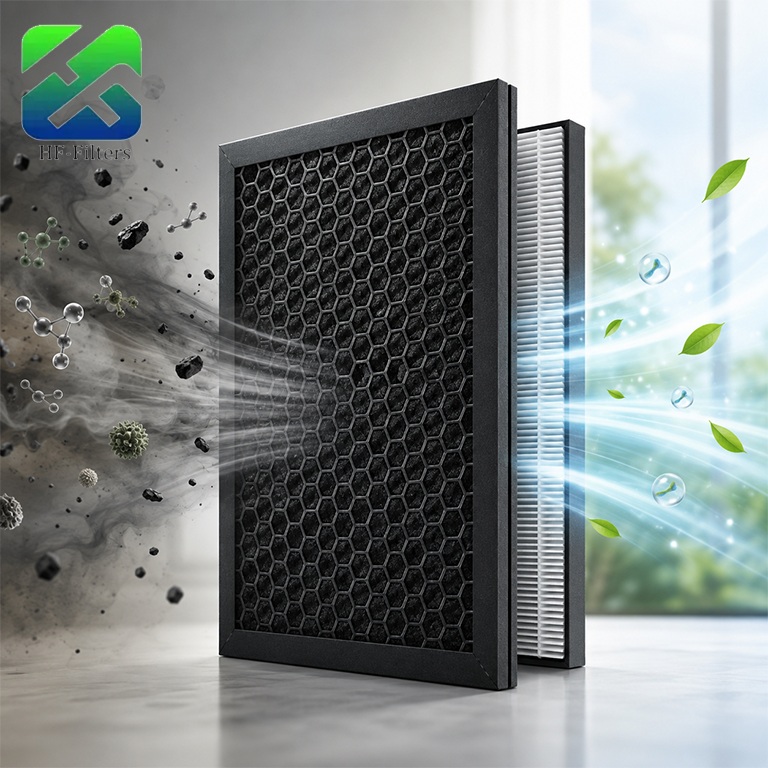
What actually happens inside a carbon filter?
Activated carbon has a huge number of tiny pores.
When odor or gas molecules pass through, some of them attach to the inner surface of those pores. This process is called adsorption.
Dust behaves differently.
Fine dust, pollen, and PM2.5 are usually handled by fiber media or a HEPA filter. Odors and many gases pass through particle filters, which is why carbon and HEPA are often used together.
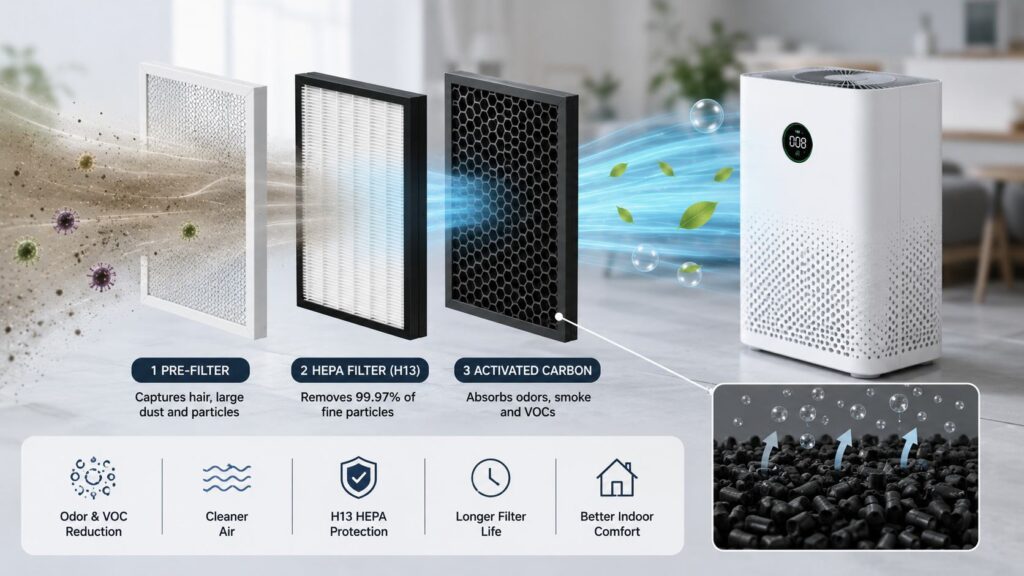
A typical combined filter may include:
- A pre-filter for hair and large dust
- An H13 HEPA filter for fine particles
- An activated carbon layer for odor and some VOCs
That combination is common in home purifiers, office units, and commercial ventilation systems.
Why do some carbon filters work better than others?
A German HVAC contractor once asked us why two activated carbon HVAC filter samples had different odor-control results, even though both suppliers claimed high carbon content.
The difference was not just the carbon grade.
Airflow was moving too fast through one sample. Contact time was too short, so the gas passed through before enough adsorption could happen.
From our factory experience, these points usually matter most:
Carbon loading
A thin carbon sheet may be suitable for light odor control.
For stronger cooking smells, smoke, solvents, or commercial use, more carbon is usually needed.
Airflow speed
Higher airflow can reduce contact time.
This does not mean the fan should always run slower. It means the filter depth and carbon structure must match the air volume.
Carbon type
Standard activated carbon can handle many everyday odors.
Formaldehyde, acid gases, or specific industrial VOCs may need modified carbon or another gas-phase media formula.
Humidity
High humidity can reduce adsorption performance because water vapor also occupies the carbon surface.
This often matters in coastal markets and Southeast Asian projects.
When drawings arrive at Shenzhen Healthy Filters Co., Ltd., our engineers normally check airflow, target gas, filter size, pressure-drop limit, and replacement cycle before choosing the carbon formula.
Where activated carbon air filters are useful
Home air purifiers
For homes, the main benefits of activated carbon air filters are odor control and basic VOC reduction.
They are commonly used for cooking odor, pet smell, smoke, and emissions from paint or furniture.
A carbon filter alone is not enough for dust. Most purifier brands combine it with H13 filter media.
Commercial HVAC systems
An activated carbon HVAC filter can be used in hotels, offices, schools, meeting rooms, and fresh-air systems.
The design needs balance. Too little carbon gives short service life. Too much dense media may raise the initial pressure drop and reduce airflow.
Healthy Filters often adjusts the carbon layer, pleat area, and frame depth together instead of simply making the filter thicker.
Workshops and industrial areas
A commercial activated carbon air filter may help with light odors from printing, packaging, adhesives, paint, or process chemicals.
For dusty sites, a primary filter or medium-efficiency filter should come first. Dust can cover the carbon surface and waste adsorption capacity.
Healthy Filters produces primary filters, bag filters, activated carbon filters, HVAC air filters, H13/H14 HEPA filters, industrial dust removal filters, and 3D printer filter media in one supply chain.
What buyers should check before ordering
Do not buy a carbon filter by color.
Also, do not compare only one laboratory number.
Ask the supplier for:
- Carbon weight or loading
- Carbon type
- Rated airflow
- Initial pressure drop
- Filter depth
- Target odor or gas
- Test conditions
- Expected replacement cycle
We recently worked with an OEM purifier brand that wanted a thinner replacement cartridge. The first idea was to reduce the carbon layer.
That saved space, but the expected service life dropped too much.
The final design used a different carbon structure and a wider airflow path. The filter stayed compact without sacrificing as much adsorption capacity.
Healthy Filters supports custom size, shape, carbon formula, frame, logo, and packaging. Our Shenzhen workshop covers 10,000㎡, with automated lines and monthly capacity above 500,000 filter elements.
Maintenance and replacement
Activated carbon becomes saturated. It cannot adsorb forever.
For home purifiers, replacement is often needed every 3–6 months. Heavy cooking, smoking, pets, renovation, or high humidity may shorten that period.
Commercial and industrial filters are better judged by:
- Odor breakthrough
- Operating hours
- Gas concentration
- Airflow change
- Site conditions
Do not wash a disposable activated carbon air filter. Water can damage the structure and reduce adsorption performance.
FAQ
Can one activated carbon filter remove every odor?
Not really. Standard carbon works well for many common odors, but some gases need specially treated carbon media.
Is an activated carbon air filter better than a HEPA filter?
They do different jobs. HEPA removes particles. Activated carbon handles odors and some gases.
Does activated carbon remove VOCs?
It can reduce many volatile organic compounds, but performance depends on the chemical, carbon type, airflow, and humidity.
Why did my carbon filter stop working so quickly?
Low carbon loading, high airflow, heavy pollution, or humid conditions can shorten service life.
How often should I replace it?
Many home filters last around 3–6 months. Commercial systems should be checked by odor breakthrough and operating conditions.
Can Healthy Filters customize carbon filters?
Yes. Healthy Filters can customize dimensions, carbon formula, loading weight, frame, shape, logo, and packaging for OEM, HVAC, and industrial projects.