
Frying and grilling release oil droplets, grease mist, smoke, and odor-causing gases. Most combination range hood filters divide the work between metal mesh and activated carbon.

What Do Grease and Odor Filters Remove?
Effective grease and odor filtration addresses droplets, mist, and gaseous compounds that remain after grease capture.
Grease Droplets and Odor Molecules
A range hood grease filter catches oil droplets before they reach the fan or carbon layer. A range hood odor filter adsorbs volatile organic cooking odor molecules within carbon pore surfaces. The metal stage comes first to limit grease loading on the carbon.
How Do Aluminum Grease Filters and Activated Carbon Filters Differ?
Metal mesh provides a washable path for grease capture. Carbon media provides a porous adsorption surface and needs replacement after its useful capacity falls.
Aluminum Mesh for Grease Capture
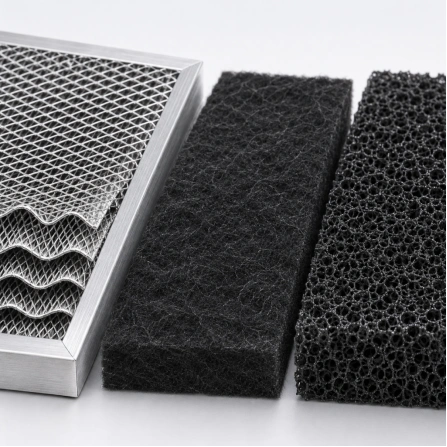
An aluminum grease filter uses corrugated or expanded metal layers. The changing air path brings droplets into contact with the aluminum mesh filter. Product materials describe this structure as high-airflow, low-resistance, and washable. Frame profile, layers, thickness, and drainage affect the finished part.
Activated Carbon for Odor Adsorption
An activated carbon filter for range hood applications may use activated carbon cotton, activated carbon foam, carbon fiber, or layered media. Activated carbon materials, carbon content, basis weight, and dimensions can all be customized to balance filtration performance, airflow resistance, and available depth.
Filter Function Comparison
| Filter Type | Main Job | Common Structure | Maintenance |
| Aluminum mesh | Captures grease and oil mist | Corrugated or expanded metal layers | Wash as directed |
| Carbon cotton or foam | Adsorbs selected cooking odors | Carbon in fibrous or porous media | Replace when odor control declines |
| Combination filter | Handles grease, then odor | Metal plus downstream carbon | Service each layer separately |
How Do Combination Range Hood Filters Work?
The stack follows hood airflow. The metal layer also limits direct grease exposure on the carbon.
Layer Sequence and Separate Functions
The usual sequence is cooking air, aluminum grease filter, carbon layer, then the fan or recirculated-air outlet. Metal collects droplets; carbon adsorbs part of the remaining odor load. Performance varies with media, loading, contact time, humidity, and airflow.
Separate Cartridges or One Assembly
Some hoods use separate metal and carbon parts. Compact appliances may combine both in one frame. Separate parts simplify servicing; one assembly reduces handling. Test the sample for fit and pressure drop.
How Do You Choose the Right Range Hood Filter?
Start with the air path and filter space, then match materials to airflow, maintenance, and the odor target.
Ducted and Ductless Range Hoods
A ducted range hood filter prioritizes grease capture before air leaves the building. Its design may add carbon. A ductless range hood filter returns air to the room and commonly uses grease and carbon stages.
Dimensions, Carbon Loading, and PPI
Specify width, height, thickness, frame, tabs, mesh, and airflow. For carbon, add material, loading, thickness, and pressure limit. PPI records pores per inch for foam; state it with thickness and airflow. Use a drawing or sample to define tabs and seals.
How Can OEM Buyers Build a Custom Filter Program?
OEM range hood filters need repeatable dimensions, material specifications, and packaging. One development file can cover both stages and future replacement range hood filters.
Materials, Samples, Labels, and Packaging
As a range hood filter manufacturer, Healthy Filters supplies aluminum grease filters, carbon cotton, carbon foam, and composite media for custom range hood filters. Its filter product range supports nonstandard dimensions, material combinations, OEM labels, and retail or bulk packaging. Send the hood model, drawing or sample, airflow, annual quantity, and destination for review.
FAQ
Q1: What is the difference between a grease filter and a carbon filter?
A: A grease filter catches droplets and mist. Carbon adsorbs selected odor molecules after the grease stage.
Q2: Does every range hood need an activated carbon filter?
A: Hood design sets the filter stack. Ductless models commonly use carbon because air returns to the room. Many ducted models use grease filtration alone.
Q3: What is the difference between activated carbon foam and carbon cotton?
A: Foam has a porous structure described by PPI. Carbon cotton holds powdered carbon in fibrous media. Compare thickness, loading, resistance, and mounting.
Q4: Can combination filters be made in custom sizes?
A: Yes. Provide the finished dimensions, thickness, frame profile, tabs, layer sequence, carbon specification, and required quantity.
Q5: What information is needed for an OEM quotation?
A: Send a drawing or sample, hood type, airflow, materials, annual volume, labels, packaging, test requirements, and destination.