
In many HVAC projects, the filter level is decided long before anyone looks at the actual product.
Engineers start with airflow calculations, pressure drop limits, and system layout. By the time filtration is discussed, the space for compromise is already very small.
That’s usually where the F7 Filter comes in.
Not because it is the most advanced option on paper, but because it often fits the balance between efficiency and system resistance in real HVAC Systems.
Why F7 is often chosen as a mid-to-high efficiency stage
In practical applications, filtration is rarely about a single layer.
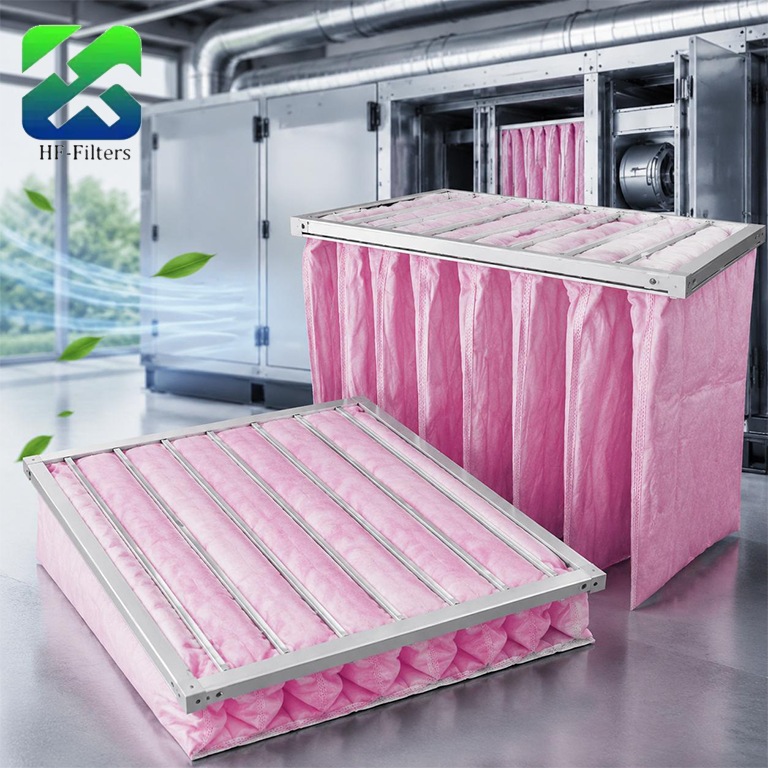
A Pocket Filter is often used as a pre or medium stage, especially in commercial ventilation systems. It handles larger dust loads and helps protect downstream filters from early clogging.
But once air quality requirements increase, especially in office buildings, hospitals, or production environments, F7-level filtration becomes more relevant.
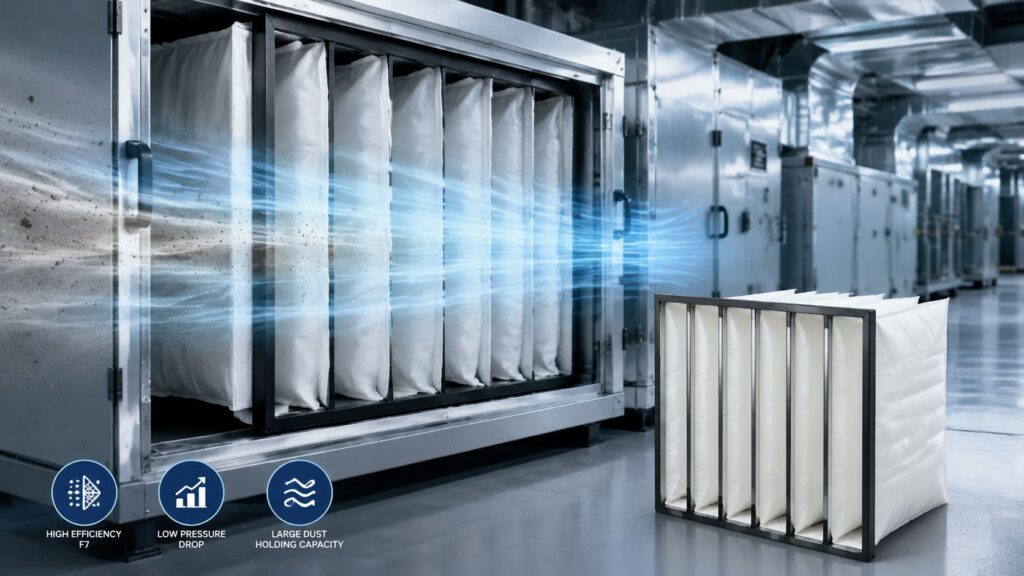
Compared to basic pre-filters, an F7 grade filter captures finer particles while still maintaining manageable pressure drop levels. That balance is the main reason it is widely used.
A system that becomes too restrictive loses efficiency. A system that is too loose loses air quality control.
F7 sits in between.
Pocket filters and bag filters in real operation
On paper, a Bag Air Filter and a pocket filter look straightforward. Multiple filter bags, increased surface area, improved dust holding capacity.
In real systems, the difference shows up over time.
Airflow distribution inside each pocket matters more than the number of pockets. If airflow is uneven, some sections load faster while others remain underused.
This is one of those details that rarely appears in product sheets but becomes obvious during maintenance cycles.
Technicians often notice it first when replacing filters:
one side is fully loaded, the other still relatively clean.
That imbalance affects service life more than most buyers expect.
Where F7 filters actually make a difference
In real HVAC Systems, F7 filters are not used in isolation.
They are part of a staged system.
Pre-filtration removes larger particles. F7 handles finer dust. Final filtration, if required, deals with sensitive environments.
When this balance is correct, the system runs smoothly for longer periods without sudden pressure increases.
When it is wrong, maintenance cycles shorten quickly.
The filter itself may not be the problem. The selection strategy usually is.
The role of manufacturing consistency
One thing experienced buyers in the filtration field learn early is that two filters with the same rating can behave differently.
Not dramatically at first.
But over months of operation, differences in media consistency, pleat stability, and frame construction become visible in performance data.
That’s why sourcing from a stable Filter Manufacturer matters more than just comparing specifications.
Inconsistent production often leads to unpredictable service life, which creates maintenance problems that are hard to trace back to the original cause.
Real-world procurement decisions are changing
In recent years, many HVAC project buyers have shifted focus.
Instead of only asking “what is the efficiency rating,” they also ask:
How stable is performance over time
How consistent is batch production
How predictable is pressure drop behavior
These questions reflect real operational experience, not just design theory.
This is also why more OEM projects are working directly with established manufacturers rather than relying on generic supply chains.
Companies such as Shenzhen Healthy Filters Co., Ltd., commonly referred to as Healthy Filters, are often involved in F7-level and multi-stage filtration projects where consistency and application matching matter more than catalog specifications alone.
In many cases, the discussion starts from system requirements rather than a ready-made product.
That shift is subtle, but important.
What makes an F7 solution “correct”
There is no single universal F7 filter solution.
The right choice depends on airflow speed, system resistance limits, dust load characteristics, and how the filter fits into the overall HVAC Systems design.
A well-matched F7 filter doesn’t stand out during operation.
It simply keeps the system stable for longer periods without forcing adjustments elsewhere.
AFQ
Where is an F7 filter typically used?
It is commonly used as a medium-efficiency stage in commercial and industrial HVAC systems.
What is the difference between pocket filter and bag air filter?
They are often used interchangeably, though design details and pocket structure may vary by manufacturer.
Why does pressure drop increase over time?
Dust loading inside the filter media gradually increases airflow resistance.
Is higher efficiency always better?
Not necessarily. It depends on system design and allowable pressure drop.
In most HVAC systems, the filter is not the most visible component.
But it often has one of the most noticeable long-term effects.
When it is selected correctly, the system runs quietly in the background.
When it is not, everything else eventually has to compensate.