

La filtración del aire en salas blancas ahora afecta el rendimiento del producto, el procesamiento estéril, el consumo de energía y la preparación para auditorías. A medida que la producción se vuelve más sensible, los compradores necesitan filtros de aire para salas blancas que funcionen como unidades completas, no solo como medios con una impresionante declaración de eficiencia. El filtro adecuado Filtros HEPA y ULPA Debe ser compatible con su flujo de aire, carcasa, riesgo del proceso y sistemas de filtración de sala limpia.
¿Por qué está creciendo la demanda de sistemas de filtración de aire para salas blancas?
Cada vez más industrias necesitan espacios de producción controlados. Las plantas de semiconductores, las instalaciones farmacéuticas, los laboratorios de biotecnología, los talleres de dispositivos médicos y las áreas críticas de los hospitales se enfrentan a mayores costos de contaminación. Una partícula minúscula puede arruinar una etapa del proceso de fabricación de obleas o provocar una desviación en la producción estéril. En una planta de producción con mucha actividad, ese es simplemente el riesgo diario.
Los procesos de semiconductores requieren un control de partículas más estricto.
Filtros ULPA para la fabricación de semiconductores Se consideran aplicaciones donde los procesos ultra limpios no toleran partículas finas. Sin embargo, una clasificación superior por sí sola no resuelve todos los problemas. También se requiere un flujo de aire constante, un bajo riesgo de derivación y una caída de presión adecuada en el filtro HEPA de la sala limpia. Los contaminantes moleculares pueden requerir filtración química independiente, por lo que los filtros de partículas siguen siendo parte del plan integral de control de la contaminación.
La producción farmacéutica necesita una filtración terminal fiable.
Los filtros HEPA para salas blancas farmacéuticas facilitan el procesamiento aséptico, el llenado estéril y otras operaciones controladas. La repetibilidad es fundamental. Un filtro que funciona bien en la fábrica pero presenta fugas tras su instalación ofrece poca protección. Los compradores suelen evaluar conjuntamente la clase de filtro, el ajuste de la carcasa, el estado del sellado, los registros de pruebas y los procedimientos de reemplazo.
¿Qué debe comprobar al seleccionar filtros de aire para salas blancas?
Una práctica Guía de compra de filtros para salas blancas La elección del filtro ideal va más allá de la eficiencia. Se trata de un conjunto que combina rendimiento de flujo de aire, resistencia mecánica, calidad de sellado y vida útil. Una buena selección de filtros para salas blancas también considera el acceso para mantenimiento y el costo de hacer circular el aire a través del filtro cada hora.
Comprobar el rendimiento del filtro terminado
Las normas de prueba de filtros para salas blancas deben aplicarse al filtro completo, no solo al material filtrante. Solicite información sobre la clase de filtro, el caudal de aire nominal, la resistencia inicial y el método de prueba de fugas. Los modelos de alta eficiencia utilizan material filtrante de fibra de vidrio o polipropileno ultrafino y capturan partículas de 0,3 micras o menos. Las unidades de pliegues profundos pueden utilizar separadores de papel o papel de aluminio, sellador de poliuretano, juntas de neopreno y marcos de madera o galvanizados.
Comparar la caída de presión con el mismo flujo de aire.
Un filtro HEPA de baja caída de presión puede reducir la carga del ventilador, pero solo cuando se comparan filtros con el mismo flujo de aire. Un modelo miniplisado de 610 × 610 × 69 mm tiene una capacidad nominal de 1100 m³/h, con una resistencia inicial inferior a 220 Pa y una eficiencia superior al 99,99 %. Estas cifras son más útiles que un porcentaje de eficiencia aislado.
A Filtro HEPA de mini pliegues Coloca una gran superficie de filtración dentro de un marco compacto. Esto permite una filtración eficiente en el consumo de energía para salas blancas, a la vez que mantiene la unidad práctica para su instalación en terminales.
Observa atentamente el sello.
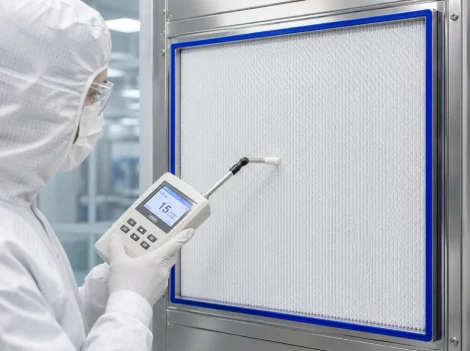
Las pruebas de fugas del filtro HEPA son importantes porque el aire sin filtrar puede pasar alrededor del paquete de medios filtrantes, las juntas del marco o la carcasa. Un filtro HEPA con junta de gel se acopla a una carcasa de borde afilado para un ajuste perfecto. Las configuraciones disponibles incluyen H14 y U15. Una versión de 636 × 636 × 69 mm tiene una capacidad de 1000 m³/h, lo que demuestra por qué las dimensiones, el flujo de aire y el diseño del sellado deben considerarse en la misma revisión.
¿Cómo se deben comparar los filtros HEPA y ULPA?
Los filtros HEPA y ULPA deben compararse según las necesidades del proceso, no por prestigio. Los filtros HEPA para salas blancas suelen ofrecer un equilibrio entre eficiencia y resistencia. Los filtros ULPA ofrecen un mayor rendimiento de captura para procesos sensibles, pero pueden exigir más al sistema de ventilación.
Haga coincidir el filtro con la aplicación.
Los filtros ULPA para la fabricación de semiconductores pueden ser adecuados para procesos electrónicos avanzados, mientras que los filtros HEPA para salas blancas farmacéuticas suelen utilizar grados H13 o H14. Los modelos HEPA de alta temperatura emplean medios filtrantes de fibra de vidrio resistentes al calor, separadores de aluminio, selladores especiales y marcos de acero galvanizado o inoxidable, con opciones que soportan temperaturas de hasta 250 °C o 350 °C.
Los filtros de aire personalizados para salas blancas son importantes cuando la carcasa utiliza un tamaño, profundidad de marco, junta o canal de gel no estándar. Nunca dé por sentado que una tolerancia aceptable es suficiente en una sala blanca. Unos pocos milímetros pueden convertirse en una vía de derivación o en un problema de instalación.
¿Por qué Healthy Filters es un fabricante práctico de filtros para salas blancas?
Filtros saludables Admite diseños HEPA y ULPA de pliegues pequeños, pliegues profundos, tipo V, alta temperatura y con sellado de gel. También fabrica dimensiones, marcos, combinaciones de medios filtrantes y soluciones de filtración OEM personalizadas. Entre sus capacidades documentadas se incluyen la gestión de calidad ISO 9001, una sala limpia estandarizada, un centro de pruebas CADR de 30 m³, plisado de precisión, sellado e inspección de integridad. Esto resulta ideal para compradores que requieren asesoramiento técnico antes de obtener un presupuesto, especialmente para filtros de aire personalizados para salas limpias.
Preguntas frecuentes
P1: ¿Qué es la filtración de aire en salas blancas?
A: La filtración de aire en salas blancas elimina partículas suspendidas en el aire de tamaños controlados, al tiempo que mantiene el flujo de aire y el nivel de limpieza requeridos por un proceso.
P2: ¿Cuál es la principal diferencia entre los filtros HEPA y ULPA?
A: Los filtros ULPA ofrecen una mayor capacidad de retención de partículas. Sin embargo, al elegir el filtro adecuado, se deben considerar la caída de presión, la capacidad de flujo de aire, el diseño de la carcasa y el riesgo del proceso.
P3: ¿Por qué es importante la caída de presión del filtro HEPA en salas blancas?
A: Una mayor resistencia hace que los ventiladores trabajen más y puede reducir el flujo de aire. Compare la caída de presión con el mismo flujo de aire nominal.
P4: ¿Qué factores influyen en la frecuencia de sustitución de los filtros de las salas blancas?
A: La frecuencia de reemplazo de los filtros de la sala limpia depende de la carga de polvo, la presión diferencial, los resultados de las pruebas, las horas de funcionamiento y las normas de mantenimiento.
P5: ¿Se pueden encargar filtros de aire personalizados para salas blancas?
R: Sí. Un fabricante de filtros HEPA a medida puede ajustar las dimensiones, los materiales del marco, el medio filtrante, la clase de eficiencia, los sellos y los objetivos de flujo de aire.