
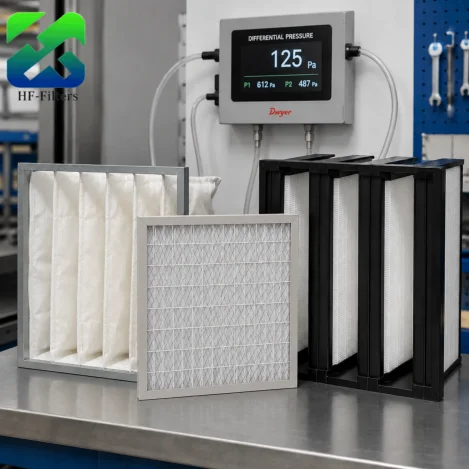
Un presupuesto de filtro muestra el precio de hoy, no lo que la unidad de tratamiento de aire (UTA) podría consumir durante las próximas 8760 horas. Un filtro de $100 puede parecer razonable, pero una mayor caída de presión del filtro de aire puede generar un costo energético mucho mayor para el filtro de HVAC. Cuando compara Filtros de aire para sistemas HVAC comercialesCéntrese en el coste total de propiedad del filtro de aire, no solo en el precio unitario.
¿Por qué el filtro más barato puede costar más?
Un filtro permanece en la corriente de aire mientras el ventilador está en funcionamiento. Su resistencia afecta el consumo de electricidad, el flujo de aire, el mantenimiento y el momento de reemplazo. Una menor resistencia puede ayudar a que la unidad de tratamiento de aire (UTA) proporcione el flujo de aire de diseño con menos esfuerzo.
Precio unitario frente al coste del ciclo de vida del filtro de aire
El costo total de propiedad de un filtro de aire incluye el filtro, el consumo de energía del ventilador, la mano de obra, la eliminación y el tiempo de inactividad. Ahorrar $20 o $30 una sola vez puede no ser útil si el filtro opera con una caída de presión promedio mayor durante todo el año. En un sistema de volumen de aire constante, el ventilador podría acelerarse. En otro sistema, el flujo de aire podría simplemente disminuir. Ninguno de los dos resultados es una buena inversión.
¿Qué es la caída de presión en un filtro de aire?
Caída de presión del filtro de aire La diferencia de presión estática se mide antes y después de un filtro. Representa la resistencia al flujo de aire. Un filtro de aire con baja caída de presión debería reducir esa resistencia sin dejar de cumplir con los requisitos de eficiencia y capacidad de retención de polvo.
Caída de presión inicial, promedio y final
La caída de presión inicial se aplica a un filtro limpio con un caudal de aire determinado. La caída de presión promedio abarca la vida útil y proporciona una base más sólida para las estimaciones de consumo energético. La caída de presión final indica el límite de reemplazo. Un valor inicial bajo puede parecer bueno, pero aumenta rápidamente tras la acumulación de polvo. Este detalle suele pasarse por alto con sorprendente frecuencia.
Comparar el mismo punto de operación
No compare la caída de presión de los filtros de las unidades de tratamiento de aire (UTA) a menos que el tamaño, la eficiencia y el caudal de aire nominal sean similares. Los datos de Healthy Filters indican que los prefiltros de panel G3 tienen una caída de presión inicial de 30 Pa y un caudal de 3200 m³/h, mientras que las versiones G4 tienen una caída de presión de 35 Pa con el mismo caudal de aire. Su material filtrante varía de M5 a F9, y su resistencia aumenta de no más de 6 Pa a 25 Pa a medida que aumenta la eficiencia. Las condiciones de prueba son importantes.
¿Cómo puede afectar un aumento de 60 Pa al coste de la energía?
El siguiente cálculo es solo un ejemplo. Los resultados reales dependen de:
- Volumen de flujo de aire
Horario de funcionamiento
• Eficiencia del ventilador
• Coste de la electricidad
·Diseño del sistema
Asumir:
Caudal de aire: 10.000 CFM (aproximadamente 4,72 m³/s)
Tiempo de funcionamiento: 8.760 horas/año (funcionamiento 24/7)
Caída de presión adicional del filtro: 60 Pa
Eficiencia del sistema de ventilación: 60%
Consumo de energía adicional:
Potencia = Flujo de aire × Caída de presión ÷ Eficiencia del ventilador = 4,72 × 60 ÷ 0,60 ≈ 472 W
Consumo energético anual: 472 W × 8760 horas ≈ 4135 kWh/año
Con una tarifa eléctrica de 0,12 $/kWh:
Coste energético anual adicional: ≈ 496 dólares al año
Este coste no se debe al precio del filtro en sí, sino a la resistencia adicional al flujo de aire que genera el filtro.
¿Qué debes solicitar?
Solicite datos sobre la caída de presión inicial, la caída de presión promedio o una curva de carga, la caída de presión final, el caudal de aire nominal, la clase de eficiencia y la capacidad de retención de partículas grandes. Esto permite una comparación justa del costo del ciclo de vida del filtro de aire.
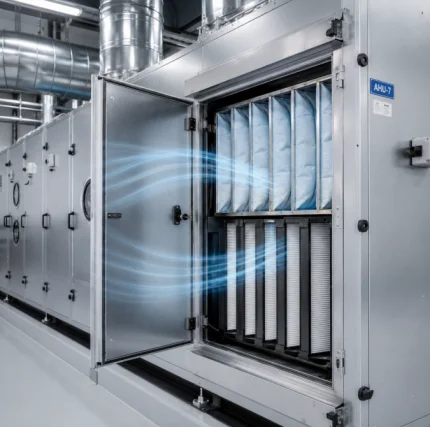
¿Qué filtro de aire de baja caída de presión se adapta a su unidad de tratamiento de aire (UTA)?
La elección correcta depende de la profundidad del gabinete, la carga de polvo, la eficiencia, el flujo de aire y la facilidad de cambio. Un filtro HVAC de baja resistencia debe ajustarse y sellar correctamente.
Opciones de bolsillo, panel y banco en V
Un filtro de aire sintético de bolsillo utiliza varios bolsillos para aumentar la superficie de filtración y la capacidad de retención de polvo. Las especificaciones del producto describen una filtración multicapa M5 a F9, baja resistencia y construcción personalizable. Un filtro de panel plisado es adecuado para la prefiltración; entre sus características destacan una gran superficie de filtración, baja resistencia inicial y tamaños personalizados.
A Filtro HEPA en V Coloca paquetes de minipliegues dentro de un marco compacto. El catálogo ofrece estructuras de 4V y 5V con una superficie de filtrado de 8,4 a 27 m². Esto permite crear un filtro de aire de alto flujo y, según datos de pruebas verificados, un filtro HEPA de baja caída de presión.
Redacte una mejor solicitud de cotización (RFQ)
Indique las dimensiones, el caudal nominal, la eficiencia, la caída de presión inicial máxima, la caída de presión final, las horas de funcionamiento, la temperatura, la humedad, el material del marco y la cantidad del pedido. Para un filtro de aire HVAC personalizado, incluya la profundidad de la carcasa y los detalles de sellado. Pregunte al proveedor del filtro de aire personalizado qué caudal se utilizó para cada valor de caída de presión.
Filtros saludables y diseño de baja resistencia
Filtros saludables Es un fabricante de filtros de aire para sistemas HVAC con capacidad de producción de paneles, bolsillos, V-bank, HEPA, carbón y medios filtrantes. Sus materiales ofrecen dimensiones personalizadas, número de bolsillos, opciones de marco, grados de medios filtrantes y opciones de flujo de aire o caída de presión. El soporte OEM abarca muestras y producción en serie, respaldado por un sistema de calidad ISO 9001, un centro de pruebas CADR e instalaciones de sala limpia. Esto resulta útil cuando se necesitan filtros de aire de alta eficiencia energética para una unidad de tratamiento de aire (UTA) real.
Preguntas frecuentes
P1: ¿Qué se considera una buena caída de presión en un filtro de aire?
R: No existe un único valor. Compárelo con el mismo flujo de aire, tamaño, eficiencia y condiciones de prueba.
P2: ¿Una mayor eficiencia siempre implica una mayor resistencia?
R: No. El material, la profundidad, el espaciado de los pliegues y el área efectiva también afectan la resistencia.
P3: ¿Debería compararse la caída de presión inicial o la caída de presión promedio?
A: Compare ambos, pero la caída de presión promedio refleja mejor el consumo de energía del ventilador durante su funcionamiento.
P4: ¿Cuándo se debe reemplazar un filtro de aire acondicionado?
A: Utilice la presión diferencial, el flujo de aire, las condiciones de polvo y la caída de presión final indicada, no solo el tiempo.
P5: ¿Puede un filtro de aire de baja caída de presión reducir el coste anual?
R: Sí, siempre que mantenga la eficiencia requerida y reduzca la resistencia promedio. Calcule el ahorro con su propio flujo de aire, horas de funcionamiento, eficiencia del ventilador y tarifa eléctrica.