
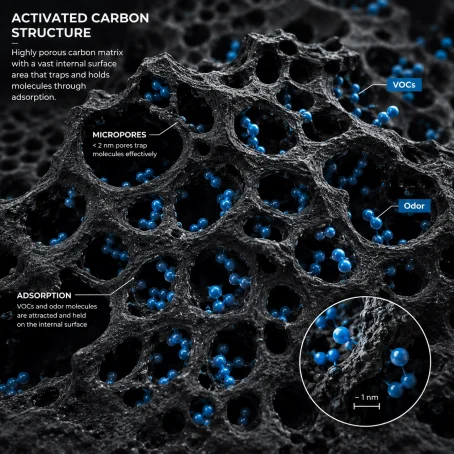
El carbón activado, también conocido como carbón vegetal activado, es una forma de carbono procesada especialmente que posee una estructura porosa muy desarrollada. Estos poros microscópicos crean una gran superficie interna, lo que permite que el carbón activado adsorba ciertos gases, olores y vapores químicos.
Ciertas moléculas de gas son atraídas y retenidas en las superficies internas de los poros del carbón activado mediante adsorción. Esto explica por qué un filtro de carbón activado Está dirigido a eliminar olores, COV y contaminantes gaseosos.
¿Qué es el carbón activado?
El carbón activado, también conocido como carbón vegetal activado, se obtiene de diversas fuentes orgánicas. Entre los materiales base más comunes se encuentran la cáscara de coco, el carbón mineral y la madera. En un filtro de aire de carbón activado, la estructura interna de los poros determina su eficiencia general. La cantidad de carbón por sí sola no determina el rendimiento del filtro. El tipo de carbón, la estructura de los poros, la carga, el flujo de aire y el contaminante objetivo también son factores importantes.
¿Qué formas puede adoptar el carbono como material de soporte?
Los filtros de carbón activado se presentan en diversas configuraciones. Entre los formatos disponibles se incluyen polvo, gránulos, fibra de carbono o espuma de carbono. También se puede encontrar el carbón suspendido entre capas de tela no tejida.
Entre las variantes de producto se incluyen el carbón de coco, el carbón de columna, el carbón de bambú y el carbón tipo sándwich. Naturalmente, los distintos gases requieren diferentes tipos de medios filtrantes.
¿Cómo funcionan los filtros de carbón activado?
La adsorción sigue siendo el mecanismo fundamental detrás del funcionamiento de los filtros de carbón activado. Los contaminantes nunca se empapan simplemente en la sustancia. En cambio, durante adsorción de carbón activadoLas moléculas de gas objetivo se adhieren firmemente a las superficies internas de los poros.
Finalmente, estos sitios de unión alcanzan su capacidad máxima. El rendimiento se degrada posteriormente. En ese momento, es necesario reemplazar el filtro.
¿Por qué son importantes la carga y el flujo de aire?
Una mayor superficie de carbón activada crea más sitios de adsorción, pero el flujo de aire aún debe pasar a través del filtro. La carga de carbón activado, la profundidad del medio filtrante, el tiempo de contacto y la caída de presión del filtro de carbón activado deben considerarse en conjunto. Una capa más gruesa no siempre es mejor.
¿Qué elimina un filtro de carbón activado?
Entonces, ¿qué elimina el filtro de carbón activado en los equipos reales? Se selecciona principalmente para eliminar olores y gases, en lugar de como filtro principal para partículas finas.
Olores y COV
Un filtro de olores de carbón activado Puede reducir los olores de la cocina, de las mascotas, del humo y de los vapores no deseados. Para aplicaciones de COV (compuestos orgánicos volátiles), la selección del medio filtrante de carbón se vuelve más específica, ya que los diferentes contaminantes pueden requerir características de carbón distintas.
Los datos del producto incluyen medios de carbono para la adsorción de benceno y formaldehído, pero los resultados varían según el tipo de carbono, la carga, el flujo de aire, la humedad y la estructura.
Filtro de carbón activado vs. filtro HEPA: ¿Cuál es la diferencia?
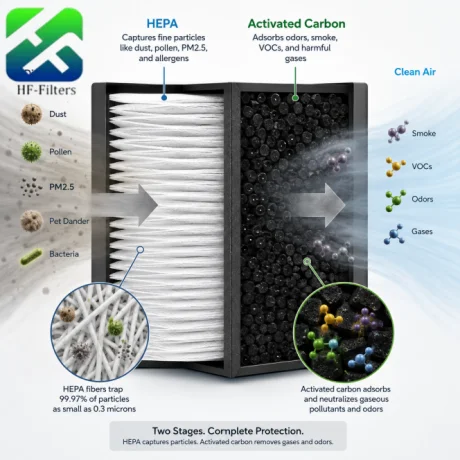
La comparación entre filtros de carbón activado y filtros HEPA se reduce al tipo de contaminante. Los filtros HEPA están diseñados para la filtración de partículas, mientras que el carbón se utiliza principalmente para la adsorción de gases y olores.
¿Por qué combinar ambos?
Un sistema de filtros HEPA y de carbón activado cubre ambas necesidades. El filtro HEPA retiene las partículas finas; el carbón, los olores y los gases. Un filtro de carbón activado para purificadores de aire puede ser de tipo panal, tipo sándwich o combinado con un filtro HEPA plisado.
¿Cómo elegir un filtro de carbón activado?
Al elegir un filtro de carbón activado, comience por el contaminante objetivo en lugar de solo por el tamaño del filtro. Un problema de olor en la cocina parece sencillo, pero agregar más carbón puede aumentar la resistencia y reducir el flujo de aire.
Verifique los principales factores de diseño.
Considere el tipo de carbón, la cantidad de carbón activado, el gas objetivo, las dimensiones, el flujo de aire y la caída de presión. Un filtro de carbón activado a medida es la mejor opción cuando una hoja de cálculo estándar no logra equilibrar estos factores.
Los filtros de carbón activado no tienen una vida útil fija. El momento de reemplazar el medio filtrante de carbón activado depende de la carga de contaminantes, el tiempo de funcionamiento, el flujo de aire, la humedad y la cantidad de carbón.
¿Cuándo es importante el diseño personalizado de un filtro de carbón?
Una vez que el tipo de carbón, la carga, el flujo de aire y la geometría se influyen mutuamente, la capacidad del proveedor pasa a formar parte de la decisión sobre el filtro. Filtros saludables Desarrollamos filtros de carbón activado a medida para purificadores de aire, equipos de ventilación y tratamiento de aire industrial. Entre los materiales disponibles se incluyen carbón de coco, carbón a base de carbón mineral, carbón tipo sándwich, fibra de carbono y espuma de carbono.
Varios modelos de filtros utilizan más de 70, 90 o 150 g/m² de carbón activado, con distintos niveles de espesor y resistencia. Healthy Filters puede ajustar el tipo de carbón, la cantidad de relleno, las dimensiones, el espesor, el marco y la estructura de filtración a partir de planos, muestras o requisitos de la aplicación. Esta flexibilidad resulta útil cuando se necesita un filtro de carbón activado OEM en lugar de una pieza estándar.
Para los compradores que comparan un fabricante o un proveedor de filtros de carbón activado, estas decisiones de ingeniería importan más que una larga lista de características.
Si busca un filtro de carbón activado personalizado para su aplicación, no dude en contactar con Healthy Filters. Podemos desarrollar el filtro a partir de sus planos, muestras, dimensiones, requisitos de flujo de aire y necesidades específicas.
Preguntas frecuentes
P1: ¿Qué es el carbón activado?
A: Se trata de un carbón poroso diseñado para proporcionar una gran superficie donde se puedan adsorber determinados gases, olores y vapores químicos.
P2: ¿El carbón activado elimina el formaldehído?
R: Puede adsorber formaldehído, pero los resultados dependen de la formulación del carbón, la carga, el flujo de aire y el diseño del filtro.
P3: ¿Puede el carbón activado eliminar el humo?
R: Puede reducir los olores y gases del humo. Las partículas finas de humo se eliminan mejor con filtros HEPA.
P4: ¿Más carbono siempre es mejor?
R: No. Un mayor contenido de carbono puede aumentar la capacidad, pero también puede afectar el flujo de aire y la resistencia.
P5: ¿Se puede personalizar un filtro de carbón activado?
R: Sí. El tipo de carbono, la cantidad de relleno, el tamaño, el marco y la estructura se pueden adaptar a la aplicación.