
¿Qué es un filtro HEPA?
¿Está buscando un filtro para una sala limpia, un sistema de tratamiento de aire de hospital o un purificador? En estos entornos, HEPA significa Filtro de Aire de Partículas de Alta Eficiencia. Los filtros HEPA están diseñados para eliminar partículas muy pequeñas en suspensión en el aire. filtro HEPA Normalmente consiste en un material filtrante plisado ensamblado dentro de un marco y sellado para evitar el paso del aire.
Atrapa activamente partículas microscópicas. Las pruebas oficiales determinan las clasificaciones específicas. Según la clasificación EN 1822, un filtro H13 tiene una eficiencia mínima del 99,95 % a MPPS, mientras que un filtro H14 tiene una eficiencia mínima del 99,995 % a MPPS.
¿Qué retiene el filtro HEPA?
Puede capturar polvo, polen, partículas de humo, aerosoles y otras partículas finas en suspensión. Sin embargo, para los gases se requiere carbón activado. Además, un prefiltro suele eliminar previamente los residuos de mayor tamaño.
¿Cómo funciona un filtro HEPA?
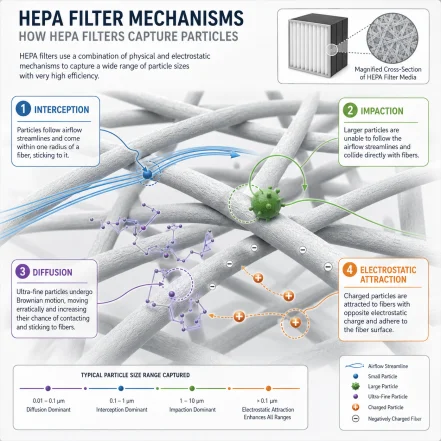
El aire pasa a través de densas redes de fibras. El material filtrante retiene partículas de distintos tamaños mediante métodos específicos. Por lo tanto, su funcionamiento es diferente al de una malla física convencional.
¿Cuáles son los principales mecanismos de filtración?
La intercepción atrapa cualquier partícula que roce una fibra. El impacto fuerza a las partículas más pesadas a salir de la corriente de aire para colisionar con el medio. La difusión provoca que las partículas ultrafinas se desplacen erráticamente hasta entrar en contacto. La atracción electrostática a veces proporciona una fuerza magnética adicional. En conjunto, estos mecanismos garantizan una eficacia notable. eficiencia del filtro HEPA.
¿Cuál es la diferencia entre H13 y H14?
H13 y H14 indican grados de rendimiento, no formas físicas. Según la norma EN 1822, H13 y H14 se clasifican según su eficiencia en MPPS. H13 tiene una eficiencia mínima del 99,95 %, mientras que H14 tiene una eficiencia mínima del 99,995 %. H14 generalmente proporciona una mayor eficiencia de eliminación de partículas, pero también puede resultar en una mayor caída de presión, dependiendo del medio filtrante y el diseño del filtro. Siempre verifique la capacidad de su ventilador antes de actualizarlo.
¿Qué son los medios y estructuras de los filtros HEPA?
El material filtrante, los separadores, el marco y el sello funcionan como un conjunto. Una fuga en la junta puede anular el buen rendimiento del material filtrante.
¿Qué estructuras son comunes?
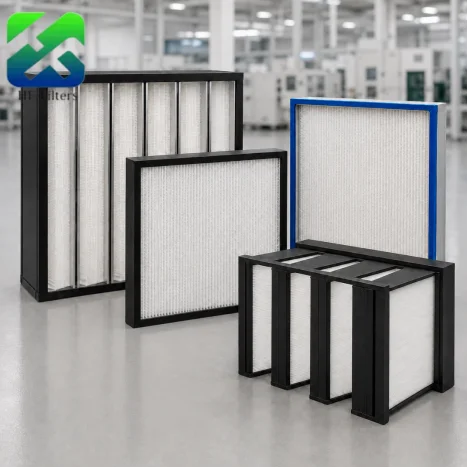
A filtro HEPA de minipliegues Utiliza fibra de vidrio superfina o material filtrante de PP con adhesivo termofusible o hilos de fibra de vidrio. Las unidades de pliegue profundo utilizan separadores de papel o papel de aluminio. Un filtro HEPA de tipo V pliega los paquetes en un banco compacto para una mayor superficie filtrante.
Un filtro HEPA Gel Seal utiliza un marco de aluminio, un sellador de poliuretano de dos componentes y protectores frontales. Los filtros HEPA de alta temperatura pueden emplear fibra de vidrio resistente al calor, selladores de alta temperatura y componentes metálicos diseñados para aplicaciones a temperaturas elevadas. Según su construcción, algunos diseños pueden estar optimizados para temperaturas de hasta 250 °C o 350 °C.
¿Cómo influyen la caída de presión y el flujo de aire en la selección?
La caída de presión del filtro HEPA es la resistencia que el ventilador debe superar. Una mayor superficie del medio filtrante suele favorecer el flujo de aire del filtro HEPA, mientras que un elemento con una granulometría más ajustada o sobrecargado aumenta la resistencia.
Los datos del producto indican unidades de minipliegues con una resistencia inicial inferior a 220 Pa y una resistencia final de referencia de 400 Pa. Los ejemplos V-bank H13 combinan aproximadamente 240 Pa con 1600 o 3200 m³/h. Verifique conjuntamente el caudal de aire nominal, la presión del ventilador, la resistencia final y la renovación del aire ambiente.
¿Dónde se utilizan los filtros HEPA?
Los hospitales, las salas farmacéuticas, las plantas de electrónica, las instalaciones de procesamiento de alimentos y las salas blancas utilizan filtros HEPA terminales. También se encuentran unidades más pequeñas en aspiradoras y purificadores.
A Filtro HEPA para purificador de aire Pueden ser cuadrados, redondos o cilíndricos, con marcos de papel, plástico o poliuretano. Muchos combinan un filtro HEPA con un prefiltro o una capa de carbón. Un intervalo de 8 a 12 meses es un punto de partida común.
¿Cómo elegir el filtro HEPA adecuado?
Confirme el grado, las dimensiones, el flujo de aire, la caída de presión, la temperatura, el tipo de sellado y el espacio de servicio. Solicite un informe de prueba de escaneo para trabajos críticos. Un filtro HEPA personalizado es útil para aberturas inusuales. El trabajo del fabricante de filtros HEPA debe abarcar el medio filtrante, el marco, el separador, el sellador, el embalaje y la planificación del reemplazo.
¿Qué debe buscar en un proveedor de filtros HEPA??
El proveedor debe mantener el mismo rendimiento en toda la producción. Filtros saludables Fabrica diseños de minipliegues, pliegues profundos, en V, con sellado de gel y HEPA de alta temperatura, utilizando materiales filtrantes de fibra de vidrio, PP, PET y PTFE.
Entre nuestras capacidades se incluyen tamaños personalizados, trabajos con moldes de plástico, asistencia en el diseño, una sala limpia, gestión de calidad ISO 9001 y un centro de pruebas CADR de 30 m³. Revise los formatos de los filtros HEPA y ULPA antes de enviar un dibujo o un objetivo de flujo de aire.
Preguntas frecuentes
P1: ¿Qué significan las siglas HEPA?
A: HEPA significa Filtro de Aire de Partículas de Alta Eficiencia. Se refiere a un sistema de filtración de alta eficiencia diseñado para capturar partículas finas en suspensión en el aire.
P2: ¿H14 siempre es mejor que H13?
R: Tiene mayor eficiencia, pero puede generar una mayor caída de presión. Asegúrese de que sea compatible con el ventilador.
P3: ¿Un filtro HEPA elimina los olores?
R: No. Añada carbón activado para controlar los gases o los olores.
P4: ¿Con qué frecuencia se debe reemplazar el filtro HEPA de un purificador de aire?
R: Muchos diseños utilizan entre 8 y 12 meses. La carga de polvo y las lecturas de presión pueden modificar ese plazo.
P5: ¿Se pueden fabricar filtros HEPA de un tamaño especial?
R: Sí. Se pueden personalizar las dimensiones, los marcos, los sellos, los medios filtrantes y las configuraciones OEM cuando se proporcionan los detalles del flujo de aire.