
Power demand is climbing in 2026, with AI data centers, electrification and industrial growth all adding to the load.
For power plants, that can mean longer operating hours and less room for unnecessary airflow problems.
One part of the system that rarely gets much attention outside maintenance teams is the air filter.
Gas Turbines Depend on Clean Intake Air
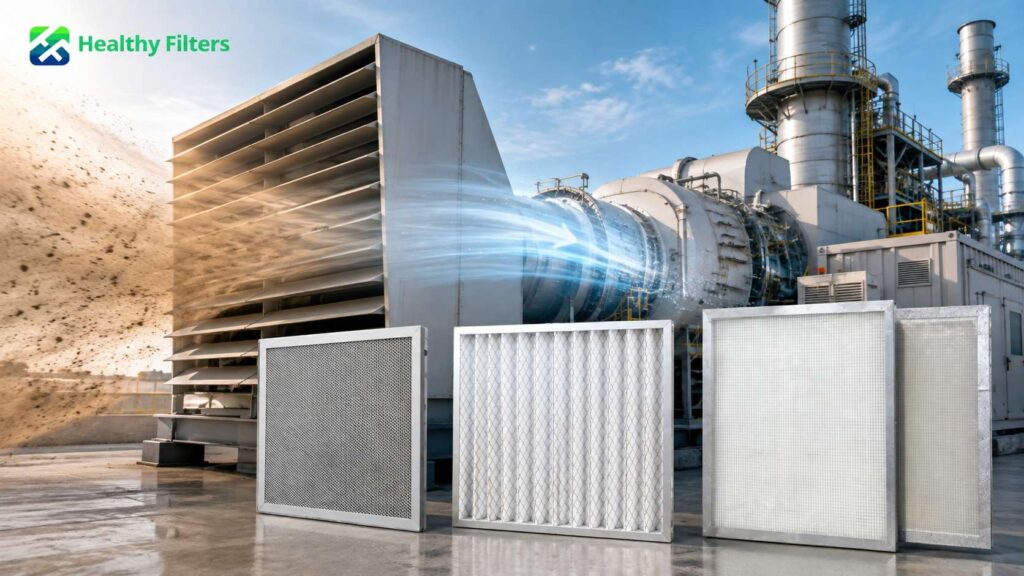
Gas turbines pull in huge amounts of outside air.
That air can bring dust, sand, pollen, salt, fine particles and industrial pollution with it.
What matters most depends on location. A desert site may deal with heavy dust. A coastal plant may see more salt and moisture. An urban or industrial site can face finer pollution.
This is why intake filtration usually needs to match the actual environment.
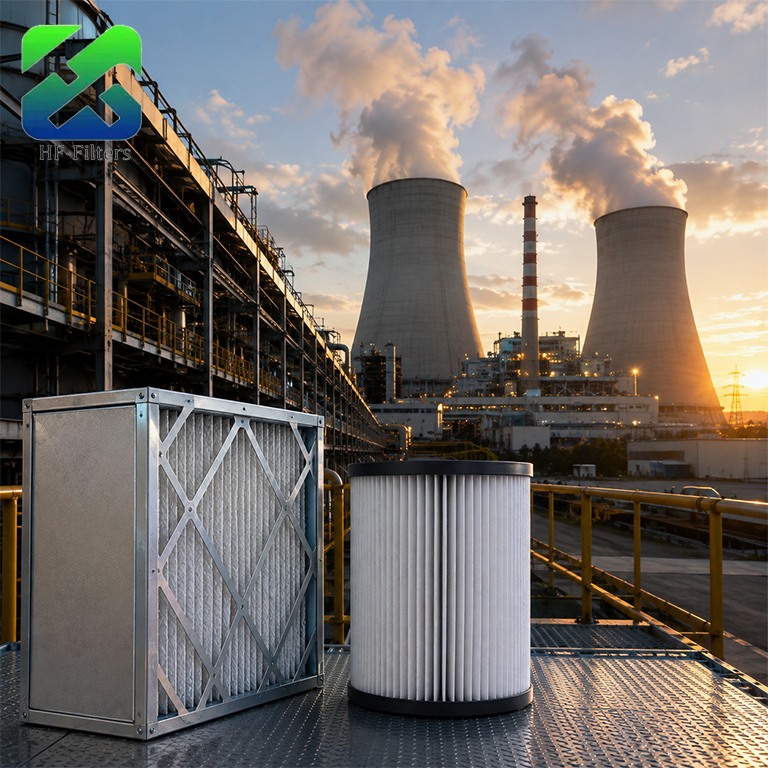
Why Several Filter Stages Are Often Used
A single filter does not always make sense for a large intake system.
A common setup starts with a pre-filter, followed by a finer filter and then a final stage if higher efficiency is needed.
Pre-filters take out larger particles first. Pocket filters and V-bank filters can then handle finer dust without putting all the load on one stage.
Healthy Filters offers these filter types for turbine intake and industrial ventilation applications.
Pressure Drop Can’t Be Ignored
A filter may look good on paper and still be a poor fit for the system.
In high-airflow equipment, resistance matters.
As filters collect dust, pressure drop usually rises. That means buyers need to look at more than efficiency. Airflow, dust capacity, service life and maintenance intervals matter too.
The highest-efficiency filter is not always the best choice if it creates too much resistance.
Local Conditions Change the Filter Choice
Power plants do not all breathe the same air.
Desert locations see sand and dust.
Coastal sites may have salt aerosols and humidity.
Industrial areas can have more fine particulate pollution.
Cold climates bring moisture, snow and ice into the picture.
This is where custom filter design starts to make sense.
Where Specialized Filters May Be Needed
Some power-generation and industrial systems operate with higher air temperatures. In those cases, high-temperature filters may be required.
Other facilities, including some nuclear-related ventilation systems, may use HEPA or gas-phase filtration depending on the actual application.
There is no single filter package that fits every part of a power plant.
Healthy Filters for Power-Generation Applications
Healthy Filters manufactures pre-filters, pocket filters, V-bank filters, HEPA filters, high-temperature filters, activated carbon filters and general ventilation filters.
Custom filters are also available for projects with unusual dimensions, airflow, pressure drop, temperature, humidity or dust conditions.
OEM/ODM support is available for equipment manufacturers, distributors and industrial customers.
Looking for air filtration solutions for gas turbines, power-generation HVAC or demanding industrial environments? Contact Healthy Filters to discuss customized filters for your operating conditions.
FAQ
Why do gas turbines need intake air filters?
Because they use large volumes of outside air. Intake filters help keep dust, sand and other airborne particles from entering the system.
What filters are commonly used in power plants?
Pre-filters, pocket filters, V-bank filters and general ventilation filters are common. HEPA, activated carbon or high-temperature filters may be used in specific areas.
Why does pressure drop matter?
Pressure drop shows how much resistance the filter adds to airflow. Too much resistance can make the filter unsuitable for a high-volume intake system.
Can Healthy Filters make custom filters for power plants?
Yes. Filters can be customized for size, media, efficiency, airflow, pressure drop, frame design and site conditions.