
A buyer once sent us a carbon report and asked a very direct question:
“BET surface area is already high. Why is the formaldehyde removal rate still average?”
This happens a lot in air purifier and HVAC filter projects. On paper, activated carbon looks powerful. Large surface area, high iodine value, dark media, thick appearance. But once it goes into a real fan system, the result may not be as strong as expected.
The reason is simple: formaldehyde is not removed by surface area alone.
Large surface area only means more pores
Activated carbon has many tiny pores. These pores help capture odor, smoke, VOCs, and some chemical gases.
For general odor removal, ordinary activated carbon can work well. That is why it is widely used in air filter products, purifier cartridges, HVAC air filter units, and industrial air filter systems.
But formaldehyde is a small and active gas molecule. It moves fast with airflow. If the carbon layer is thin, or the fan speed is high, the gas may pass through before enough adsorption happens.
So a filter may remove smell quickly, while formaldehyde data still looks general.
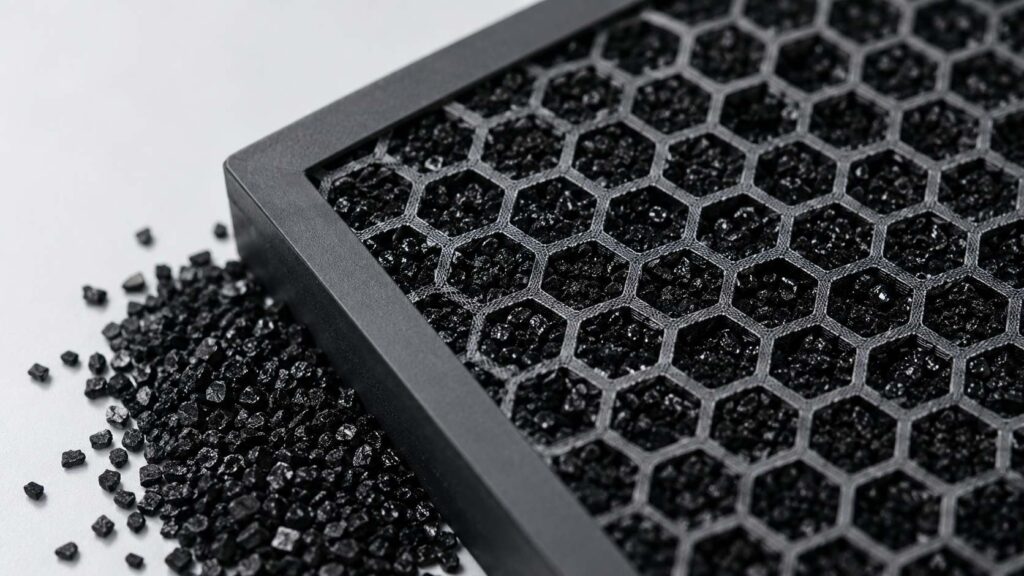
The real problem is often carbon loading
In factory sampling, we often see one issue: the media looks black, but the actual carbon content is low.
A thin carbon fabric may be fine for light odor control. For formaldehyde, it is usually not enough.
Buyers should check carbon loading, filter thickness, airflow resistance, and test condition, not only BET surface area.
At Healthy Filters, we usually ask for airflow, filter size, target gas, and expected service life before recommending an activated carbon filter. Without these details, the quote may be fast, but the filter may not fit the real job.
Ordinary carbon is weak for formaldehyde
Most standard activated carbon mainly relies on physical adsorption.
Formaldehyde often needs modified carbon media or composite gas-phase material. This can improve chemical adsorption and make the filter more suitable for formaldehyde control.
Humidity is another issue. In humid markets, water vapor takes part of the adsorption space. This is why the same activated carbon filter may perform differently in Europe, Australia, Southeast Asia, or coastal industrial sites.
Airflow speed matters more than many buyers expect
A carbon filter needs contact time.
If the purifier is compact and the fan is strong, the air passes too quickly. If an HVAC system has limited filter depth, the same problem appears.
Adding more carbon is not always the answer either. Too much carbon can raise initial pressure drop and reduce airflow.
A practical design needs balance:
- Enough carbon loading
- Suitable media depth
- Low initial resistance
- Proper airflow speed
- Pre-filter protection
- Formaldehyde test data under real conditions
Healthy Filters produces activated carbon filter, H13/H14 HEPA filter, HVAC air filter, industrial dust removal filter, bag filter, and custom replacement air filter products. For formaldehyde projects, we prefer adjusting the media formula instead of simply making the filter thicker.
How buyers can avoid wrong selection
Do not judge an activated carbon filter by one number.
Ask these questions before placing an order:
- Is it for odor, VOCs, formaldehyde, or mixed gas?
- What is the carbon loading?
- What is the initial pressure drop?
- What airflow was used in testing?
- Is the carbon modified?
- How long is the expected replacement cycle?
For air purifier OEM brands, the common structure is HEPA plus activated carbon. The HEPA filter removes particles. The carbon layer handles gas and odor.
For HVAC contractors, MERV grade, frame strength, air volume, and pressure drop must be checked together.
For industrial buyers, dust should be filtered first. If dust blocks the carbon surface, service life drops quickly.
Healthy Filters supports custom size, media formula, frame, logo, and packaging. Our Shenzhen factory has a 10,000㎡ workshop, automated lines, and monthly capacity of 500,000+ filter elements. Regular orders can usually ship in 7–10 days, and custom quotation plans can be prepared within 72 hours after receiving drawings or working conditions.
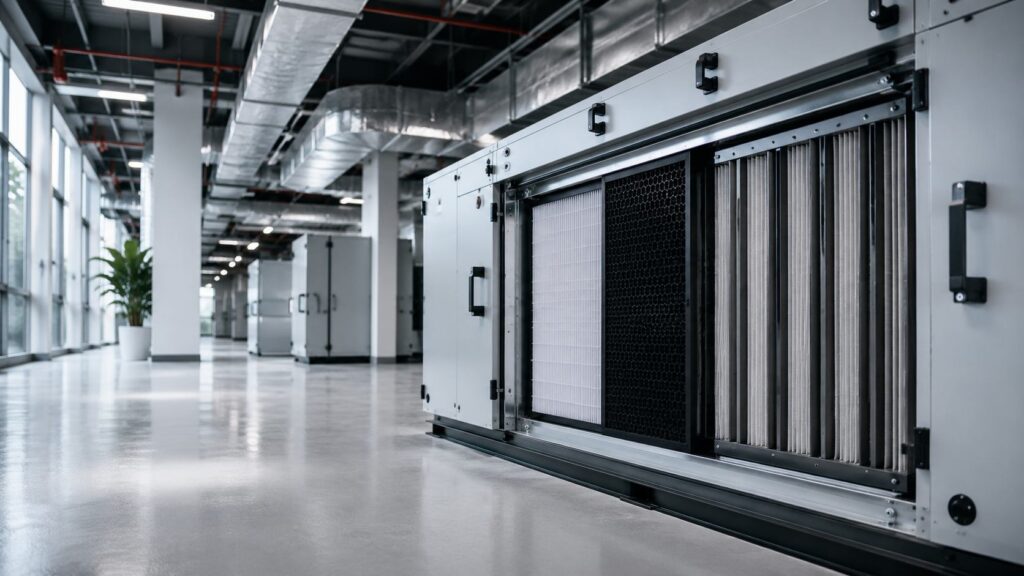
When should activated carbon filters be replaced?
For home air purifiers, many carbon filters are replaced every 3–6 months.
For HVAC air filter systems, replacement depends on airflow, pressure drop, outdoor air quality, and odor breakthrough.
For industrial air filter use, working hours, gas concentration, humidity, and pressure differential matter more than calendar time.
One small reminder from factory experience: gas filters often fail before they look dirty. If formaldehyde control is important, do not wait until the filter turns dusty.
FAQ
Does activated carbon remove formaldehyde?
Yes, but ordinary activated carbon is often limited. Modified activated carbon is usually better for formaldehyde removal.
Why is odor removal better than formaldehyde removal?
Many odor molecules are easier to adsorb. Formaldehyde is smaller, more volatile, and needs better media design.
Can HEPA remove formaldehyde?
No. HEPA removes particles such as dust, pollen, PM2.5, and aerosols. Formaldehyde is a gas.
Is high BET surface area enough?
No. Carbon loading, pore structure, airflow speed, humidity, and chemical treatment are also important.
How long does an activated carbon filter last?
Home use is usually 3–6 months. HVAC and industrial systems depend on airflow, gas level, humidity, and working hours.
Can Healthy Filters customize activated carbon filters?
Yes. Healthy Filters can customize size, shape, media formula, carbon loading, frame, logo, and packaging for OEM and project orders.
Need a practical filter suggestion?
Send your drawing, airflow, target gas, and expected service life to Healthy Filters.
Our engineering team can help choose a suitable activated carbon filter structure for sample testing, OEM air purifier filters, HVAC projects, or industrial filtration systems.