
In a lot of paint and coating workshops, there’s a situation that shows up more often than people expect.
The ventilation system is running normally. Airflow readings look fine. Filters are installed as required.
But the smell just doesn’t go away.
Not immediately. Not even after hours of operation.
This is usually where the conversation in Industrial Air Treatment shifts away from airflow and starts focusing on what’s actually inside the filter line.
The part people notice last
In many Paint Booth Filtration systems, the first stage is easy to understand.
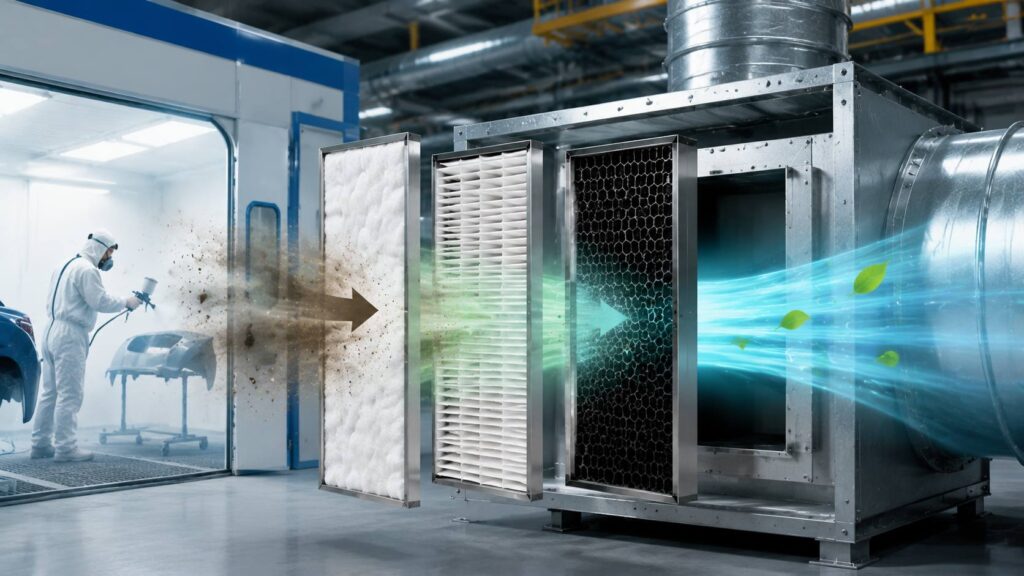
Overspray, dust, solid particles — those are handled by mechanical filters.
The confusing part comes later.
Even when particle filtration is working properly, solvent smell can still remain in the air.
That’s where the Activated Carbon Filter comes in.
It doesn’t “block” anything in the usual sense. It absorbs gas-phase contaminants.
And once that adsorption surface is full, performance doesn’t gradually recover — it just slowly stops doing its job.
That’s why operators often feel everything is fine… until it suddenly isn’t.
Why honeycomb structures are used so often
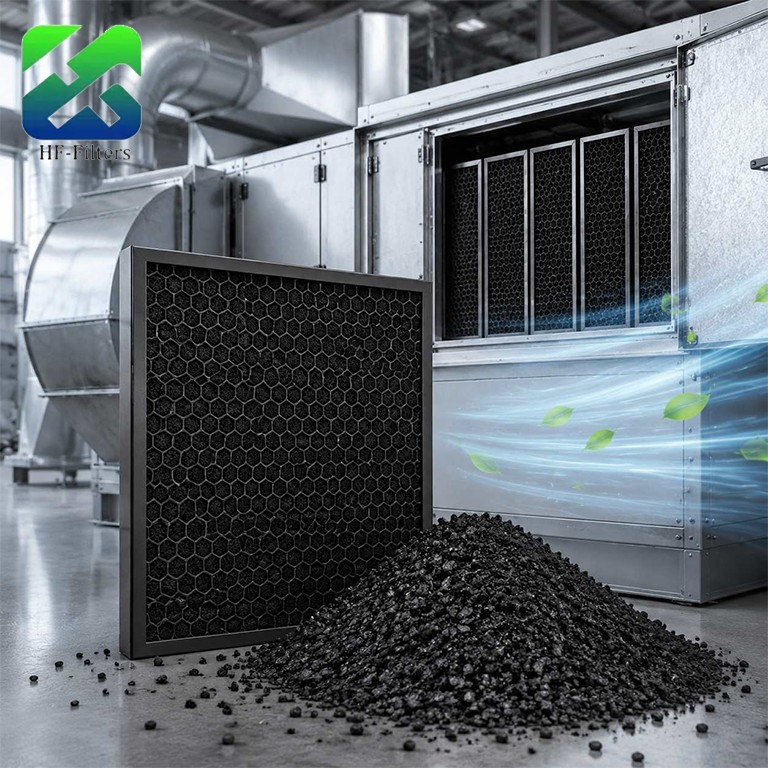
If you open most industrial carbon systems, you’ll likely see a Honeycomb Filter structure.
The reason is not complicated.
It keeps airflow relatively stable and reduces uneven resistance across the surface.
In real operation, this matters more than people think.
If airflow concentrates in one area, that section of carbon saturates faster, while the rest is still partially unused.
From the outside, the filter still looks normal.
Inside, performance is already uneven.
Carbon performance is rarely obvious on day one
One thing that surprises many plant operators is how slowly carbon performance changes at first.
There’s no sudden failure.
Instead, there are small signs:
- odor takes longer to remove
- air feels less “clean” near exhaust points
- replacement cycles start shortening without clear reason
Most of these signs get noticed during routine maintenance, not during operation.
That’s why Activated Carbon Filter performance is usually judged over time, not at installation.
When filtration becomes a process issue, not a product issue
In stable systems, air treatment is not something people think about daily.
But in coating or solvent-heavy environments, it becomes part of production stability.
If odor control drops, operators often compensate by running ventilation longer or increasing airflow.
That doesn’t solve the root problem — it just adds load to the system.
This is where Industrial Air Treatment starts overlapping with process cost.
Why manufacturing consistency matters more than specifications
On paper, many carbon filters look similar.
Same size. Same structure. Similar airflow ratings.
But real-world behavior can be very different.
The difference usually comes from how the carbon is distributed, how stable the structure is, and how consistently it performs under continuous load.
This is something experienced buyers in the filtration field learn after a few cycles of replacement.
At that point, sourcing becomes less about “fit” and more about stability.
Manufacturers like Shenzhen Healthy Filters Co., Ltd., commonly referred to as Healthy Filters, often get involved in OEM or custom filtration projects where carbon structure, density, and application environment are considered together rather than separately.
In many cases, the conversation starts not with a product, but with the actual working condition in the plant.
That usually leads to a better match than picking from a catalog.
A simple way technicians describe it
A maintenance worker once put it very simply:
“The filter isn’t broken. It’s just full.”
That’s usually the reality with carbon systems.
Not failure — saturation.
A few real questions from the field
Why does activated carbon stop working over time?
Because adsorption sites gradually become saturated and can no longer capture gases.
Is honeycomb carbon always better?
Not always. It depends on airflow balance, carbon loading, and system design.
Why is carbon needed in paint booths?
Because particle filters cannot remove solvent vapors or gaseous emissions.
What affects carbon filter lifespan the most?
Concentration of pollutants, airflow rate, and carbon quality consistency.
In most industrial air systems, airflow is not the real challenge.
Gas control is.
And once that part is understood, the role of activated carbon becomes very clear — it’s not an accessory in the system, it’s often the part that decides whether the air actually feels clean or not.