

AI clusters have changed the old rules of server room airflow. A 40-100 kW GPU rack can push much heavier heat loads than a traditional rack, so AI data center cooling now depends on cleaner air, steadier pressure, and better contaminant control. If your current setup is still a MERV 8 pre-filter plus MERV 11 main filter, it may be doing only the basic job.
Why Does AI Data Center Air Filtration Need an Immediate Upgrade?
AI data center air filtration is no longer just about keeping visible dust out. You are protecting GPUs, busbars, PCB surfaces, cooling coils, fans, and service windows. One small airflow issue can become a hot aisle problem very quickly. Anyone who has opened a dusty CRAC panel knows it is never “just a little dust.”
Higher Heat Means Lower Tolerance
AI GPU rack cooling needs stable airflow. Dust control in data centers helps reduce blocked heat sinks and clogged ventilation paths. At the same time, gaseous contamination in data centers can trigger copper sulfide corrosion, especially where humidity, outdoor air, or industrial pollution are present.
Why Is MERV 8 Pre-Filter Plus MERV 11 Main Filter No Longer Enough?
The old two-stage setup worked for many normal IT rooms, but high-density data center cooling has less room for mistakes. The filter grade, pressure drop, and service life all matter. A cheap filter that loads fast may cost more later through fan energy consumption and emergency maintenance.
Upgrade the Main Filter Layer
A MERV 13 data center filter or MERV 14 air filter is a better direction for many AI sites. Knowledge-base data shows MERV 8 media at about 40-45% efficiency, MERV 11 at 60-65%, MERV 13 at 85-90%, and MERV 14 at 90-95%, with listed resistance rising only from 4 Pa to 6 Pa in that media series. That gap is hard to ignore.
How Should You Upgrade Your Data Center Air Filtration Strategy?
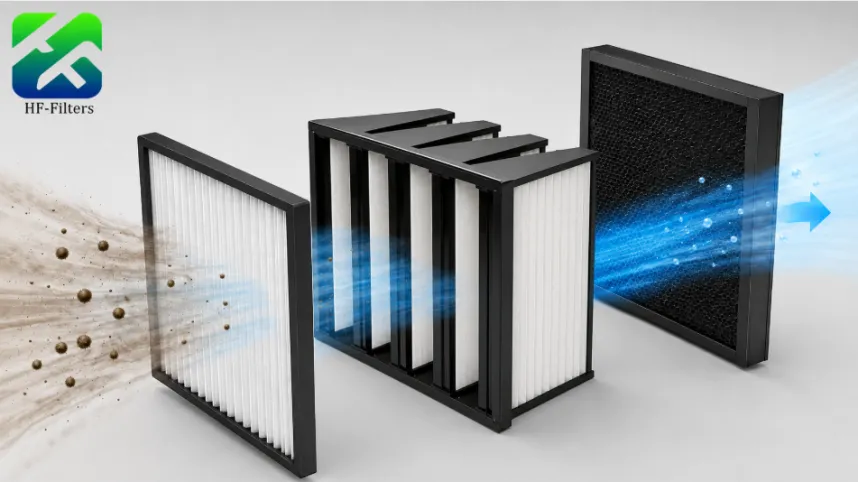
A practical data center air filtration strategy should be staged, not random. Start with a high dust holding capacity filter to protect the system, then move to higher-efficiency filtration, then add gas treatment if the site needs it.
Build a Layered System
For data center air filters, use a low pressure drop air filter at the front end to catch large particles. Then use MERV 13 air filters or MERV 14 media for fine particles. For sensitive HPC air filtration areas, a V-bank HEPA filter can help where high airflow and higher efficiency are both required.
When Should You Add Gas-Phase Filtration?
Particles are only half the story. If your site is near traffic, a coastal area, a waste facility, or industrial emissions, corrosion control in data centers becomes a real issue. That is where molecular filtration for data centers enters the discussion.
Add Activated Carbon for Risk Areas
An activated carbon filter can adsorb odor, fine dust, benzene, formaldehyde, and other volatile organic pollutants. Sandwich carbon media can combine filtration and adsorption, with customizable efficiency from 85% to 99.97%. For AI rooms, that extra layer may save you from ugly surprises three months after commissioning.
What Should Be Monitored After a Data Center Filter Upgrade?
A data center filter upgrade should not end at installation. You need feedback from the system. Otherwise, the filter is just a box in the air path.
Track Pressure, Particles, and Corrosion
Use filter differential pressure monitoring, particle monitoring, and air quality monitoring in data centers. In higher-risk locations, add copper coupon monitoring or silver coupon monitoring.
Healthy Filters is a Shenzhen OEM filter maker founded in 2016, with ISO9001 production, a 30 m³ CADR test center, cleanroom capability, and practical support for custom air filter solution projects.
FAQ
Q1: Is MERV 8 Enough for AI Data Centers?
A: It functions decently as an initial pre-filter. However, it rarely suffices as the primary defense for AI data center air filtration.
Q2: Should Data Centers Upgrade From MERV 11 to MERV 13?
A: For many AI and HPC setups, absolutely. MERV 13 traps fine particles much more effectively. Plus, properly engineered media keeps pressure drop totally reasonable.
Q3: When Should Data Centers Use Gas-Phase Filtration?
A: Apply it whenever sulfur compounds, VOCs, dampness, smog, or factory exhausts threaten the site. These specific hazards easily trigger copper corrosion indoors.
Q4: Why Is Low Pressure Drop Important for Data Center Filters?
A: Minimal resistance ensures smooth airflow. This instantly cuts fan strain. That mechanical relief is crucial since AI cooling demands are incredibly intense.
Q5: What Is the Best Air Filtration Strategy for AI Data Centers?
A: Rely on a tiered setup. Install a MERV 8 pre-filter alongside a MERV 13 or MERV 14 main filter. Add activated carbon filters if needed. Lastly, maintain continuous monitoring.