
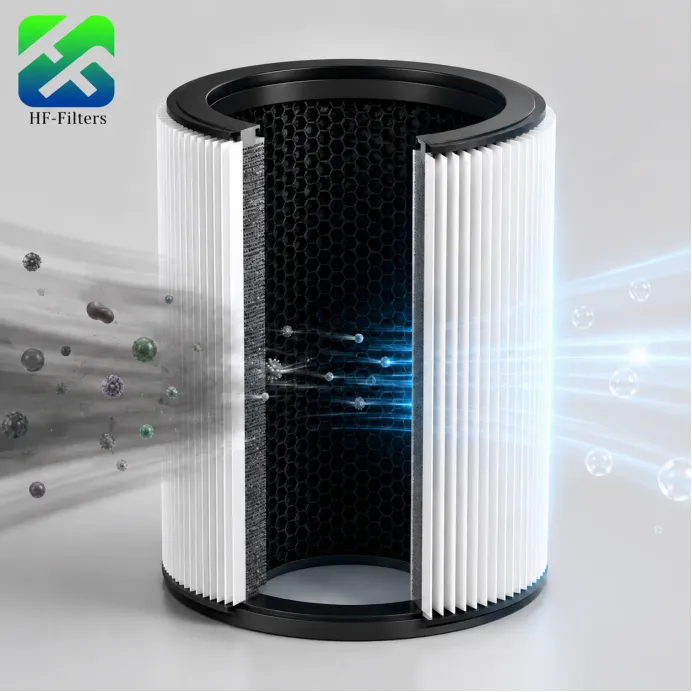
If a room smells bad after cleaning, dust is likely not the issue. Things like new furniture, fresh paint, glue, smoke, and pets make smells. Cooking oil and old shoes also give off bad scents. They put VOCs, formaldehyde, benzene, and other mixed odors into the air.
Because these are gases, a good activated carbon air purifier filter is very important. Many buyers do not realize how much they need one at first.
Why Can’t HEPA Alone Remove VOCs and Formaldehyde?
HEPA filter media is made to trap solid bits. It grabs fine dust, pollen, PM2.5, and pet dander. It stops other tiny particles too. True HEPA gives 99.97% particle filtration. That sounds great, and it really does work well for dust.
HEPA Handles Particles, Not Gas
But VOCs and formaldehyde are gas molecules, not plain dust. They will slip right through a basic HEPA layer. You must add something else to catch them. That is why an air purifier for VOCs and formaldehyde must have both HEPA and activated carbon.
How Does an Activated Carbon Filter Work?
Activated carbon is full of tiny holes. Air moves through this carbon layer. When it does, bad smells and unsafe gases get stuck inside those little holes. The idea is quite simple. Still, the way the filter is built decides if it does a good job.
Carbon Loading and Airflow Both Matter
A thin carbon layer might clear out household odors for just a little while. Then, it hits carbon filter saturation fast. But a very thick layer can block the air. This makes airflow resistance go up and drops the CADR. A smart design finds a nice balance. It gives you enough carbon, a strong shape, and a low pressure drop.
Data shows that activated carbon filter media uses powdered activated carbon to help with odor, dust, benzene, formaldehyde, and air purification. Some specs show carbon content over 70g/m², 90g/m², and 150g/m². The air resistance stays below 12Pa to 25Pa.
What Makes Sandwich Carbon Filter Media Better?
Older powdered carbon has a big flaw. It can cause carbon leakage or drop black dust. Normal cloth with low carbon is easy to make, but it fills up with bad air way too fast. This is a huge headache when you build a full product line instead of buying just one filter sample.
A Three-Layer or Four-Layer Carbon Structure
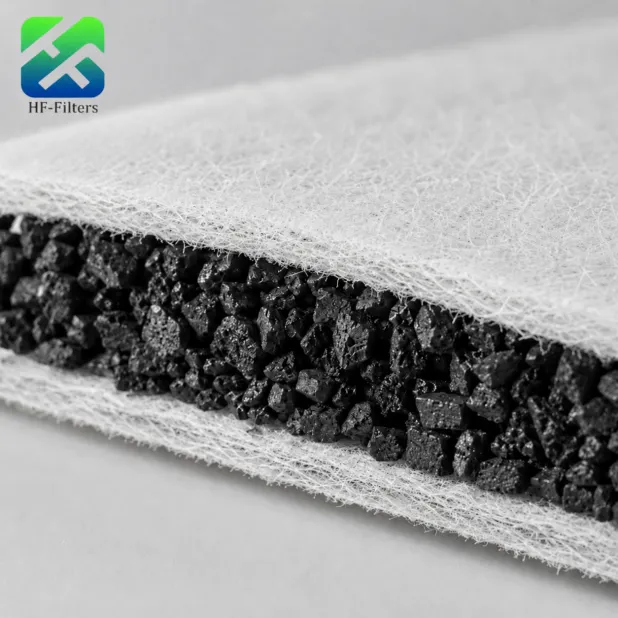
Sandwich Carbon Filter Media puts activated carbon particles safely between layers of non-woven fabric. You can also mix this sandwich carbon filter cloth with HEPA filter media. This creates a HEPA carbon filter. It handles both particle filtration and VOC adsorption.
Healthy Filters is an air filtration manufacturer in Shenzhen. They have true OEM experience, CADR testing skills, and custom filter media solutions for worldwide appliance buyers. For more gas cleaning needs, Healthy Filters carbon air filter products cut down odor, pollutants, and bad gases in air purifiers and air vents.
How Should You Choose a Carbon Air Purifier Filter?
Do not just trust a pretty product photo. You must ask about the carbon content. Ask about carbon leakage control and the pressure drop. Check the frame sealing and target gases. A filter for cooking odors might not work like a formaldehyde removal filter meant for new furniture.
Custom Structures Help Match Real Equipment
Every machine is different. For OEM air purifier filter projects, Healthy Filters offers custom HEPA carbon filter designs. They make carbon panel filters, cylindrical carbon HEPA filters, home appliance filters, and replacement air purifier filters. The company also supplies air purifier filters, formaldehyde removal filters, carbon filters, and custom air filtration solutions for many uses.
FAQ
Q1: Do Activated Carbon Filters Remove VOCs?
A: Yes. Activated carbon filters can adsorb VOCs. But how well they work depends on the carbon quality, carbon loading, airflow, and the saturation level.
Q2: Can HEPA Filters Remove Formaldehyde?
A: HEPA filters mainly grab solid particles. Formaldehyde is a gas. Because of this, a formaldehyde removal filter needs activated carbon or other gas catchers.
Q3: Is a HEPA Carbon Filter Better Than HEPA Alone?
A: Yes, if your indoor air has mixed problems. HEPA cleans up dust and small bits. The activated carbon handles VOCs, smoke smells, and other odors.
Q4: What Is Sandwich Carbon Filter Media?
A: It is a special carbon filter cloth with a three-layer or four-layer shape. It hides activated carbon particles safely between non-woven fabric layers.
Q5: Can Air Purifier Filters Be Customized?
A: Yes. You can change the size, shape, carbon layer, and HEPA grade. Frame type, coating, and cleaning power can match what air purifier brands need.