
Most complaints about air purifiers start the same way.
“The machine is running, but the air still doesn’t feel clean.”
In many cases, the purifier itself is not the problem.
The real issue is the filter inside it.
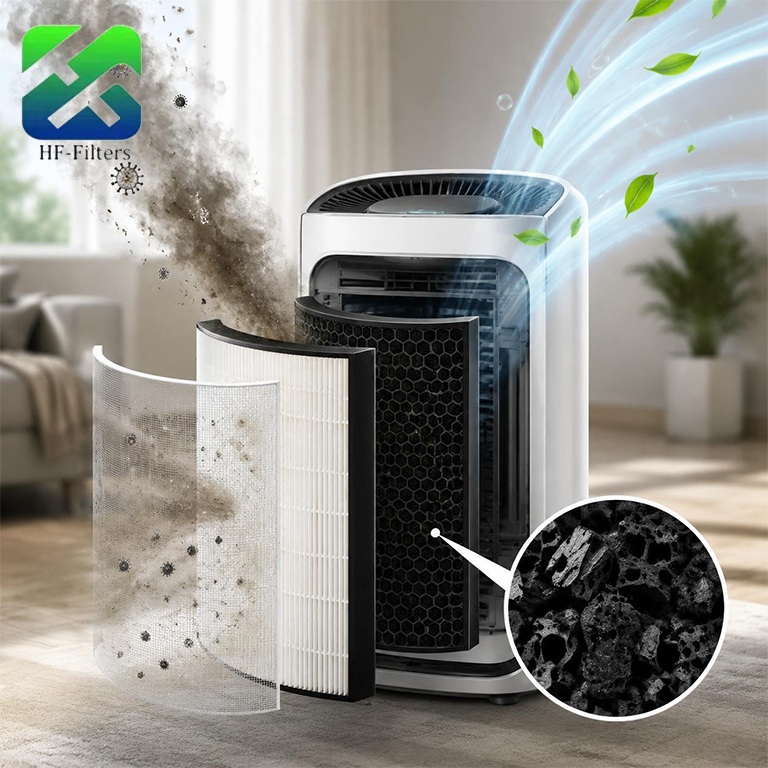
An Air Purifier Filter can look perfectly fine on the outside and still perform poorly in real use. That gap between appearance and performance is where most confusion in the air purification field comes from.
It usually doesn’t fail suddenly
An air purifier filter rarely stops working in a clear, obvious way.
Instead, performance drops gradually.
Odors stay longer in a room. Cooking smells don’t disappear as quickly. Dust seems to settle faster than expected.
People often assume the purifier is “getting weak.”
But in many situations, the airflow system is still working as designed.
What has changed is the filtration stage inside.
The hidden role of carbon in air cleaning
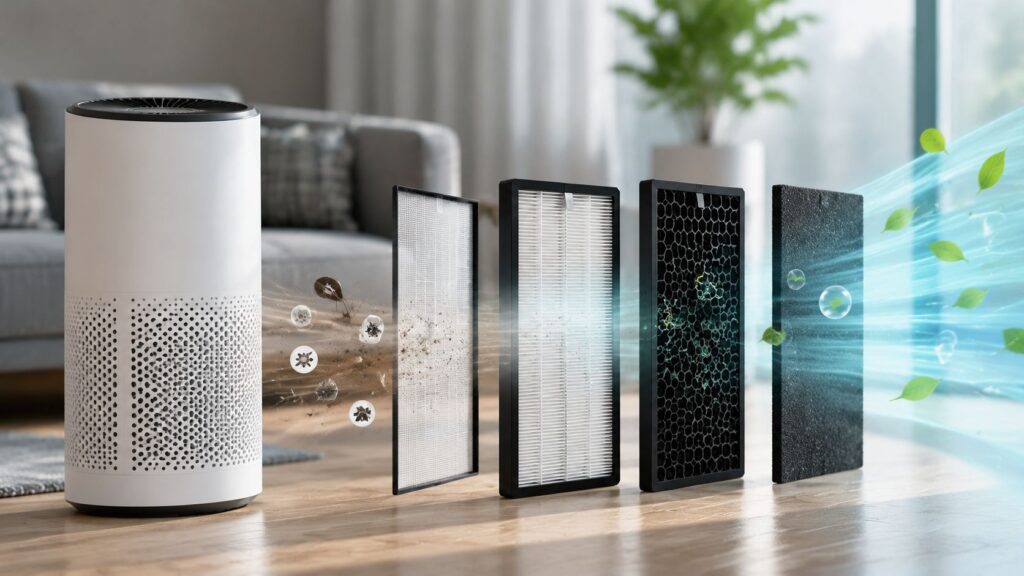
In most residential and commercial units, particle filtration and odor removal are handled separately.
A standard Air Filter Media layer captures dust, pollen, and visible particles. But gases, VOCs, and odors behave differently. They pass through mechanical fibers much more easily.
That’s where the Activated Carbon Filter comes in.
Activated carbon works through adsorption rather than physical blocking. It captures gas molecules on a microscopic surface area, which is why it is widely used in odor control and indoor air improvement systems.
When this layer becomes saturated, the purifier may still move air effectively—but it loses its ability to remove smells.
That’s often the point where users feel performance has dropped.
Not all filter media behaves the same way
Two air purifier filters can look identical and still perform differently after a few weeks of use.
The difference often comes from the quality and structure of the carbon layer.
Low-density or unevenly distributed carbon media tends to saturate quickly in high-use environments. Once that happens, airflow continues, but adsorption capacity drops sharply.
This is why filter structure matters as much as filter size.
In practical applications, engineers often focus less on appearance and more on how the Air Filter Media is layered and bonded inside the frame.
Why airflow is not the full story
A common misunderstanding is that stronger airflow means better performance.
In reality, airflow and purification are two different things.
A filter can allow air to pass through easily while doing very little in terms of odor removal if the activated carbon layer is no longer effective.
That’s why many users only notice a problem when smells return—not when airflow changes.
By that point, the carbon stage has usually reached saturation.
Activated carbon doesn’t “fix” everything—but it restores balance
Replacing or upgrading the carbon layer often brings the system back to expected performance levels.
A properly designed Activated Carbon Filter doesn’t just improve odor control. It also helps stabilize the overall filtration process by reducing the load on other filter stages.
When the carbon media performs consistently, the entire air purification system tends to operate more predictably over time.
Manufacturing quality makes the difference
In real-world use, performance depends heavily on how the filter is manufactured.
Bonding consistency, carbon distribution, and media density all influence how long the filter maintains effectiveness.
This is where production experience becomes important, especially for OEM and customized filtration products.
In ODM Manufacturing, the focus is not only on producing a filter that fits a device, but also on ensuring it performs consistently across different environments and usage conditions.
Many air purifier brands work closely with specialized manufacturers to achieve this balance.
One example is Shenzhen Healthy Filters Co., Ltd., commonly known as Healthy Filters, which supports customized air filtration solutions for different applications. In many ODM projects, the discussion is less about “what size filter is needed” and more about how the filter behaves after months of real operation.
That shift reflects how the industry has matured.
Why performance drops are often misunderstood
When an air purifier stops meeting expectations, users usually look at the machine first.
But in most cases, the issue is inside the filter system.
Dust loading in particle media. Saturation in carbon media. Changes in airflow resistance over time.
These small changes add up slowly, making performance decline feel sudden even though it isn’t.
A few practical questions users often ask
Why does my air purifier still smell even when it’s running?
The activated carbon layer may be saturated and no longer absorbing odors effectively.
Can airflow stay strong while performance drops?
Yes. Air movement and odor removal are handled by different parts of the filter system.
How long does activated carbon last?
It depends on usage, air quality, and carbon loading, but it generally weakens before particle filtration fails.
Is all air filter media the same?
No. Structure, density, and material quality can significantly affect long-term performance.
In most air purification systems, performance is not about whether air is moving.
It’s about what the air passes through while it moves.
And in many cases, the activated carbon layer is what decides whether the system still feels effective—or not.