
Someone asked me recently why a ventilation system could remove dust but still leave a room smelling like paint.
It’s a fair question.
Because most people assume all filters do the same thing.
They don’t.
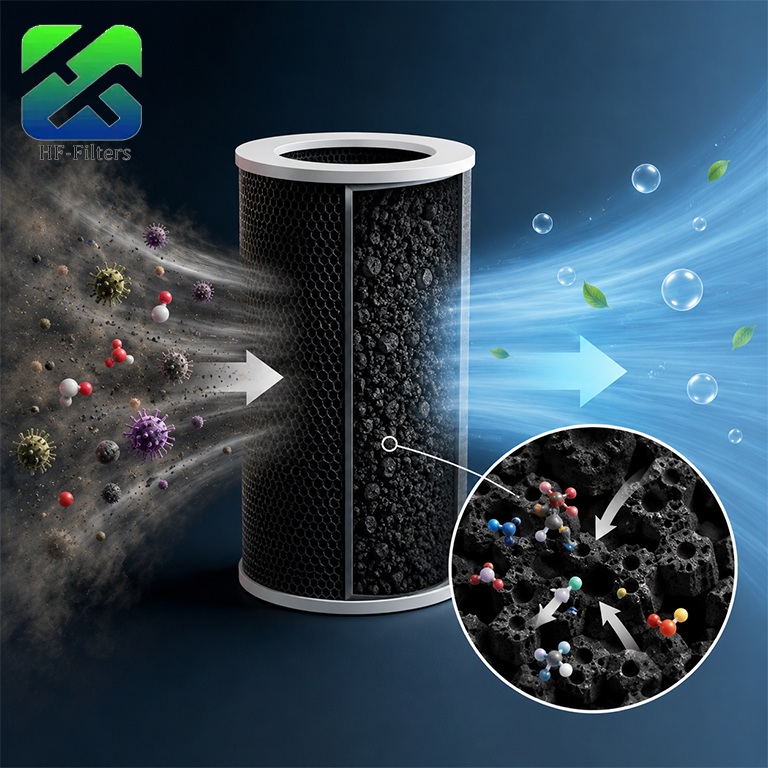
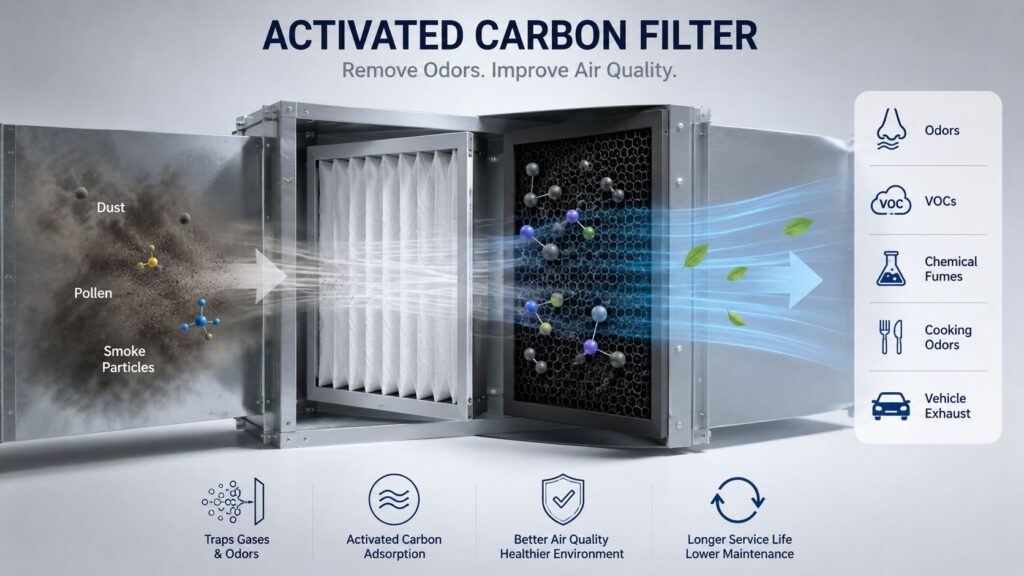
A standard filter is usually dealing with particles. Dust. Fibers. Pollen. Smoke particles.
The smell from fresh paint is something else.
The same goes for cooking odors, solvents, vehicle exhaust, and many industrial fumes.
That’s where an Activated Carbon Filter comes into the picture.
The interesting thing is that carbon doesn’t really work like ordinary filtration media.
Instead of stopping particles from passing through, it attracts certain gas molecules and holds them on the surface of the carbon itself.
Think of it this way.
A conventional filter catches things floating in the air.
Activated carbon deals with things mixed into the air.
Different problem. Different solution.
This becomes obvious in buildings that rely heavily on a Fresh Air System.
Bringing outside air indoors sounds simple enough until the building happens to be close to traffic, restaurants, loading docks, or manufacturing facilities.
Suddenly fresh air isn’t always that fresh.
The airflow may be fine.
Occupants may still complain.
Most facility managers eventually learn that air movement and air quality aren’t exactly the same thing.
One doesn’t guarantee the other.
The performance of an activated carbon filter depends heavily on the Carbon Filter Media being used.
That’s something buyers occasionally overlook.
Two filters can have identical dimensions.
Identical frames.
Even similar-looking carbon.
Yet their service life may be completely different once installed.
I’ve seen projects where the issue wasn’t the HVAC equipment.
It wasn’t the fan.
It wasn’t the ductwork.
The carbon media simply wasn’t designed for the contaminant load it was expected to handle.
The result?
Frequent replacements.
Higher maintenance costs.
Lots of frustration.
This is why many contractors now spend more time discussing applications than discussing filter sizes.
An office building, a laboratory, and a paint facility rarely need the same filtration strategy.
Treating them the same usually creates problems later.
Over the last few years, suppliers offering customized HVAC Filtration products have become increasingly popular for exactly that reason.
Companies like Healthy Filters, officially known as Shenzhen Healthy Filters Co., Ltd., often work with customers who already know that a standard catalog product isn’t always the answer.
Sometimes the difference comes down to carbon type.
Sometimes media quantity.
Sometimes airflow requirements.
Small details.
Big impact.
Especially in projects focused on long-term Clean Air Solutions rather than short-term fixes.
FAQ
Do activated carbon filters remove dust?
Not very well. Their primary purpose is odor and gas removal. Particle filtration is typically handled by other filter types.
Can activated carbon remove VOCs?
Many volatile organic compounds can be reduced through activated carbon adsorption, although performance depends on the specific contaminant and carbon media used.
How often should a carbon filter be replaced?
There isn’t a universal schedule. Service life depends on contaminant concentration, airflow, humidity, and media volume.
Are activated carbon filters used in HVAC systems?
Yes. They’re commonly installed as part of commercial and industrial HVAC filtration systems where odor and gas control is required.
One Last Thing
When people talk about air quality, they often focus on what they can see.
Dust on a surface.
Particles in sunlight.
The reality is that some of the most noticeable air quality issues are completely invisible.
And that’s exactly why activated carbon filters continue to play such an important role in modern air filtration systems.