
A filter’s pressure gauge can tell you plenty about airflow resistance. What it can’t always tell you is how well the filter is still catching particles.
Researchers brought this problem into focus in July 2026. A study published in Environmental Science & Technology found that soot from wildfire smoke could damage the electrostatic charge of certain residential HVAC filters, reducing their efficiency without much change in pressure drop. ASHRAE also addressed wildfire-related building air quality concerns in August.
The study wasn’t testing fiberglass. Its relevance here is broader: filter materials behave differently, and the conditions they face matter.
For manufacturers buying fiberglass filter media, that distinction is worth keeping in mind before choosing a grade.

Different Fiberglass Media, Different Jobs
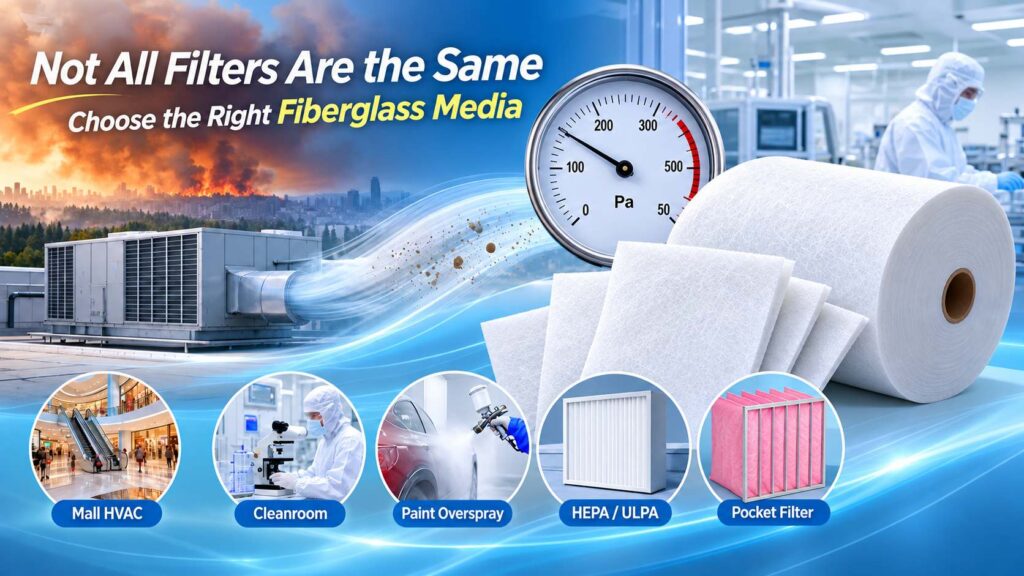
Consider the filters inside a shopping mall’s air handling system. The first stage may only need to catch lint, larger dust, and debris. Using expensive high-efficiency media there could add resistance without solving a particular problem.
Coarse fiberglass filter media is often used for this job. It can be cut into Filter Pads or assembled into Panel Filters and HVAC Pre-Filters. The relatively open fibers suit initial dust collection, usually ahead of finer filtration.
Move to a pharmaceutical cleanroom, and the requirements change completely.
Here, microfiberglass filter media is used in suitable grades for HEPA Filters, ULPA Filters, and Mini-Pleat Filters. Fine glass fibers provide the structure needed for high-efficiency mechanical filtration. Similar filters appear in electronics manufacturing and laboratories, where controlling small airborne particles is part of normal production.
Then there’s the commercial Filtro de bolsillo. Some pocket and bag filters use fiberglass-based media, with the pockets providing a larger area for airflow and dust collection. The material must also be strong enough for the intended construction and operating conditions.
Paint Stop fiberglass media belongs in another category altogether. It catches overspray in automotive paint booths, furniture finishing shops, and industrial coating lines. Manufacturers use it in Paint Arrestor Filters and Spray Booth Exhaust Filters, not as a substitute for HEPA media.
What Can We Learn from Actual Product Data?
Something easy to overlook when comparing fiberglass media is that thickness alone says very little about filtration performance.
Take three grades from the HF-GF superfine glass fiber range:
| Media Grade | Eficiencia | Resistencia |
| HF-GF-F7 | ≥40% | ≤30 Pa |
| HF-GF-H13 | ≥99.95% | ≤330 Pa |
| HF-GF-H15 | ≥99.9995% | ≤480 Pa |
According to the supplied specifications, all three have a thickness of 0.33±0.02 mm. The F7 weighs 70±5 g/m², while H13 and H15 weigh 75±5 g/m². The series also lists temperature resistance of up to 200°C and a short-duration peak limit of 300°C.
Here’s what catches my attention: H13 and H15 have the same specified weight and thickness, yet their stated efficiency and resistance limits differ.
For a buyer, that’s a good reason not to select media by appearance, thickness, or weight alone.
There’s also a missing piece in the specification: the test method and face velocity aren’t stated. Without those details, the numbers shouldn’t be used to predict finished-filter performance.
The Problem with Buying the Highest Grade
It’s tempting to assume higher efficiency means a better filter.
But suppose you’re designing a pre-filter for an existing HVAC unit with limited fan capacity. Installing unnecessarily restrictive media may increase energy demand or reduce airflow. A cleanroom filter, meanwhile, has much stricter particle capture requirements that can’t be compromised.
The same thinking applies to dust-holding capacity. A material with an attractive initial pressure drop may behave differently once it starts collecting particles.
And the roll of media isn’t the finished filter. Pleat spacing, frame design, sealing, and operating airflow affect the final result. Even good fiberglass HEPA filter media won’t prevent air leakage around a poorly sealed frame.
That’s why fiberglass filter media for HVAC equipment should be evaluated alongside the complete filter design.
Before Placing a Media Order
When speaking with a fiberglass filter media supplier, a drawing of the intended filter can be more useful than simply requesting an efficiency grade.
Will the media be pleated or used flat? Is it intended for coarse dust, fine particles, or paint overspray? What pressure drop can the equipment tolerate?
These are the details worth settling early.
Filtros saludables provides a starting point for manufacturers comparing materials for different finished-filter applications. Buyers can use their product requirements and available specifications to narrow down suitable fiberglass media options.
There’s no universal best grade. From wildfire smoke concerns to cleanroom filtration and paint overspray, the sensible choice is the material that fits the actual job. For a new filtration project, discussing those requirements with Filtros saludables is a reasonable place to begin.
Frequently Asked Questions (FAQ)
- What are the main types of fiberglass filter media?
Common types include coarse fiberglass media, microfiberglass media, fiberglass-based media for certain pocket filters, and Paint Stop media. Their fiber structures and intended particle capture applications differ.
- What products can be made from fiberglass filter media?
Depending on the grade, manufacturers can produce Filter Pads, Panel Filters, HVAC Pre-Filters, HEPA Filters, ULPA Filters, Mini-Pleat Filters, certain Pocket Filters, and Paint Arrestor Filters.
- Can fiberglass filter media be used to manufacture HEPA filters?
Yes. Specially engineered microfiberglass media is widely used in HEPA filters. However, the assembled product still needs to pass the required efficiency and leakage tests.
- How do I choose the right fiberglass filter media for my application?
Start with the finished filter and the particles it needs to capture. Then check efficiency, pressure drop, airflow, dust capacity, operating temperature, and manufacturing compatibility.