
Seasonal haze from forest and vegetation fires in Indonesia can affect air quality across parts of Southeast Asia, including Singapore and Malaysia. During haze events, fine particulate matter and other pollutants can enter indoor environments, raising concerns about indoor air quality.
What exactly should we do inside our homes when the outdoor air turns nasty? Fixing your indoor air during the haze does two huge jobs. First, it catches tiny dust. Second, it sucks up foul smoke smells.
How Does Haze Enter Indoor Spaces?
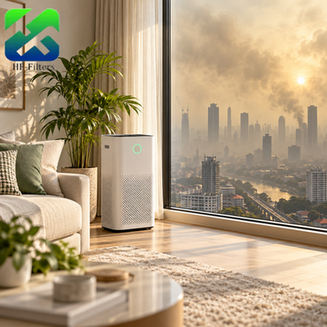
That bad outside smoke sneaks right into our living spaces. It blows through open windows and doors. It also slips past air vents and super small wall cracks. Plus, inside PM2.5 levels shoot up when you cook meals or clean up. These numbers jump when family members walk around the house.
Even a totally shut room collects dust over time. This happens if air pushes through an open vent. It also occurs when folks just step in and out of the door.
What Does PM2.5 Mean for Indoor Air?
PM2.5 basically means incredibly tiny dust bits. They measure just 2.5 micrometers, sometimes less. Outdoor reports give a rough idea for your day. Yet, an indoor monitor reveals the actual air quality right where you sleep. These readings often clash. So, keep an eye on your room’s air tool. Also, check the local forecast.
How Does a HEPA Filter Capture Smoke Particles?
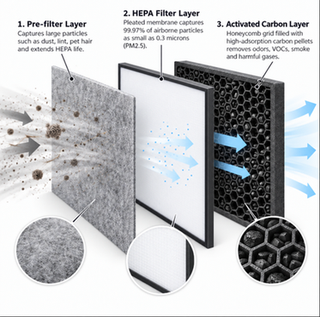
A HEPA filter for smoke particles traps floating grime easily. It pushes room air through packed fibers. The filter grade alters the outcome. Size plays a role. Wind speed, a tight seal, and run time count, too. Your portable purifier must fit the specific space. A small unit beside a massive couch simply won’t clean the air properly for a big family.
Which HEPA Data Helps You Compare Filters?
Always look at the data for air-purifier filter media at 0.3 μm: H11 at 95%, H12 at 99.5%, and H13 at 99.97%. These lab numbers let you compare how well different filters are made.
Yet, real room cleaning relies on other things. Fan speed, a tight fit, and room size are super important. Time matters too. Always read the complete device manual. Never just trust a single percentage for your entire house.
What Does Activated Carbon Do During a Haze Event?
Un activated carbon smoke odor filter grabs onto gross smells. It uses a spongy surface to trap awful gases. The honeycomb shape easily catches odors. At the same time, it lets the wind blow freely. The total amount of carbon matters a lot. Room wetness is also key. The time the air actually touches the filter changes how much smell it holds.
When Should You Add Carbon to the Filter Setup?
Put carbon in if the smoke smell sticks around. Do this right after your first filter grabs the heavy dust. The best setups group a prefilter, a HEPA layer, and a carbon layer all together. Some options use carbon media with more than 70, 90, or 150 g/m² of activated carbon.
They show benzene adsorption values from 65% to 75% for certain models. These numbers come straight from strict lab tests. Still, your own room needs its own real-world check.
What Can You Do When Outdoor Air Quality Deteriorates?
Always listen to local news. That helps you decide if you should stay outdoors. If the air gets super dirty, shut all windows and doors tight. Turn your air machines to the correct setting. Run your purifier. Make sure no furniture blocks its wind. Keep the unit near where you hang out. Putting it next to your couch might seem like a silly thing. But, proper airflow makes it work much faster.
How Should You Maintain the Filter?
Check your filter all the time for heavy dirt or rips. Make sure it fits tight inside the box. Swap it out when the manual tells you to. A basic prefilter catches big dust chunks first. This simple step keeps the inner parts totally safe. The guide lists MERV 13 media at 85% to 90% efficiency. It also shows MERV 14 media at 90% to 95% in tests. Just ensure the filter grade, size, and wind speed match your specific machine.
How Can Filter Design Support Haze-Ready Indoor Air?
Picking a filter is super easy when the maker gives you the exact fit and wind speed. Filtros saludables makes air purifier filters and carbon air filters. They also make HEPA and ULPA filters.
Plus, they build general ventilation filters. They create custom shapes, sturdy frames, and tight seals. They test everything really well. These things matter because a filter must sit perfectly inside. It stops dirty air from sneaking past the edges. Start with your machine’s size and wind speed. After that, ask for the matching media grade.
Preguntas frecuentes
Q1: Can a HEPA filter reduce PM2.5 indoor air levels?
Yes. A properly selected and installed HEPA filter can capture airborne fine particles, including PM2.5. The actual reduction in room concentration depends on the purifier’s CADR, room size, operating time, and air leakage.
Q2: Can activated carbon filters help remove smoke odors?
Yes. Activated carbon filters can adsorb many odor-causing compounds and certain gaseous pollutants associated with smoke.
Q3: What type of air filter is best for Southeast Asian haze?
The best filter depends on the pollutants you need to address. HEPA filters are designed to capture fine airborne particles, including PM2.5, while activated carbon filters can adsorb certain smoke-related odors and gaseous pollutants.
Q4: How often should you replace a haze-season filter?
Follow the maker’s manual. However, always check for heavy dirt or damage. A lot of thick smoke means you might need to swap it much sooner.
Q5: Can one filter handle particles and smoke odor?
Yes. A mixed filter uses both a dust layer and an activated carbon layer. Just check the manual for the proper media, fan speed, and lab test details.