
Un cliente de Canadá nos envió dos filtros de repuesto el año pasado. Ambos se anunciaban en línea como "HEPA verdadero".
Tras abrirlos, la diferencia era evidente.
Una de ellas utilizaba un material filtrante de fibra de vidrio denso y plisado uniformemente, con una junta adecuada alrededor del marco. La otra tenía un aspecto similar por fuera, pero la superficie filtrante era mucho menor y carecía por completo de junta de sellado.
Esa es la parte complicada de comprar filtros de aire.
La etiqueta puede decir HEPA verdaderoPero el rendimiento real de la filtración depende de mucho más que una descripción de marketing.
¿Qué significa realmente "Hepa verdadero"?
La gente suele preguntar si todos los filtros HEPA son filtros HEPA auténticos.
No exactamente.
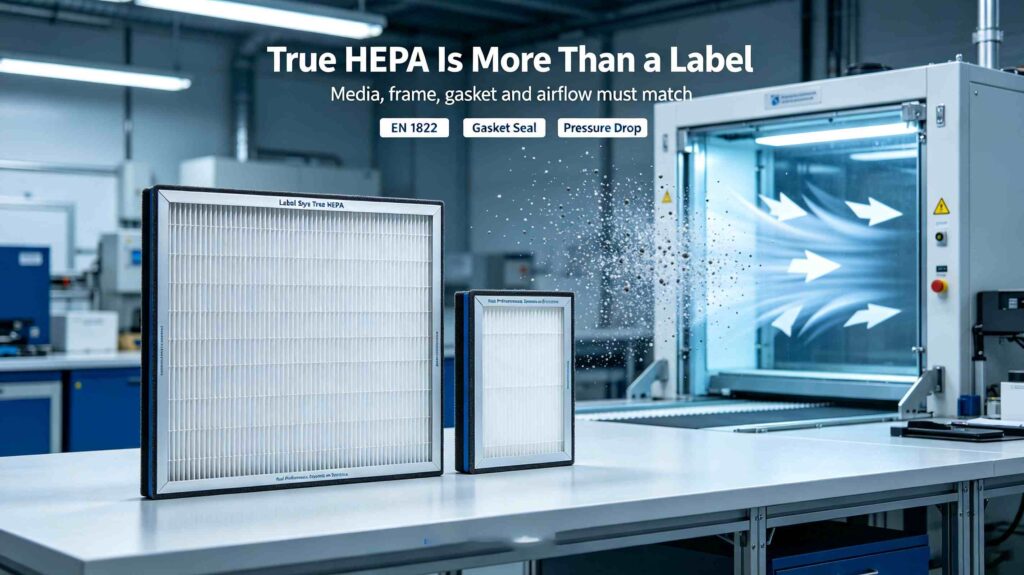
En la mayoría de los proyectos industriales y comerciales, prestamos más atención a las normas de ensayo reconocidas que a los términos publicitarios. Según la norma EN 1822, los filtros H13 alcanzan al menos 99.95% eficiencia en el tamaño de partícula más penetrante, mientras que H14 alcanza 99.995%.
Para nuestro equipo de ingeniería, el informe es más importante que el texto impreso en el paquete.
Si un proveedor no puede explicar el método de prueba o proporcionar la certificación, esa suele ser la primera señal de alerta.
Los buenos medios por sí solos no son suficientes.
Una marca de purificadores nos preguntó por qué habían aumentado repentinamente las reclamaciones de garantía.
Tras recibir varias unidades devueltas en nuestra fábrica, comprobamos que el soporte en sí funcionaba correctamente. El problema radicaba en un marco de plástico que se había deformado ligeramente durante la producción.
Incluso una pequeña abertura permitía que parte del flujo de aire sorteara el filtro.
Por eso Filtro de aire HEPA auténtico Depende de la estructura completa (medio filtrante, marco, junta y sellado), no solo de la eficiencia del filtro.
En Healthy Filters, cada proyecto de alta eficiencia comienza con el flujo de aire, la caída de presión y los detalles de instalación antes de hablar de H13 o H14.
Los diferentes entornos requieren diferentes soluciones.
Un purificador utilizado en un dormitorio tiene una tarea relativamente sencilla.
Una clínica dental, un laboratorio o un taller de electrónica son un caso aparte. El horario de funcionamiento es más prolongado, la cantidad de polvo es mayor y el flujo de aire suele ser continuo.
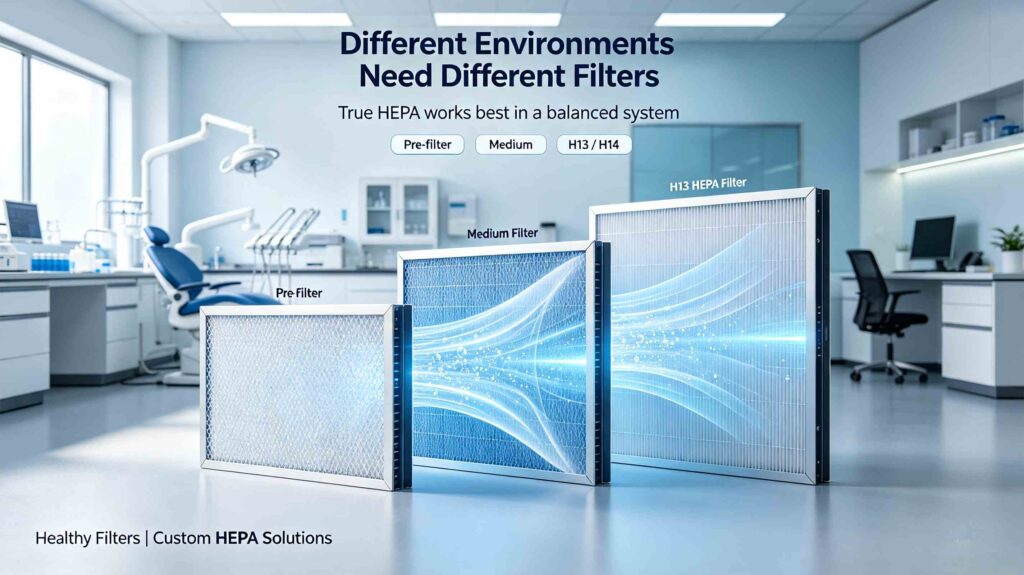
Para estos proyectos, solemos recomendar un sistema de filtración por etapas. Un filtro primario elimina primero las partículas más grandes, seguido de un filtro intermedio. La etapa True HEPA se encarga de los contaminantes finos restantes presentes en el aire.
Esa disposición suele prolongar la vida útil y mantener la caída de presión más estable.
Shenzhen Healthy Filters Co., Ltd. fabrica cada etapa del sistema, lo que permite a los clientes OEM obtener filtros compatibles de un solo proveedor en lugar de mezclar diferentes especificaciones.
Comprar un filtro de repuesto
Muchas consultas comienzan con el número de modelo.
A veces eso es suficiente.
Sin embargo, los equipos más antiguos suelen requerir más información.
Nuestros ingenieros suelen solicitar fotografías, dimensiones generales, posición de la junta y caudal de aire de funcionamiento. Dos filtros pueden tener el mismo tamaño exterior, pero utilizar estructuras internas completamente diferentes.
Healthy Filters fabrica regularmente filtros HEPA de repuesto personalizados para purificadores de aire, equipos de climatización, dispositivos médicos y sistemas industriales. La marca del fabricante, los materiales del marco y la configuración del medio filtrante se pueden personalizar según los planos del cliente.
El mantenimiento es más sencillo de lo que la gente piensa.
Un filtro no falla de la noche a la mañana.
La mayoría pasa semanas acumulando partículas gradualmente antes de que alguien note la reducción del flujo de aire.
Si el ventilador hace más ruido, el flujo de aire se debilita o la caída de presión sigue aumentando después del mantenimiento rutinario, es hora de inspeccionar el filtro en lugar de esperar a que aparezca polvo visible.
Una sugerencia que solemos dar a nuestros clientes es sorprendentemente sencilla: no juzguen el filtro solo por su color. Un filtro oscuro no siempre está terminado, y un filtro de aspecto limpio no siempre funciona bien.
Preguntas frecuentes
¿Qué es un filtro HEPA verdadero?
Un filtro HEPA verdadero se entiende generalmente como un filtro de alta eficiencia capaz de capturar partículas suspendidas en el aire muy finas. Para proyectos industriales, las normas reconocidas como EN 1822 e ISO 29463 ofrecen una referencia más fiable que la terminología comercial.
¿Es True HEPA mejor que un filtro HEPA estándar?
Depende de cómo se defina el "filtro HEPA estándar". Siempre compare el rendimiento de filtración certificado, la caída de presión y la calidad de construcción, en lugar de basarse únicamente en las etiquetas del producto.
¿Los filtros HEPA auténticos pueden eliminar los olores?
No. Capturan partículas, no gases. El control de olores generalmente requiere carbón activado.
¿El H13 es compatible con la mayoría de los purificadores de aire?
Sí. El H13 se utiliza ampliamente en la purificación de aire residencial y comercial donde se requiere una alta eficiencia en la eliminación de partículas.
¿Puede Healthy Filters fabricar filtros HEPA auténticos a medida?
Sí. Healthy Filters fabrica filtros H13 y H14 personalizados con diferentes dimensiones, marcos, juntas, combinaciones de medios filtrantes y embalaje OEM.
¿Cuánto tiempo suele durar la producción?
Tras confirmar las especificaciones, Shenzhen Healthy Filters Co., Ltd. suele proporcionar presupuestos en un plazo de 72 horas, y la producción estándar se completa en aproximadamente 7-10 días.
¿Tienes un filtro viejo pero no encuentras uno de repuesto?
Envíenos la muestra, el dibujo o el modelo del equipo.
El equipo de ingeniería de Healthy Filters revisará la estructura, comprobará la compatibilidad y recomendará un repuesto que se ajuste a sus requisitos de flujo de aire e instalación, en lugar de simplemente copiar la pieza original.