
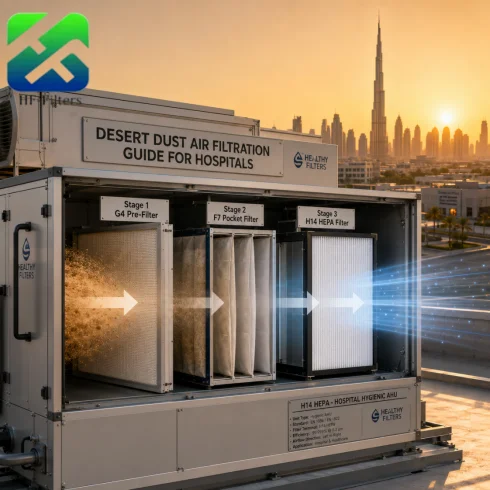
Diseñar sistemas de filtración de aire multietapa para hospitales en la región implica lidiar con dos cargas simultáneamente. Los sistemas de filtración de aire de los hospitales de Oriente Medio se enfrentan a una alta concentración de partículas exteriores, mientras que las salas críticas requieren un control estricto de las partículas en suspensión. Filtración de sistemas HVAC hospitalarios En el CCG, estas tareas se realizan de forma independiente. Se elimina el polvo del desierto en las primeras etapas y luego se utilizan filtros HEPA donde más se necesita. Esta es la manera práctica de controlar el polvo del desierto y los patógenos en el aire sin convertir cada episodio de polvo en una emergencia de mantenimiento.
¿Por qué el clima desértico modifica el diseño de los filtros de los hospitales?
Su sistema toma aire exterior a diario, no solo en días despejados. La arena, el polvo grueso y las partículas finas aumentan la resistencia del filtro, ensucian las bobinas y acortan los intervalos de mantenimiento. El resultado puede manifestarse primero como un problema de flujo de aire, no como un problema de limpieza visible.
Detenga la carga pesada aguas arriba
Un sistema de filtración de polvo del desierto debe comenzar con protección de entrada y una etapa de filtración gruesa. Un sistema de filtración hospitalario en climas desérticos no puede exigirle a su filtro terminal que capture todo. Una especificación de medio prefiltrante G4 indica una capacidad de retención de polvo de 630 g/m² con una resistencia inicial de 25 Pa, lo que demuestra la importancia de una primera etapa de baja resistencia y alta capacidad. Adecuado filtros de panel Puede servir como protección reemplazable aguas arriba.
Observa la resistencia antes de que disminuya el flujo de aire.
La caída de presión en los filtros HEPA aumenta a medida que el polvo se acumula en el medio filtrante. Un ventilador de velocidad variable puede compensar temporalmente, pero el consumo de energía se incrementa. Una unidad de velocidad fija simplemente puede suministrar menos aire. En cualquier caso, el control de presión del sistema de climatización del hospital puede variar. Un problema rutinario con el filtro puede convertirse en un problema de programación de quirófanos matutinos si se pierde presión durante la noche.
¿Por qué la filtración multietapa es mejor que el H14 solo?
Sistemas de filtración de aire multietapa para hospitales Cada componente cumple una función específica. Las etapas delanteras se encargan de la gestión del polvo. La etapa final protege el espacio clínico. Esta disposición facilita el mantenimiento y reduce la probabilidad de sorpresas costosas.
Asigna una tarea a cada etapa.
Una cadena funcional común es la separación de entrada, la filtración gruesa, los filtros de bolsa o la filtración fina compacta, y finalmente el filtro HEPA. Healthy Filters describe los filtros de bolsillo como una protección de alta capacidad para el polvo antes de los filtros de alta eficiencia. Un ejemplo F7 alcanza los 2300 m³/h a 45 Pa en un formato de 595 × 595 × 600 mm.
La filtración HEPA en hospitales se encarga de las partículas finas. Un filtro HEPA H14 para hospitales es la última barrera, no el primer colector de polvo. Una unidad de tratamiento de aire (UTA) higiénica para hospitales también debe proporcionar acceso limpio, carcasas selladas y un flujo de aire estable.
Pruebe el sistema instalado.
La eficiencia de fábrica es solo una de las comprobaciones. Las pruebas de integridad del filtro HEPA deben confirmar que el material filtrante, las juntas y las carcasas no presenten fugas tras la instalación. Healthy Filters ofrece productos H14 con una resistencia inicial inferior a 240 Pa en varios tamaños, por lo que la selección del ventilador debe tener en cuenta la carga real en la etapa terminal.
Agregar monitoreo de presión diferencial para filtros de hospital por etapa, con líneas base limpias y alarmas de servicio. Gama de filtros HEPA y ULPA Incluye formatos de panel y en V. Healthy Filters enumera ejemplos de filtros en V H13-H14 para hospitales y salas blancas, incluyendo una unidad de 594 × 594 × 292 mm con una capacidad de 1800 m³/h.
¿Cómo se mantienen estables las salas críticas?
Los filtros no funcionan solos. Aún se necesita la tasa de renovación de aire, la trayectoria del flujo de aire, el sellado de la sala y la relación de presión adecuados. Seleccione valores del estándar del proyecto y los requisitos de la autoridad local en lugar de copiar una misma combinación para todos los departamentos.
Adaptar la filtración a la función de la habitación.
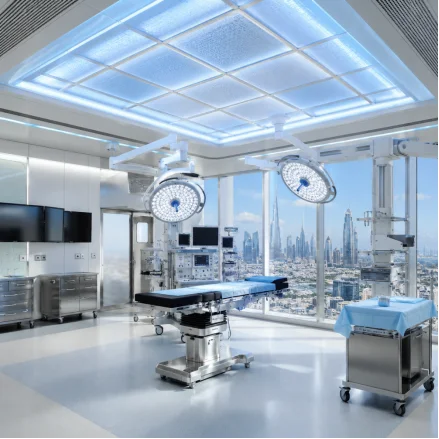
Los sistemas de filtración de aire en quirófanos deben garantizar un suministro de aire limpio y presión positiva cuando se especifique. Un sistema de filtración de aire en la UCI puede atender a pacientes vulnerables con diferentes necesidades de ventilación. La ventilación de las salas de aislamiento generalmente depende de un flujo de aire controlado y presión negativa cuando sea necesario. En cada caso, el control de patógenos transmitidos por el aire en los hospitales depende de la filtración y el flujo de aire, no solo de la etiqueta del filtro.
Diseño centrado en la continuidad del servicio
Un sistema de climatización hospitalaria sin interrupciones es un objetivo de resiliencia. Requiere capacidad de reserva, filtros accesibles, lecturas de presión escalonadas y reemplazos planificados. Compare el costo del ciclo de vida de los filtros hospitalarios, incluyendo energía, mano de obra, existencias, pruebas, gestión de residuos y tiempo clínico perdido. Los materiales filtrantes baratos que se saturan rápidamente rara vez se mantienen baratos.
Nota práctica del proveedor
Cuando un proyecto de filtración hospitalaria debe equilibrar la carga de polvo, la caída de presión y el rendimiento del aire limpio, Filtros saludables Puede dar soporte a toda la cadena de filtrado en lugar de a una sola etapa terminal. Su catálogo incluye prefiltros, filtros de bolsa, filtros HEPA y ULPA, productos de carbón activado, medios filtrantes y carcasas, con personalización OEM en cuanto a caudal, resistencia y dimensiones.
La certificación ISO 9001, un centro de pruebas CADR de 30 m³, instalaciones estandarizadas de sala limpia, sellado avanzado y pruebas de integridad garantizan una producción constante. Una capacidad mensual superior a 500 000 unidades y más de 10 especialistas en I+D también contribuyen a proyectos de gran envergadura basados en especificaciones.
Solicite una propuesta de filtración para su hospital.
Comparta la siguiente información:
País del proyecto y área hospitalaria
flujo de aire de la UAT
Dimensiones del filtro
Clase de filtro requerida
Caída de presión máxima admisible
Cantidad anual prevista
Le recomendaremos la secuencia de filtración, los productos adecuados y un presupuesto.
Preguntas frecuentes
P1: ¿Por qué H14 por sí solo no es suficiente?
R: Puede cargarse demasiado rápido si las etapas anteriores no eliminan la arena y el polvo fino.
P2: ¿Cuál es la mejor secuencia de filtrado?
A: Utilice protección de entrada, etapas gruesa y fina, y luego HEPA terminal, según el riesgo de la habitación y la capacidad del sistema.
P3: ¿Con qué frecuencia se deben cambiar los filtros?
A: Utilice la caída de presión medida, el flujo de aire y las condiciones, no solo un calendario.
P4: ¿Es necesario probar los filtros HEPA después de su instalación?
R: Sí. Compruebe los sellos, las fugas de derivación y la integridad de la instalación antes de su uso clínico.
P5: ¿Qué más debería comparar además del precio del filtro?
A: Compare el consumo de energía, la mano de obra, la frecuencia de reemplazo, las pruebas, los repuestos y el tiempo de inactividad.