
Kitchen exhaust carries grease droplets, oil mist, smoke particles, odors, and gaseous pollutants. A cleanable metal stage intercepts grease and coarse material near the hood inlet. Activated carbon cotton supplies a thin adsorption layer. Sandwich carbon media combines contained carbon particles with an optional particle-filter layer.
The usual airflow sequence is the cooking source, metal grease stage, activated carbon stage, fan, and exhaust or recirculation path. The metal stage protects the carbon surface from direct grease loading and supports a practical cleaning and replacement schedule.
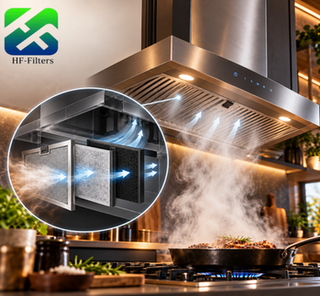
Metal Mesh Filters in the First Stage
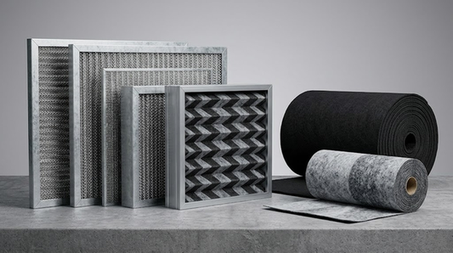
Kitchen hoods use metal baffle or mesh constructions selected for the appliance and applicable safety requirements. Healthy Filters lists HF-JS as a washable G2 metal mesh prefilter made with corrugated aluminum mesh and a stainless-steel support layer. Its catalog data reports about 65% average arrestance for particles above 5 micrometers.
HF-JS specifications vary by size and depth. For a 595 x 595 mm face, the catalog lists 2,200 m3/h at 15 Pa for 21 mm depth, 2,600 m3/h at 18 Pa for 25 mm, and 3,200 m3/h at 25 Pa for 46 mm. These models use two, three, or six corrugated aluminum layers plus one stainless-steel support mesh. System airflow also depends on face velocity, loading, sealing, and the fan curve.
Clean the metal stage according to the cooking load and the approved method for the frame and mesh. Project approval should confirm grease-separation performance, temperature limits, drainage, cleaning access, and the fire-safety requirements that apply to the hood.
Activated Carbon Cotton Specifications
Activated carbon cotton distributes powdered activated carbon through a fibrous sheet. The carbon surface adsorbs cooking odors and selected volatile organic compounds. The thin roll format suits cut pads and compact filter housings when the fan can accommodate the specified resistance.
Healthy Filters lists three grades. HF-Z180 has activated carbon content above 70 g/m2, basis weight 180 +/- 10 g/m2, thickness 3 +/- 0.5 mm, and resistance below 12 Pa. HF-Z210 has carbon content above 90 g/m2, basis weight 240 +/- 10 g/m2, thickness 5 +/- 0.5 mm, and resistance below 15 Pa. HF-Z350 has carbon content above 150 g/m2, basis weight 350 +/- 15 g/m2, thickness 6 +/- 0.5 mm, and resistance below 25 Pa. Standard roll sizes are 1 x 50 m and 1.2 x 50 m, with cut pieces available.
The catalog reports benzene adsorption of at least 65% for HF-Z180, 70% for HF-Z210, and 75% for HF-Z350. Apply these figures with the supplier’s test conditions. Kitchen performance also depends on the target compounds, carbon formulation, humidity, airflow, contact time, grease exposure, and sealing.
Sandwich Carbon Media Construction
Sandwich carbon media encloses activated carbon particles in a three-layer or four-layer nonwoven structure. An added particle-filter layer can address smoke or fine particles. The contained structure supports cutting, pleating, framing, and replacement.
Healthy Filters describes a customizable particle-filtration range of 85% to 99.97% for sandwich constructions paired with a selected high-efficiency layer. Treat that percentage as a particle-filtration specification tied to the chosen layer and test method. Specify gas adsorption through carbon loading, target pollutant, airflow, contact time, and the required breakthrough limit.
HF-HXT is a separate pleated carbon-fabric panel series with aluminum or galvanized-steel frames. Its 46 mm models range from 295 x 295 mm at 800 m3/h to 595 x 595 mm at 3,200 m3/h, with a nominal initial pressure drop of 40 Pa. Fit and airflow testing confirm each installation.
How the Filter Stages Work Together
The first stage intercepts grease, oil mist, and coarse material. The downstream carbon stage adsorbs odor molecules and selected gases. Carbon cotton provides a thin pad, sandwich carbon media provides a contained multilayer sheet, and HF-HXT provides a framed pleated panel. The selected format must fit the available depth and pressure-drop allowance.
The housing must guide air through the media. Sample review should cover dimensions, gaskets, mounting direction, airflow, pressure drop, sound level, cleaning access, and replacement access.
Filter Selection and Maintenance
Start with hood dimensions, airflow, fan curve, depth, temperature, humidity, cooking process, odor target, and pressure-drop allowance. Match the metal stage to the grease load and cleaning method. Match the carbon grade to the target gas, service interval, and available space.
Clean the reusable metal stage before grease restricts airflow or reaches the carbon. Replace carbon media at the validated operating-hour limit or odor-breakthrough criterion. Record the installed model, dimensions, airflow, and replacement date.
Filtros saludables can develop a sample from an existing filter or drawing. Sample approval should verify dimensions, sealing, airflow, pressure drop, grease-stage performance, odor reduction, and maintenance access.
Preguntas frecuentes
Can activated carbon cotton replace a metal grease filter
The metal stage captures grease and oil mist near the inlet. Activated carbon cotton belongs downstream, where it adsorbs odors and selected gases.
What is the difference between activated carbon cotton and sandwich carbon media
Activated carbon cotton distributes powdered carbon through a fibrous sheet. Sandwich carbon media encloses carbon particles between nonwoven layers and can carry an added particle-filter layer. Available depth, carbon loading, airflow resistance, and manufacturing format determine the selection.
Which information is needed for a custom kitchen filter
Provide the current filter or drawing, length, width, depth, rated airflow, fan data, pressure-drop limit, cooking process, target pollutants, cleaning method, and replacement plan.