
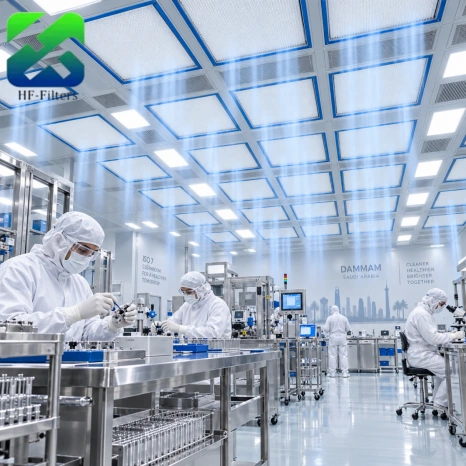
In September 2026, the global medical community turned its eyes toward Saudi Arabia as new tenders were announced for medical device manufacturing cleanrooms in Dammam Industrial City. As part of Saudi Vision 2030, the Kingdom is aggressively localizing its healthcare supply chain, transforming from a major importer to a hub of precision manufacturing.
However, for contractors and pharmaceutical firms, building ISO 7 or ISO 8 controlled environments in Saudi Arabia is not just a compliance exercise—it is a strategic investment in asset security. With 20 years of experience in air filtration, we know that the filtration system is the ‘Invisible Defense Line’ of any medical facility.
1.The Saudi Challenge: Why There is Zero Room for Error
Medical manufacturing in Saudi Arabia faces a dual challenge: extremely high external particulate loads (sand and fine dust) combined with stringent local SFDA and international ISO standards.
In projects like Dammam’s new clusters, ISO 7 and ISO 8 are the benchmarks. A filtration failure doesn’t just mean a clogged vent—it means batch contamination, regulatory shutdowns, and millions in lost revenue.
2.Differentiating Filtration Strategies: ISO 8 vs. ISO 7
Proper cleanroom design requires precise matching of filtration technology to the specific process requirements:
- ISO 8 Environments (Packaging & Assembly): The focus here is on high air exchange and multi-stage protection. We recommend FFU (Fan Filter Units) equipped with H13 HEPA filters. Given Saudi’s dust levels, a robust pre-filtration stage (G4 + F9) is mandatory to extend terminal filter life by over 40%.
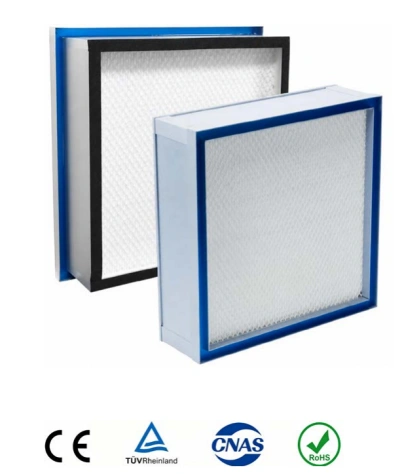
- ISO 7 Environments (Sterile Processing & Injection): Zero leakage is non-negotiable. Standard gasket seals can degrade over time due to high ambient temperatures. We advocate for Gel Seal HEPA filters. Using a specialized gel channel creates a ‘zero-pressure’ mechanical seal, eliminating bypass leakage. Anodized aluminum frames are also standard to prevent corrosion in coastal industrial zones like Dammam.
3.FFU Integration and Energy Management
In modular medical facilities, FFUs are replacing centralized HVAC delivery. The advantages are clear: modular flexibility, simplified maintenance, and easier terminal PAO/DOP leak testing. Furthermore, with Saudi’s increasing focus on industrial energy efficiency (PUE), FFUs equipped with high-efficiency DC motors are becoming a critical factor in lowering operational overhead.
4.The Expert Insight: The ‘Cost of Failure’ vs. The ‘Price of Filter’
In our work with Middle Eastern medical integrators, we often see ‘low-cost’ initial quotes lead to catastrophic maintenance costs later. The logic of a superior filtration system is simple: Intercept at the front, protect at the middle, and lock standards at the terminal. In the high-stakes world of medical manufacturing, stability is profit, and compliance is life.
En Filtros saludables, we don’t just supply H14minipleat filters; we provide complete life-cycle consulting to ensure your Dammam project meets every standard—from sand management to gel-seal integrity.
Contact Healthy Filters today for a technical review of your next cleanroom project.
Preguntas frecuentes
Q1: Why is Gel Seal HEPA preferred over Gasket Seal in Saudi medical cleanrooms?
A: In Saudi Arabia’s high-temperature environments, traditional EPDM or PU gaskets can undergo minor thermal expansion or aging, which creates micro-gaps over time. In ISO 7 (Class 10,000) sterile environments, these gaps lead to ‘bypass leakage.’ Gel Seal filters use a specialized silicone or polyurethane gel channel that creates a physical, zero-pressure airtight seal. It is virtually immune to the vibration and thermal shifts common in large-scale AHU systems, ensuring the ‘Leak-Free’ integrity required by SFDA.
Q2: How does Saudi’s wind-sand climate affect the Life Cycle Cost (LCC) of filtration?
A: Without a robust pre-filtration strategy, terminal HEPA filters in Dammam or Riyadh can clog in less than 6 months due to high dust mass. We utilize a ‘3-Stage Defense’ model: G4 (Coarse) for sand, F9 (Fine) to protect the HEPA, and H13/H14 for final sterile air. By investing in high-quality F9 synthetic or glass fiber media, you can extend the life of your expensive HEPA filters from 12 months to over 24 months, reducing total maintenance labor and consumable costs by approximately 30-40%.
Q3: Are Healthy Filters’ FFU systems compatible with Saudi Vision 2030 energy mandates?
A: Yes. Modern Saudi industrial regulations are placing stricter limits on PUE (Power Usage Effectiveness). Our Fan Filter Units (FFUs) are equipped with high-efficiency EC/DC motors that consume up to 50% less energy than traditional AC motors. They also allow for localized airflow control—meaning you only use maximum power in active sterile zones, significantly reducing the carbon footprint of the facility.
Q4: What frame material is recommended for medical projects in coastal zones like Dammam?
A: Dammam is a coastal industrial city with high humidity and salinity. We strictly recommend Anodized Aluminum or SUS304 Stainless Steel frames. Standard galvanized steel, even if coated, is susceptible to localized oxidation in high-moisture cleanrooms (such as those involving liquid pharmaceuticals or regular chemical washdowns). Anodized surfaces prevent particle shedding caused by corrosion, which is a common cause of failed ISO 14644 validation.
Q5: How does Healthy Filters support SFDA cleanroom validation?
A: We provide full documentation traceability—including EN1822 test reports, material safety data sheets, and individual leak test certificates for each H13/H14 unit. Our filters are designed to be easily verified via DOP/PAO aerosol testing, with built-in test ports available for Hooded HEPA units, ensuring that your facility passes the final certification audit without costly retrofits.