
When choosing replacement air filters, higher efficiency doesn’t always mean a better fit. HEPA and ULPA filters both capture extremely fine airborne particles, but they differ in filtration performance, airflow requirements, and applications.
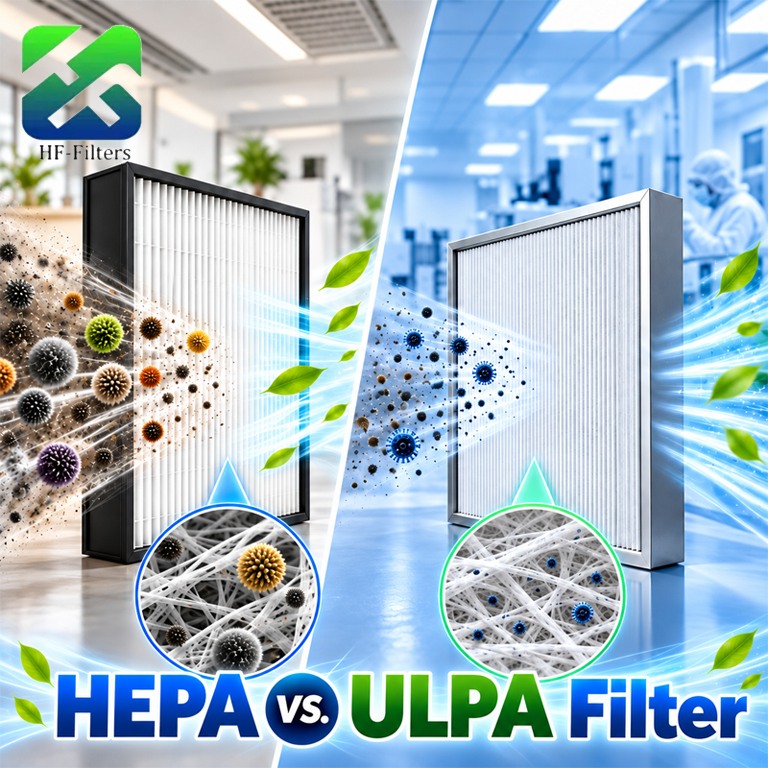
For equipment manufacturers, distributors, and industrial buyers, understanding HEPA vs. ULPA filters can help prevent costly purchasing mistakes and ensure reliable system performance.
¿Qué es un filtro HEPA?
HEPA stands for High-Efficiency Particulate Air. These filters capture particles through interception, impaction, and diffusion.
Under EN 1822, H13 HEPA filters achieve at least 99.95% overall efficiency at the most penetrating particle size (MPPS), while H14 filters reach 99.995%.
HEPA filters are widely used in air purifiers, healthcare facilities, pharmaceutical production, laboratories, and industrial ventilation systems.
Their combination of high filtration efficiency and practical airflow performance makes them suitable for many commercial and industrial applications.
What Is a ULPA Filter?
ULPA stands for Ultra-Low Penetration Air. These filters provide even higher particle collection efficiency for environments with particularly strict cleanliness requirements.
Under EN 1822, U15 ULPA filters achieve at least 99.9995% overall efficiency at the MPPS. Higher classifications, including U16 and U17, offer greater filtration efficiency.
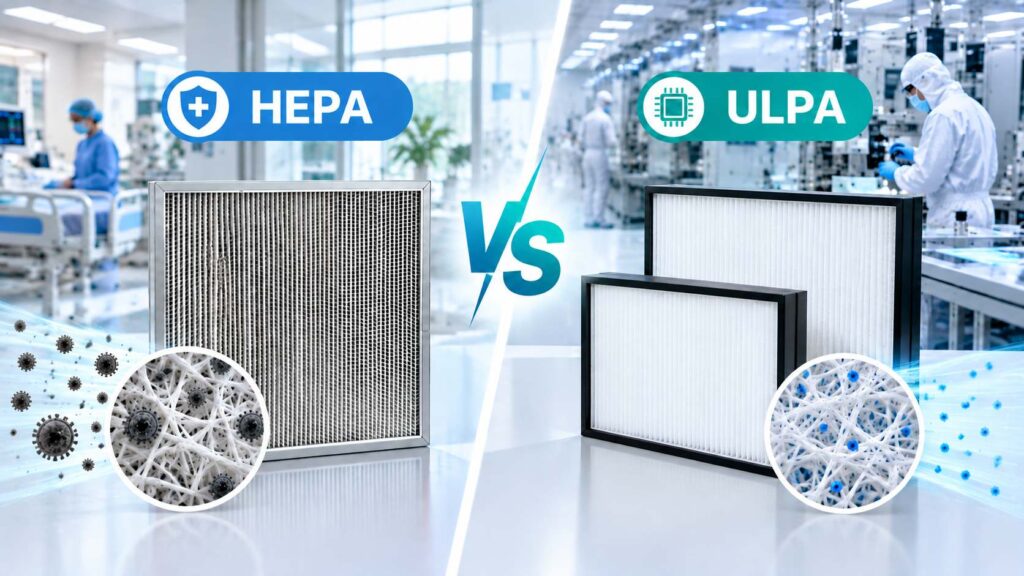
HEPA vs. ULPA Filter: Key Differences
| Característica | Filtro HEPA | Filtro ULPA |
| EN 1822 classification | H13–H14 | U15–U17 |
| Minimum overall efficiency | 99.95%–99.995% | 99.9995%–99.999995% |
| Typical applications | Healthcare, HVAC, industrial filtration | Semiconductor and specialized cleanrooms |
| Airflow resistance | Depends on filter design | May be higher for comparable designs |
| Replacement cost | Generally lower | Generally higher |
Efficiency values refer to EN 1822 testing at the MPPS.
Does ULPA Filtration Reduce Airflow?
ULPA filters may use more specialized filtration media to achieve higher efficiency. In comparable designs, this can increase pressure drop and place additional demands on the ventilation system.
However, resistance also depends on pleat design, media area, and operating airflow.
How to Choose the Right HEPA or ULPA Replacement Filter
Before purchasing HEPA or ULPA replacement filters, consider four factors:
- Eficiencia de filtración:Confirm the required EN 1822 or ISO 29463 classification.
- Dimensions and sealing:Check frame size, gasket type, and installation requirements.
- Airflow and pressure drop:Match filter performance to the equipment’s operating conditions.
- Supplier capabilities:Look for consistent manufacturing, technical support, and customization options.
For buyers managing multiple equipment models, finding a manufacturer that can accommodate different specifications can simplify sourcing considerably.
Custom HEPA and ULPA Filter Solutions from Healthy Filters
Standard filters don’t always match existing equipment, especially when dealing with discontinued models, specialized housings, or OEM applications.
Filtros saludables, a Shenzhen-based air filter manufacturer established in 2016, provides customized filtration solutions for commercial, industrial, and air purification equipment.
Its manufacturing capabilities cover HEPA and ULPA filters alongside pre-filters, medium-efficiency filters, and activated carbon filtration products.
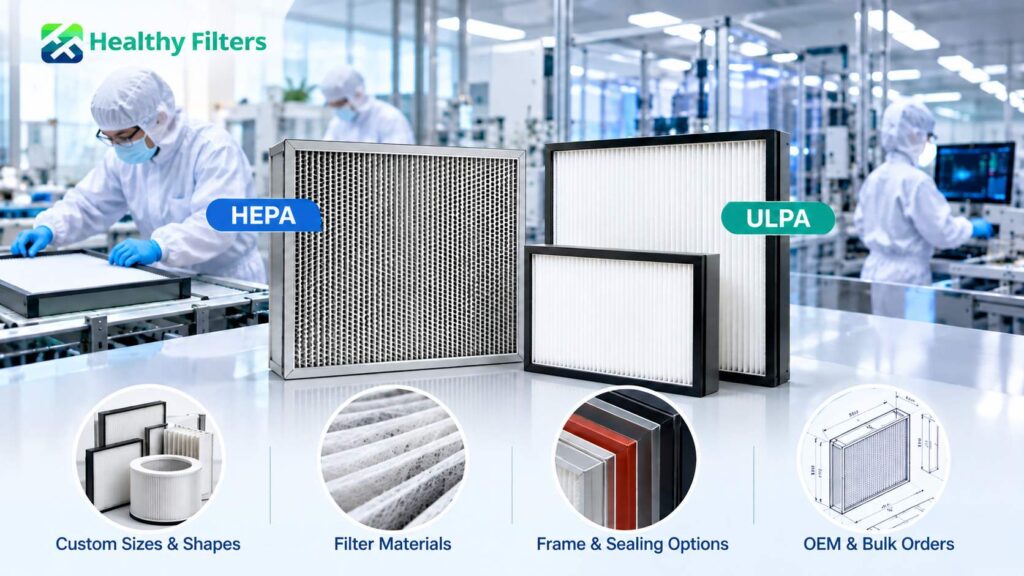
For customers requiring custom HEPA and ULPA filters, Healthy Filters offers flexibility in:
- Dimensions and shapes:Custom sizes, cylindrical designs, panels, and other configurations.
- Filter materials:Media selection based on efficiency, airflow, and application requirements.
- Frame and sealing options:Configurations designed around equipment compatibility.
- OEM and bulk orders:Product development and manufacturing support for brands, distributors, and replacement-filter buyers.
With manufacturing capabilities spanning different filtration stages, Healthy Filters can also help buyers source multiple filter types through one supplier rather than coordinating with several vendors.
For replacement projects, customers can share drawings, samples, or technical specifications to discuss suitable filter designs. Required efficiency ratings, pressure-drop targets, and testing documentation should be confirmed before production.
Preguntas frecuentes
Is ULPA always better than HEPA?
No. ULPA provides higher filtration efficiency, but HEPA may offer a more suitable balance of performance, airflow, and cost for many applications.
Can a ULPA filter replace a HEPA filter?
Only when dimensions, sealing, airflow resistance, and equipment requirements are compatible. Similar dimensions alone do not guarantee interchangeability.
Where can I source custom HEPA and ULPA filters?
Industrial buyers can work directly with a HEPA filter manufacturer such as Healthy Filters to discuss custom dimensions, materials, replacement compatibility, and wholesale requirements.
Find the Right Filtration Solution
Whether you’re sourcing wholesale HEPA replacement filters or developing filters for specialized equipment, choosing the correct specification matters more than simply selecting the highest efficiency rating.
Contacta con Healthy Filters to discuss your application, share your filter specifications, and explore a customized filtration solution for your business.